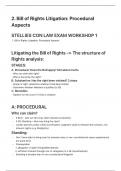
2. Bill of Rights Litigation: Procedural
Aspects
STELLIES CON LAW EXAM
1. Bill of Rights Litigation: Procedural Aspects
WORKSHOP 1
Litigating the Bill of Rights -> The structure of
Rights analysis:
STAGES:
A. Procedural: Does the BoR apply? Not about merits
- Who can claim this right?
- Who is bound by the right?
B. Substantive: Has the right been violated? 2 steps
- Scope of right, determine whether it has been limited
- Determine whether limitation is justified (s 36)
C. Remedies
- Options for the court if it finds a violation
A: PROCEDURAL
Who can claim?
• S 8(4) – sets out who may claim (natural and juristic)
• S 38: Standing – who may bring the case?
• Juristic persons under s 8(4) (Certification Judgment used to interpret this section), not
inherent rights (e.g. life/dignity)
Standing:
• Don’t have right to bring case for someone else, in non-constitutional cases requirements
are quite strict
• Prerequisites:
1. allegation of right infringed/threatened;
2. sufficient interest through one of categories in s 38 (constitutional)
• Standing is broader than in non-constitutional litigation
,Who is bound by the BoR?
• Our Constitution allows horizontal application of BoR (unusual), claiming right from
another individual
• Vertical
Who is entitled to the rights in the BoR?
• ‘everyone’, ‘citizens’, ‘children’, ‘workers’ ,‘detained people’
Direct v Indirect application of the BoR
• Direct: When the BoR applies directly, the purpose is to determine whether the ordinary
rules of law (legislation, common law and customary law) are consistent with the BoR.
• Indirect: When the BoR applies indirectly, the purpose is to determine whether the
ordinary rules of law promote the values of the BoR. If they do not, the BoR does not
override the ordinary law or generate its own special remedies. Instead, the BoR is used
to develop the rules and remedies of the ordinary law to avoid any inconsistency between
those laws and the BoR.
Vertical vs Horizontal application of the BoR
• When the BoR applies vertically, it confers rights on private persons and obligations on
the state to respect, protect, promote, and fulfill and the rights in the BoR. Vertical
disputes must therefore involve the state.
• Horizontal application is where rights are conferred on private persons and obligations
are conferred on private persons. If the dispute is horizontal, then neither of the parties is
the state.
Direct & vertical application
• Section 8(1) of the Constitution governs the direct vertical application of the BoR. Despite
the wording of the Constitution here, the CC has held that s8(1) does not regulate the
direct application of the BoR to disputes between private persons. Rather, 8(2) regulates
the direct application of the BoR in these disputes. Confirmed in Khumalo and Others v
Holomisa
Direct & horizontal application
• S8(2): subject to the qualifier that a fundamental right only applies directly to a horizontal
relation ‘if, and to the extent that, it is applicable, taking into account the nature of the
right and the nature of the duty imposed by the right.’
• CC held in Juma Musjid that s29(1) applied directly to common law principles governing
evictions.
2
, ◦ Held that the purpose of 8(2) is not to obstruct private autonomy or to impose on a
private party the duties of the state in protecting the BoR, but rather to require private
parties not to interfere with or diminish the enjoyment of the right.
▪ Negative duty
• Which negative duties exist depends on the ‘intensity of the constitutional right’
– unclear of the meaning here.
▪ May not impose positive duties on private parties
Indirect application of BoR
• S39 governs indirect application to legislation. CC has held that courts have obligation
to examine the objects and purport of an Act and to read the provisions of the legislation,
so far as possible, in conformity with the BoR.
Indirect application of the BoR to the common law and
customary law
• Carmichele: Obligation on courts to develop common law and customary law in line with
s39(2) is a general one, although it is not purely discretionary.
• Courts do not have to develop the common law in every case. The circumstances of a
particular case dictate whether or not such development is required.
Carmichele v Minister of Safety and Security 2001 (CC)
• This case concerns the constitutional obligation on the courts to develop the common
law to promote the spirit, purport and objects of the BoR. The issue was whether the High
Court and the SCA should have broadened the concept of “wrongfulness” in the law of
delict in the light of the State’s constitutional duty to safeguard the rights of women.
• The applicant suffered an attack by a man awaiting trial for having attempted rape on
another woman. This man had a history of sexual violence, yet the police and prosecutor
recommended his release. The applicant wants to hold the two Ministers involved liable
for damages as she alleged that this was an omission by the police and prosecutor. She
relied also on the duties imposed on the police by the interim C and on the state (under
rights of life, equality, dignity, freedom and security, privacy).
• The HC and SCA dismissed claim of vertical application stating that she had not met the
requirements of delict. Delict requirements: act/omission; wrongful; causation; damage.
3
Aspects
STELLIES CON LAW EXAM
1. Bill of Rights Litigation: Procedural Aspects
WORKSHOP 1
Litigating the Bill of Rights -> The structure of
Rights analysis:
STAGES:
A. Procedural: Does the BoR apply? Not about merits
- Who can claim this right?
- Who is bound by the right?
B. Substantive: Has the right been violated? 2 steps
- Scope of right, determine whether it has been limited
- Determine whether limitation is justified (s 36)
C. Remedies
- Options for the court if it finds a violation
A: PROCEDURAL
Who can claim?
• S 8(4) – sets out who may claim (natural and juristic)
• S 38: Standing – who may bring the case?
• Juristic persons under s 8(4) (Certification Judgment used to interpret this section), not
inherent rights (e.g. life/dignity)
Standing:
• Don’t have right to bring case for someone else, in non-constitutional cases requirements
are quite strict
• Prerequisites:
1. allegation of right infringed/threatened;
2. sufficient interest through one of categories in s 38 (constitutional)
• Standing is broader than in non-constitutional litigation
,Who is bound by the BoR?
• Our Constitution allows horizontal application of BoR (unusual), claiming right from
another individual
• Vertical
Who is entitled to the rights in the BoR?
• ‘everyone’, ‘citizens’, ‘children’, ‘workers’ ,‘detained people’
Direct v Indirect application of the BoR
• Direct: When the BoR applies directly, the purpose is to determine whether the ordinary
rules of law (legislation, common law and customary law) are consistent with the BoR.
• Indirect: When the BoR applies indirectly, the purpose is to determine whether the
ordinary rules of law promote the values of the BoR. If they do not, the BoR does not
override the ordinary law or generate its own special remedies. Instead, the BoR is used
to develop the rules and remedies of the ordinary law to avoid any inconsistency between
those laws and the BoR.
Vertical vs Horizontal application of the BoR
• When the BoR applies vertically, it confers rights on private persons and obligations on
the state to respect, protect, promote, and fulfill and the rights in the BoR. Vertical
disputes must therefore involve the state.
• Horizontal application is where rights are conferred on private persons and obligations
are conferred on private persons. If the dispute is horizontal, then neither of the parties is
the state.
Direct & vertical application
• Section 8(1) of the Constitution governs the direct vertical application of the BoR. Despite
the wording of the Constitution here, the CC has held that s8(1) does not regulate the
direct application of the BoR to disputes between private persons. Rather, 8(2) regulates
the direct application of the BoR in these disputes. Confirmed in Khumalo and Others v
Holomisa
Direct & horizontal application
• S8(2): subject to the qualifier that a fundamental right only applies directly to a horizontal
relation ‘if, and to the extent that, it is applicable, taking into account the nature of the
right and the nature of the duty imposed by the right.’
• CC held in Juma Musjid that s29(1) applied directly to common law principles governing
evictions.
2
, ◦ Held that the purpose of 8(2) is not to obstruct private autonomy or to impose on a
private party the duties of the state in protecting the BoR, but rather to require private
parties not to interfere with or diminish the enjoyment of the right.
▪ Negative duty
• Which negative duties exist depends on the ‘intensity of the constitutional right’
– unclear of the meaning here.
▪ May not impose positive duties on private parties
Indirect application of BoR
• S39 governs indirect application to legislation. CC has held that courts have obligation
to examine the objects and purport of an Act and to read the provisions of the legislation,
so far as possible, in conformity with the BoR.
Indirect application of the BoR to the common law and
customary law
• Carmichele: Obligation on courts to develop common law and customary law in line with
s39(2) is a general one, although it is not purely discretionary.
• Courts do not have to develop the common law in every case. The circumstances of a
particular case dictate whether or not such development is required.
Carmichele v Minister of Safety and Security 2001 (CC)
• This case concerns the constitutional obligation on the courts to develop the common
law to promote the spirit, purport and objects of the BoR. The issue was whether the High
Court and the SCA should have broadened the concept of “wrongfulness” in the law of
delict in the light of the State’s constitutional duty to safeguard the rights of women.
• The applicant suffered an attack by a man awaiting trial for having attempted rape on
another woman. This man had a history of sexual violence, yet the police and prosecutor
recommended his release. The applicant wants to hold the two Ministers involved liable
for damages as she alleged that this was an omission by the police and prosecutor. She
relied also on the duties imposed on the police by the interim C and on the state (under
rights of life, equality, dignity, freedom and security, privacy).
• The HC and SCA dismissed claim of vertical application stating that she had not met the
requirements of delict. Delict requirements: act/omission; wrongful; causation; damage.
3