Monopoly Basics
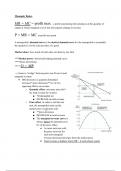
MR = MC = profit max - a profit maximizing firm produces at the quantity of
output at which marginal cost of last unit equates change in revenue
P > MR = MC at profit max point
A monopolist's demand curve is the market demand curve b/c the monopolist is essentially
the market b/c it's the sole provider of a good.
Market share: how much of total sales are done by one firm
***Market power: downward-sloping demand curve
****Some advertising
*****D > MR
→ Causes a "wedge" between price (on D curve) and
marginal revenue
● MR decreases as quantity demanded
increases*/price decreases** b/c of two
opposing effects on revenue
○ Quantity effect: one more unit sold =
inc total revenue by its price
■ *Q demanded inc
■ INCREASE in total revenue
○ Price effect: in order to sell the last
unit, the monopolist must cut the
market price on all units sold
■ **price decreases
■ DECREASE in total revenue
■ The marginal revenue curve is
always below the demand curve
b/c of the price effect.
● As more units are sold,
the price received for
each unit (marginal
revenue) decreases/diverges from the market price
● Total revenue is highest when MR = 0 (unit-elastic point)
, ○ After MR hits 0, total revenue decreases (b/c MR is
negative past that point)
● At low levels of output, QE > PE b/c in order when the price is lowered to sell more
units, it is only lowered on a few units
○ INCREASE in total revenue
○ ELASTIC
● At high levels of output, PE > QE b/c the price is lowered on more units, having a larger
effect on total revenue
○ DECREASE in total revenue
○ INELASTIC
When compared to a competitive industry, a monopoly:
❖ Produces a smaller quantity
➢ Monopoly will produce at Q in which MC = MR, whereas a comp indus will
produce where MC = P (b/c their P = MR)
❖ Charges a higher price
➢ Charges at the point on the
(market) demand curve
corresponding to Q where MC =
MR
■ Price-maker
❖ Earns a profit
If MR > MC, profit increases by producing
more
If MR < MC, profit increases by producing less
**Difference between MR and P depends on price
elasticity of demand
● Elastic (PED > 1) , price dec = TR inc
○ More ppl will buy if price is lower
○ Produce in this range
● Inelastic (PED < 1), price dec = TR dec
○ Ppl would buy the same amount either
way, so TR decreases w/price
● Highly elastic monopoly is very similar to a
perfectly competitive firm
A monopoly can earn a profit or loss in the short
run, barriers to entry make it possible to earn
profits in the long run
MR = MC = profit max - a profit maximizing firm produces at the quantity of
output at which marginal cost of last unit equates change in revenue
P > MR = MC at profit max point
A monopolist's demand curve is the market demand curve b/c the monopolist is essentially
the market b/c it's the sole provider of a good.
Market share: how much of total sales are done by one firm
***Market power: downward-sloping demand curve
****Some advertising
*****D > MR
→ Causes a "wedge" between price (on D curve) and
marginal revenue
● MR decreases as quantity demanded
increases*/price decreases** b/c of two
opposing effects on revenue
○ Quantity effect: one more unit sold =
inc total revenue by its price
■ *Q demanded inc
■ INCREASE in total revenue
○ Price effect: in order to sell the last
unit, the monopolist must cut the
market price on all units sold
■ **price decreases
■ DECREASE in total revenue
■ The marginal revenue curve is
always below the demand curve
b/c of the price effect.
● As more units are sold,
the price received for
each unit (marginal
revenue) decreases/diverges from the market price
● Total revenue is highest when MR = 0 (unit-elastic point)
, ○ After MR hits 0, total revenue decreases (b/c MR is
negative past that point)
● At low levels of output, QE > PE b/c in order when the price is lowered to sell more
units, it is only lowered on a few units
○ INCREASE in total revenue
○ ELASTIC
● At high levels of output, PE > QE b/c the price is lowered on more units, having a larger
effect on total revenue
○ DECREASE in total revenue
○ INELASTIC
When compared to a competitive industry, a monopoly:
❖ Produces a smaller quantity
➢ Monopoly will produce at Q in which MC = MR, whereas a comp indus will
produce where MC = P (b/c their P = MR)
❖ Charges a higher price
➢ Charges at the point on the
(market) demand curve
corresponding to Q where MC =
MR
■ Price-maker
❖ Earns a profit
If MR > MC, profit increases by producing
more
If MR < MC, profit increases by producing less
**Difference between MR and P depends on price
elasticity of demand
● Elastic (PED > 1) , price dec = TR inc
○ More ppl will buy if price is lower
○ Produce in this range
● Inelastic (PED < 1), price dec = TR dec
○ Ppl would buy the same amount either
way, so TR decreases w/price
● Highly elastic monopoly is very similar to a
perfectly competitive firm
A monopoly can earn a profit or loss in the short
run, barriers to entry make it possible to earn
profits in the long run