Samenvatting EM HC.4
1. Qualitative description of image formation
The specimen needs to interact with and scatters the electrons if we want to see something.
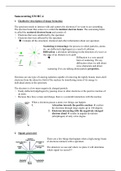
The electron beam that comes in is called the incident electron beam. The outcoming beam
is called the scattered electron beam and consist of:
Electrons that were unaffected by the specimen
Electrons that were affected by the specimen
Contains all the structural, chemical and other information about our specimen.
Scattering (verstooring): the process in which particles, atoms
etc. are deflected (afgebogen) as a result of collision
Diffraction: a deviation (afwijking) in the direction of a wave at
the edge of an obstacle in its path
Diffraction is a very special
form of scattering. We say
diffraction when we talk about
wave characters and about
scattering if we are talking about particle properties.
Electrons are one type of ionizing radiation capable of removing the tightly bound, inner-shell
electrons from the attractive field of the nucleus by transferring some of its energy to
individual atoms in the specimen.
The electron is a low-mass negatively charged particle
Easily deflected (afgebogen) by passing close to other electrons or the positive nucleus of
an atom.
Because they have a mass and charge, there is a coulomb interaction with the nucleus
When a electrons passes a atom, two things can happen
1. Attraction towards the positive nucleus scatters
the electrons through large angles up to 180 degrees
2. Electrons interacting with the negatively charged
electron cloud results in angular deviations
(afwijkingen) of only a few degree
2. Signals generated
There are a few things that happen when a high-energy beam
of electrons interacts with a specimen.
The detectors we use and where we place it will determine
which signal we record!!!
, Scanning electron microscopy (SEM) topographical information
Backscattered electrons (BSE)
Secondary electrons (SE)
Energy-dispersive X-ray spectrometry (EDS/EDX) atomic composition
Characteristic X-rays
Electron energy-loss spectrometry (EELS) detailed chemical info
Inelastically scattered electrons
For biological samples spectrum to complicated
Transmission electron microscopy (TEM) internal structure
Elastically scattered electrons
Direct beam
Transmission electron microscopy: you record electrons that do not deviate far from the
incident electron direction The microscope is constructed to gather these electrons primarily
(voornamelijk). TEM images give us information we seek about internal structure and
chemistry of the specimen.
You have forward- and backscattered electrons and forward scattering is the cause of most
of the signals used in TEM. As the specimen gets thicker, fewer electrons are forward
scattered and more are backscattered.
3. Electron scattering
Scattering probability the probability of scattering from the nuclei of atoms in the
specimen is determined by the following equation. The factors that effect this probalitity:
Atomic number (Z) lighter elements scatter less because they have less electrons
Beam energy (E0) high acceleration/energy causes less scattering because the
electrons are moving faster.
Scattering angle () it’s harder to scatter a large angle zo most electrons will
scatter to lower angles.
Scattering angle how much the scattered electrons deviates from the incident direct
beam. Apertures or detectors are used to select and collect a certain fraction of scattered
electrons. It controls the signal we image!. Place and size of the apertures is important.
1. Qualitative description of image formation
The specimen needs to interact with and scatters the electrons if we want to see something.
The electron beam that comes in is called the incident electron beam. The outcoming beam
is called the scattered electron beam and consist of:
Electrons that were unaffected by the specimen
Electrons that were affected by the specimen
Contains all the structural, chemical and other information about our specimen.
Scattering (verstooring): the process in which particles, atoms
etc. are deflected (afgebogen) as a result of collision
Diffraction: a deviation (afwijking) in the direction of a wave at
the edge of an obstacle in its path
Diffraction is a very special
form of scattering. We say
diffraction when we talk about
wave characters and about
scattering if we are talking about particle properties.
Electrons are one type of ionizing radiation capable of removing the tightly bound, inner-shell
electrons from the attractive field of the nucleus by transferring some of its energy to
individual atoms in the specimen.
The electron is a low-mass negatively charged particle
Easily deflected (afgebogen) by passing close to other electrons or the positive nucleus of
an atom.
Because they have a mass and charge, there is a coulomb interaction with the nucleus
When a electrons passes a atom, two things can happen
1. Attraction towards the positive nucleus scatters
the electrons through large angles up to 180 degrees
2. Electrons interacting with the negatively charged
electron cloud results in angular deviations
(afwijkingen) of only a few degree
2. Signals generated
There are a few things that happen when a high-energy beam
of electrons interacts with a specimen.
The detectors we use and where we place it will determine
which signal we record!!!
, Scanning electron microscopy (SEM) topographical information
Backscattered electrons (BSE)
Secondary electrons (SE)
Energy-dispersive X-ray spectrometry (EDS/EDX) atomic composition
Characteristic X-rays
Electron energy-loss spectrometry (EELS) detailed chemical info
Inelastically scattered electrons
For biological samples spectrum to complicated
Transmission electron microscopy (TEM) internal structure
Elastically scattered electrons
Direct beam
Transmission electron microscopy: you record electrons that do not deviate far from the
incident electron direction The microscope is constructed to gather these electrons primarily
(voornamelijk). TEM images give us information we seek about internal structure and
chemistry of the specimen.
You have forward- and backscattered electrons and forward scattering is the cause of most
of the signals used in TEM. As the specimen gets thicker, fewer electrons are forward
scattered and more are backscattered.
3. Electron scattering
Scattering probability the probability of scattering from the nuclei of atoms in the
specimen is determined by the following equation. The factors that effect this probalitity:
Atomic number (Z) lighter elements scatter less because they have less electrons
Beam energy (E0) high acceleration/energy causes less scattering because the
electrons are moving faster.
Scattering angle () it’s harder to scatter a large angle zo most electrons will
scatter to lower angles.
Scattering angle how much the scattered electrons deviates from the incident direct
beam. Apertures or detectors are used to select and collect a certain fraction of scattered
electrons. It controls the signal we image!. Place and size of the apertures is important.