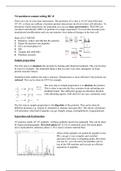
Virusziekten samenvatting HC.8
There are a lot of virus-host interactions. The proteome of a virus is 10-102 and of the host
104-105, so there are millions of protein-protein interactions involved in host cell infection. To
determine which interactions are important you can use mass spectrometry. With MS you
can detect and identify 1000’s of proteins in a single experiment. You can also measure post-
translational modifications and you can monitor virus-induced changes in the host cell.
Steps of LC-MS/MS
1. Denature, reduce and alkylate the proteins
2. Digest the proteins into peptides
3. Do a reversed-phase LC
4. MS
5. Tandem MS (MS/MS)
6. Database research.
Sample preperation
The first step is to denature the proteins by heating and chemical treatment. This can be done
by urea for example. The important thing is that you don’t use ionic detergents (to keep
protein structure intact).
Disulfide bonds stabilize the native structure. Denaturation is more efficient if the proteins are
reduced. This can be done by DTT for example.
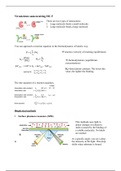
The next step in sample preperation is to alkylate the proteins.
This is done to prevent the free cysteines from reforming new
disulfide bonds. The sulfhydryl groups are therefore blocked
with alkylating agents. IAM and IAA are very commonly used.
The last step in sample preperation is the digestion of the proteins. This can be done by
different proteases e.g. trypsin (C-terminal) or elastase (non-specific). The choice of protease
will determine what kind of peptide you get (length, charge, hydrophobicity, fragmentation).
Separation and fractionation
103 proteins yields 104-105 peptides. All these peptides need to be separated. This can be done
by liquid chromatography. Reversed phase LC (C18) is commonly used. Reversed phase
uses a hydrophobic stationary phase. C18 is used a column material then.
When all the peptides are putted all together in the
MS, you get a very complex and crowded
spectrum with many overlapping peaks. But when
you use LC, you can send your peptides one by
one in the MS machine and you get an efficient
separation of peptides.
, Ionization and MS detection
To enable MS of your molecules (peptide), you need to ionize them and get rid of the solvent.
You can do this in two ways:
MALDI
Electrospray mostly used.
Gentle ionization (no fragmentation of the peptides)
Flow rates compatible with LC
Continuous ionization
Charge can be calculated by looking at the space between the peaks (1/z)
High voltage on spray droplets
get charge droplet evaporates
individual molecules get a charge
go into mass analyzer.
The charged peptide ions in a vacuum can be focused, manipulated and detected by a mass
analyzer. With a mass analyzer you measure the mass-to-charge ratio. A few things are
important for a mass analyzer:
Precision measurements close together
Accuracy ratio of the m/z measurement error to the true m/z
Resolution:
Resolving power to distinguish between two peaks
Peak resolution how narrow the peaks are
Dynamic range the range over which ion signal is linear with analyte concentration
(sensitivity instrument)
There are different kinds of mass analyzers:
Time-of-flight (TOF) you accelerate all the molecules and the smaller molecules
derive earlier at the detector.
Orbitrap the molecules spin very fast around a spindle. When they do this, they get a
axial frequency that depends on the m/z value. So every molecule has his one frequency.
Quadruple consist of 4 parallel metal rods. The two opposite rods have the same
voltage (+ and -). Only ions of a certain m/z ratio will reach the detector on the end. You
can change the voltages and so measure different m/z ratio’s.
Ion trap 3D quadruple. When you increase the voltage, ions from low till high m/z
will become unstable and go to detector.
TOF and the orbitrap are non-
scanning all ions go all together to
the detector
Quadrupole and ion trap small m/z
packages go to detector.
Fragmentation – tandem MS
The intact mass of the peptide is very redundant (can be the same). You need fragmentation
spectra to assign the correct sequence of the peptides. A survey (overzicht) scan of all
There are a lot of virus-host interactions. The proteome of a virus is 10-102 and of the host
104-105, so there are millions of protein-protein interactions involved in host cell infection. To
determine which interactions are important you can use mass spectrometry. With MS you
can detect and identify 1000’s of proteins in a single experiment. You can also measure post-
translational modifications and you can monitor virus-induced changes in the host cell.
Steps of LC-MS/MS
1. Denature, reduce and alkylate the proteins
2. Digest the proteins into peptides
3. Do a reversed-phase LC
4. MS
5. Tandem MS (MS/MS)
6. Database research.
Sample preperation
The first step is to denature the proteins by heating and chemical treatment. This can be done
by urea for example. The important thing is that you don’t use ionic detergents (to keep
protein structure intact).
Disulfide bonds stabilize the native structure. Denaturation is more efficient if the proteins are
reduced. This can be done by DTT for example.
The next step in sample preperation is to alkylate the proteins.
This is done to prevent the free cysteines from reforming new
disulfide bonds. The sulfhydryl groups are therefore blocked
with alkylating agents. IAM and IAA are very commonly used.
The last step in sample preperation is the digestion of the proteins. This can be done by
different proteases e.g. trypsin (C-terminal) or elastase (non-specific). The choice of protease
will determine what kind of peptide you get (length, charge, hydrophobicity, fragmentation).
Separation and fractionation
103 proteins yields 104-105 peptides. All these peptides need to be separated. This can be done
by liquid chromatography. Reversed phase LC (C18) is commonly used. Reversed phase
uses a hydrophobic stationary phase. C18 is used a column material then.
When all the peptides are putted all together in the
MS, you get a very complex and crowded
spectrum with many overlapping peaks. But when
you use LC, you can send your peptides one by
one in the MS machine and you get an efficient
separation of peptides.
, Ionization and MS detection
To enable MS of your molecules (peptide), you need to ionize them and get rid of the solvent.
You can do this in two ways:
MALDI
Electrospray mostly used.
Gentle ionization (no fragmentation of the peptides)
Flow rates compatible with LC
Continuous ionization
Charge can be calculated by looking at the space between the peaks (1/z)
High voltage on spray droplets
get charge droplet evaporates
individual molecules get a charge
go into mass analyzer.
The charged peptide ions in a vacuum can be focused, manipulated and detected by a mass
analyzer. With a mass analyzer you measure the mass-to-charge ratio. A few things are
important for a mass analyzer:
Precision measurements close together
Accuracy ratio of the m/z measurement error to the true m/z
Resolution:
Resolving power to distinguish between two peaks
Peak resolution how narrow the peaks are
Dynamic range the range over which ion signal is linear with analyte concentration
(sensitivity instrument)
There are different kinds of mass analyzers:
Time-of-flight (TOF) you accelerate all the molecules and the smaller molecules
derive earlier at the detector.
Orbitrap the molecules spin very fast around a spindle. When they do this, they get a
axial frequency that depends on the m/z value. So every molecule has his one frequency.
Quadruple consist of 4 parallel metal rods. The two opposite rods have the same
voltage (+ and -). Only ions of a certain m/z ratio will reach the detector on the end. You
can change the voltages and so measure different m/z ratio’s.
Ion trap 3D quadruple. When you increase the voltage, ions from low till high m/z
will become unstable and go to detector.
TOF and the orbitrap are non-
scanning all ions go all together to
the detector
Quadrupole and ion trap small m/z
packages go to detector.
Fragmentation – tandem MS
The intact mass of the peptide is very redundant (can be the same). You need fragmentation
spectra to assign the correct sequence of the peptides. A survey (overzicht) scan of all