Lecture 1 + 2
Section 1: Theoretical explanation of the distribution of
power.
Definitions and sources of power.
(Kourvetaris, G. A. 1997. The study of societal power and authority, in Political
Sociology: Structure and process. London: Allyn & Bacon. 48-57.)
1. Social bases of power and power structures.
Social bases of power include collective resources that are mastered or mobilized to
promote or stem change.
Mobilization involves forming groups for collective goals.
Oberschall (1973) defined mobilization as the “process of forming crowds,
groups, associations and organizations for the pursuit of collective goals”.
Green movement or the Peace
movement.
Power resources are tangible or
intangible:
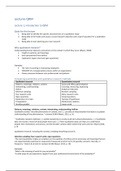
Tangibles are elements that can be measured.
- Natural resources. - Good jobs.
- Property. - Military capabilities.
- Money. - Agricultural output.
Intangibles are elements that cannot be easily measured.
- Morale. - Respect.
- Leadership. - Honor.
- Reputation - Character
1.1. The structure of power.
Power structures are stable relationships shaping power distribution.
A social structure consists of various social positions occupied by persons who play
certain roles.
Positions are often static, whereas roles tend to be more dynamic.
Power relations can be either static or dynamic.
An individual can occupy Position = President of USA Shapes
more than one position at the
a time and perform diEerent president’s
Carries authority and entails
roles. role.
social responsibilities.
Sometimes, those who
occupy diEerent positions
and roles find themselves in conflict.
, Chaplains in military might find
themselves in conflict when their
religious convictions lead them to
disagree with a particular military
operation.
Power is correlated with variables:
- Economic class. - Gender. - Age
- Ethnicity. - Race. - Religion.
In a stratified society, those who occupy high status positions exercise more
influence than those who occupy lower positions.
- Trickle-down economics = financial benefits given to big businesses by the
government in terms of tax breaks would pass down to smaller businesses and
consumers.
1.2. Forms of social power.
Wrong (1979) identified four distinct forms of social power:
- (1) Force. - (3) Persuasion.
- (2) Manipulation. - (4) Authority.
- (Wrong, 1979) includes five subtypes of authority:
§ (a) Coercive authority: force-based compliance.
§ (b) Induced authority: compliance via rewards.
§ (c) Legitimate authority: socially acknowledge right to command.
§ (d) Personal authority: compliance to please others.
§ (e)Competent authority: compliance due to expertise.
Similarly, Olsen and Marger (1993) recognised four forms of social power:
- (1) Force: intentional exertion of social pressures.
- (2) Dominance: performance of established roles of functions.
- (3) Authority: right to issue directives to others who must accept them.
- (4) Attraction: ability of an actor to aEect others because of who he or she is.
Wrong (1979): Force can be defined as violence or commission of harm to
the person, either physical or psychic, violent or non-violent.
Estzioni (1993) recognised three diEerent types of force:
- (1) Utilitarian force: the recipient is oEered desired benefits.
- (2) Coercive force: punishments are inflicted or benefits are withheld.
- (3) Persuasive force: messages are conveyed in a way that alters the recipients
beliefs, values, attitudes, emotions or motivations in an attempt to produced
compliance.
Manipulation, a more concealed, psychological form of power exemplified by
commercial advertising or political propaganda,
has a sinister reputation.
Section 1: Theoretical explanation of the distribution of
power.
Definitions and sources of power.
(Kourvetaris, G. A. 1997. The study of societal power and authority, in Political
Sociology: Structure and process. London: Allyn & Bacon. 48-57.)
1. Social bases of power and power structures.
Social bases of power include collective resources that are mastered or mobilized to
promote or stem change.
Mobilization involves forming groups for collective goals.
Oberschall (1973) defined mobilization as the “process of forming crowds,
groups, associations and organizations for the pursuit of collective goals”.
Green movement or the Peace
movement.
Power resources are tangible or
intangible:
Tangibles are elements that can be measured.
- Natural resources. - Good jobs.
- Property. - Military capabilities.
- Money. - Agricultural output.
Intangibles are elements that cannot be easily measured.
- Morale. - Respect.
- Leadership. - Honor.
- Reputation - Character
1.1. The structure of power.
Power structures are stable relationships shaping power distribution.
A social structure consists of various social positions occupied by persons who play
certain roles.
Positions are often static, whereas roles tend to be more dynamic.
Power relations can be either static or dynamic.
An individual can occupy Position = President of USA Shapes
more than one position at the
a time and perform diEerent president’s
Carries authority and entails
roles. role.
social responsibilities.
Sometimes, those who
occupy diEerent positions
and roles find themselves in conflict.
, Chaplains in military might find
themselves in conflict when their
religious convictions lead them to
disagree with a particular military
operation.
Power is correlated with variables:
- Economic class. - Gender. - Age
- Ethnicity. - Race. - Religion.
In a stratified society, those who occupy high status positions exercise more
influence than those who occupy lower positions.
- Trickle-down economics = financial benefits given to big businesses by the
government in terms of tax breaks would pass down to smaller businesses and
consumers.
1.2. Forms of social power.
Wrong (1979) identified four distinct forms of social power:
- (1) Force. - (3) Persuasion.
- (2) Manipulation. - (4) Authority.
- (Wrong, 1979) includes five subtypes of authority:
§ (a) Coercive authority: force-based compliance.
§ (b) Induced authority: compliance via rewards.
§ (c) Legitimate authority: socially acknowledge right to command.
§ (d) Personal authority: compliance to please others.
§ (e)Competent authority: compliance due to expertise.
Similarly, Olsen and Marger (1993) recognised four forms of social power:
- (1) Force: intentional exertion of social pressures.
- (2) Dominance: performance of established roles of functions.
- (3) Authority: right to issue directives to others who must accept them.
- (4) Attraction: ability of an actor to aEect others because of who he or she is.
Wrong (1979): Force can be defined as violence or commission of harm to
the person, either physical or psychic, violent or non-violent.
Estzioni (1993) recognised three diEerent types of force:
- (1) Utilitarian force: the recipient is oEered desired benefits.
- (2) Coercive force: punishments are inflicted or benefits are withheld.
- (3) Persuasive force: messages are conveyed in a way that alters the recipients
beliefs, values, attitudes, emotions or motivations in an attempt to produced
compliance.
Manipulation, a more concealed, psychological form of power exemplified by
commercial advertising or political propaganda,
has a sinister reputation.