1
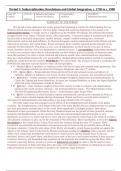
Period 5: Industrialization, Revolutions and Global Integration, c. 1750 to c. 1900
Long 19th 1750 CE Industrial Revolution Core/periphery POWRR-B
Century Atlantic Revolution Abolition Indentured Servitude
1900 CE
SUMMARY OF THE PERIOD
This period is best understood not simply going from beginning to end but by understanding the two
different threads that run through it. The first major change that marks the beginning of the period is the
Industrial Revolution. A change nearly as significant as the Neolithic Revolution, the Industrial Revolution
changed nearly every aspect of human society. Most importantly, it increased output of manufactured goods,
but also lead to increased urbanization, smaller families, created a middle/working class, increased
deforestation, and air and land pollution. As Western European countries industrialized, led by Britain and later
followed by Germany, the United States, Russia and Japan, these countries required greater amounts of raw
materials for their factories. This lead to a new wave of imperialism, in which nearly every area of Africa,
South, Southeast and East Asia were dominated by industrial powers. A core/periphery relationship developed
in which core countries (areas that are industrialized) use their military power to colonize or dominate other
areas (the periphery) in order to extract material and resource wealth. Also called/termed new imperialism,
these new relationships between the core and periphery changed global trading patterns and led to tremendous
upheavals, symbolized by the acronym POWRR-B in the course chart. The acronym is meant to symbolize the
POWER that industrial countries had over their colonies/periphery.
P – Matthew Perry Expedition, an American sailor who forced Japan into unequal trade agreements. This
ended Japanese isolation set out by the Tokugawa Shogunate since the 17th century.
OW – Opium Wars – Britain defeated China and forced them into unequal treaties and spheres of
influence. Spheres of influence were a form of semi-colonization: economic, but not political control.
R – Rebellions – various countries resisted the changes brought by imperialism and industrialization. In
China, the Taiping and Boxer Rebellions; in Japan, the Satsuma Rebellion; in India, the Sepoy Rebellion
which led to the colonization of India by Britain.
R – Reforms – some countries sought to reform their society in order to compete with industrialized
nations (with varied success). Ottoman – the Tanzimat Reforms; Japan – The Meiji Reforms; China –
The Self-Strengthening Movement; Russia – modernization under Sergei Witte.
B – Berlin Conference, in which European nations systematically carved up the continent of Africa in
order to limit colonial disputes during colonization. Britain and France were the main colonizers.
This period of industrialization and imperialism is one major thread of the 19th century.
The other major issue that emerged was the effects of the Enlightenment and demands of the global
economy. The Enlightenment, which began in the end of the Early Modern Period, transformed the way people
saw their government and their place in the world. Most importantly, it changed peoples’ ideas about
themselves in their governments. While the Early Modern Period saw the growth of more powerful, absolute
monarchs, the Enlightenment was the rejection of this idea and encouraged (educated) people to view
themselves as citizens of a nation that have a voice and say in government rather than as the monarch’s subject.
This dynamic continues to play out for the remainder of World History. Most immediately, it led to the Atlantic
Revolutions in the United States, France, Haiti and Latin America during the early 19th century. These
revolutions are essentially decolonization movements (except for France) that successfully threw off their
European colonizers. Using the same ideas of life, liberty and equality, people began speaking out against the
abuses of the Atlantic Slave Trade (lead by Britain) and began pushing for abolition within countries. By the
1850s, most nations had abolished the worst forms of chattel slavery and the Atlantic Slave Trade was
abolished. Russia, the United States, and Brazil were some of the last to end slavery/serfdom in their societies.
Countries, however, still demanded large quantities of raw materials and needed to replace the labor. Many
countries, especially Britain, turned to a system of indentured servitude in order to fill the need for labor.
Population pressures in India and China led to the large-scale migration of millions of indentured servants to
tropical locations in order to continue to produce raw materials, sugar primarily.
, 2
Key Concept 5.1. Industrialization and Global Capitalism
Big Picture: Industrialization fundamentally altered the production of goods around the world. It not only
changed how goods were produced and consumed, as well as what was considered a “good,” but it also had far-
reaching effects on the global economy, social relations, and culture. Although it is common to speak of an
“Industrial Revolution,” the process of industrialization was a gradual one that unfolded over the course of the
eighteenth and nineteenth centuries, eventually becoming global. Changes brought by industrialization:
Social – created a working class; solidified “domestic” role for women- less economic role for women
Economic – increased global trade; created core/periphery relationship; increased production of goods
Cultural – allowed for the spread of Christianity; spread of English as a language of trade
Demographic – urbanization; increased labor migrants across international regions
Environmental – deforestation; soil, air, water pollution increased
Political – laissez-faire capitalism; greater protection of private property
I. Industrialization fundamentally changed how goods were produced. Simply put, this is the change from
the cottage industry to the factory system. In the cottage system, people produced manufactured goods in their home,
generally for personal use. With the development of the factory system, goods could be made much more quickly and
inexpensively, and were therefore available to a larger group of consumers.
A. A variety of factors led to the rise of industrial production.
Required examples of factors leading to the rise of industrial production:
Europe’s location on the Atlantic Ocean – Geography is always a good starting point for explanations, though
never the whole thing. Europe’s location allowed it to quickly dominate sea trade and find greater supplies of raw
materials (peripheral areas that boarded the Atlantic) and access to foreign markets.
The geographical distribution of coal, iron and timber - coal, iron and timber were all in close proximity to
industrial cities in England, allowing industrialists to combine these resources into industrial power. Coal and
timber were used for energy to power the machinery while the iron was necessary in transportation and the
machinery itself.
European demographic changes – declining death rates and increased birth rates in rural communities led to
population pressures and a labor force seeking economic opportunities in urban areas; led to the increased
numbers of folks willing to work factory jobs.
Urbanization - This goes with the demographic changes. Urbanization made labor available in concentrated areas.
Improved agricultural productivity – The industrial revolution is a product of the 2nd Agricultural Revolution.
This was a mechanized agriculture that allowed for greater productivity. More productivity, more people, more
urbanization, more labor available for factory work.
Legal protection of private property – governments provided protection for individual’s property and patents so
they could make greater profits. This protection of property allowed investors to take more risks with their capital
in order to increase profits when companies made gains.
An abundance of rivers and canals – made for really easy transportation of materials and goods.
Access to foreign resources – colonies in the Americas initially provided significant raw materials for Europe
and later imperialism in Africa and Asia continued to provide those resources.
The accumulation of capital – The development of joint-stock companies in the Early Modern Period allowed
many entrepreneurs to gain a great deal more money. Financial capital (or money used for investment/expansion
of businesses) was essential in investing in new business opportunities and these investors pooled a great deal
capital to create the new factory systems.
B. The development of machines, including steam engines and the internal combustion engine, made it
possible to exploit vast new resources of energy stored in fossil fuels, specifically coal and oil. The “fossil
fuels” revolution greatly increased the energy available to human societies. These machines and their ability to
extract energy from resources is what literally provided the fuel for the factory system.
C. The development of the factory system concentrated labor in a single location and led to an increasing
degree of specialization of labor. As labor became concentrated around urban, industrial areas, new forms of labor and
greater specialization of it developed. A wage earning class developed, which is a tremendous development in human
, 3
history. People became disconnected from the “fruits” of their labor and worked for a wage. Identity developed more
around one’s purchasing power instead of the quality and dignity of work.
D. As the new methods of industrial production became more common in parts of northwestern Europe, they
spread to other parts of Europe and the United States, Russia, and Japan. Britain is the most significant industrial
power early on. This industrial power quickly spread to France and Belgium in Europe, and later Germany. Eventually,
this technology and economic change would spread to the United States, Russia and Japan. Here are some important
contrasts in the various industrialization movements. Industrialized = Core.
Britain was earlier than Germany, the US, Russia and Japan.
Japan was much more state-sponsored than the others, and much more rapid.
Germany and the United States were the most industrial (in terms of output) by 1900.
Japan’s lack of natural resources made it quickly develop into an imperial power, although all of them were
imperial.
E. The “second industrial revolution” led to new methods in the production of steel, chemicals, electricity
and precision machinery during the second half of the nineteenth century. The first Industrial Revolution was
almost entirely focused on the production of textiles. The Second Industrial Revolution was heavily focused on steel, the
development of railroads, chemicals (primarily Germany), and electricity.
II. New patterns of global trade and production developed and further integrated the global economy
as industrialists sought raw materials and new markets for the increasing amount and array of goods
produced in their factories. Because factories could produce more, they demanded a greater amount of raw materials
than could be produced locally. Furthermore, as production increased, businesses needed to look for new places to sell all
of their goods, and imperialism provided both the materials and markets necessary. This is a good place to elaborate on
the core/periphery model for the course.
Core Periphery
Industrialized Exports raw materials
Superior military Imports manufactured goods (market for goods)
Imports raw materials Supply of labor
Exports manufactured goods Rebellions due to instability and inequality
Politically stable (tends to be) Poor infrastructure and lacks military power
Modernized
A. The need for raw materials for the factories and increased food supplies for the growing population in
urban centers led to the growth of export economies (periphery nations) around the world that specialized in mass
producing single natural resources (banana republics). The profits from these raw materials were used to
purchase finished goods.
Required Examples of the production and export of single natural resources:
Cotton – The Southern United States, Egypt and India were primary producers. Needed for textiles.
Rubber – The Belgium Congo in Africa, Brazil and Southeast Asia were major producers of rubber.
Palm oil – West Africa produced palm oil and was used as a lubricant in early industrial machines.
Sugar – Brazil and Caribbean remained the major producers of sugar.
Wheat – Western United States, Eastern Europe provided wheat to the industrialized world.
Meat – South America and the Western United States provided a great deal of beef and pork.
Guano – Guano is bat-droppings with high levels of nitrates. Major export of Peru. Used as fertilizer.
Metals and minerals – This is a general statement as many areas produced these things for export.
B. The rapid development of steam-powered industrial production in European countries and the US
contributed to the increase in this region’s share of global manufacturing. While Middle Eastern and Asian
countries continued to produce manufactured goods, these regions’ share in global manufacturing declined. As
industrial powers increased in production, they surpassed other countries’ ability to compete with the production of
manufactured goods. These (peripheral) societies were therefore forced into a larger agricultural role and exportation of
raw materials. Furthermore, it minimized or eliminated other traditional forms of production and altered social and
demographic relationships in those (peripheral) societies.
Period 5: Industrialization, Revolutions and Global Integration, c. 1750 to c. 1900
Long 19th 1750 CE Industrial Revolution Core/periphery POWRR-B
Century Atlantic Revolution Abolition Indentured Servitude
1900 CE
SUMMARY OF THE PERIOD
This period is best understood not simply going from beginning to end but by understanding the two
different threads that run through it. The first major change that marks the beginning of the period is the
Industrial Revolution. A change nearly as significant as the Neolithic Revolution, the Industrial Revolution
changed nearly every aspect of human society. Most importantly, it increased output of manufactured goods,
but also lead to increased urbanization, smaller families, created a middle/working class, increased
deforestation, and air and land pollution. As Western European countries industrialized, led by Britain and later
followed by Germany, the United States, Russia and Japan, these countries required greater amounts of raw
materials for their factories. This lead to a new wave of imperialism, in which nearly every area of Africa,
South, Southeast and East Asia were dominated by industrial powers. A core/periphery relationship developed
in which core countries (areas that are industrialized) use their military power to colonize or dominate other
areas (the periphery) in order to extract material and resource wealth. Also called/termed new imperialism,
these new relationships between the core and periphery changed global trading patterns and led to tremendous
upheavals, symbolized by the acronym POWRR-B in the course chart. The acronym is meant to symbolize the
POWER that industrial countries had over their colonies/periphery.
P – Matthew Perry Expedition, an American sailor who forced Japan into unequal trade agreements. This
ended Japanese isolation set out by the Tokugawa Shogunate since the 17th century.
OW – Opium Wars – Britain defeated China and forced them into unequal treaties and spheres of
influence. Spheres of influence were a form of semi-colonization: economic, but not political control.
R – Rebellions – various countries resisted the changes brought by imperialism and industrialization. In
China, the Taiping and Boxer Rebellions; in Japan, the Satsuma Rebellion; in India, the Sepoy Rebellion
which led to the colonization of India by Britain.
R – Reforms – some countries sought to reform their society in order to compete with industrialized
nations (with varied success). Ottoman – the Tanzimat Reforms; Japan – The Meiji Reforms; China –
The Self-Strengthening Movement; Russia – modernization under Sergei Witte.
B – Berlin Conference, in which European nations systematically carved up the continent of Africa in
order to limit colonial disputes during colonization. Britain and France were the main colonizers.
This period of industrialization and imperialism is one major thread of the 19th century.
The other major issue that emerged was the effects of the Enlightenment and demands of the global
economy. The Enlightenment, which began in the end of the Early Modern Period, transformed the way people
saw their government and their place in the world. Most importantly, it changed peoples’ ideas about
themselves in their governments. While the Early Modern Period saw the growth of more powerful, absolute
monarchs, the Enlightenment was the rejection of this idea and encouraged (educated) people to view
themselves as citizens of a nation that have a voice and say in government rather than as the monarch’s subject.
This dynamic continues to play out for the remainder of World History. Most immediately, it led to the Atlantic
Revolutions in the United States, France, Haiti and Latin America during the early 19th century. These
revolutions are essentially decolonization movements (except for France) that successfully threw off their
European colonizers. Using the same ideas of life, liberty and equality, people began speaking out against the
abuses of the Atlantic Slave Trade (lead by Britain) and began pushing for abolition within countries. By the
1850s, most nations had abolished the worst forms of chattel slavery and the Atlantic Slave Trade was
abolished. Russia, the United States, and Brazil were some of the last to end slavery/serfdom in their societies.
Countries, however, still demanded large quantities of raw materials and needed to replace the labor. Many
countries, especially Britain, turned to a system of indentured servitude in order to fill the need for labor.
Population pressures in India and China led to the large-scale migration of millions of indentured servants to
tropical locations in order to continue to produce raw materials, sugar primarily.
, 2
Key Concept 5.1. Industrialization and Global Capitalism
Big Picture: Industrialization fundamentally altered the production of goods around the world. It not only
changed how goods were produced and consumed, as well as what was considered a “good,” but it also had far-
reaching effects on the global economy, social relations, and culture. Although it is common to speak of an
“Industrial Revolution,” the process of industrialization was a gradual one that unfolded over the course of the
eighteenth and nineteenth centuries, eventually becoming global. Changes brought by industrialization:
Social – created a working class; solidified “domestic” role for women- less economic role for women
Economic – increased global trade; created core/periphery relationship; increased production of goods
Cultural – allowed for the spread of Christianity; spread of English as a language of trade
Demographic – urbanization; increased labor migrants across international regions
Environmental – deforestation; soil, air, water pollution increased
Political – laissez-faire capitalism; greater protection of private property
I. Industrialization fundamentally changed how goods were produced. Simply put, this is the change from
the cottage industry to the factory system. In the cottage system, people produced manufactured goods in their home,
generally for personal use. With the development of the factory system, goods could be made much more quickly and
inexpensively, and were therefore available to a larger group of consumers.
A. A variety of factors led to the rise of industrial production.
Required examples of factors leading to the rise of industrial production:
Europe’s location on the Atlantic Ocean – Geography is always a good starting point for explanations, though
never the whole thing. Europe’s location allowed it to quickly dominate sea trade and find greater supplies of raw
materials (peripheral areas that boarded the Atlantic) and access to foreign markets.
The geographical distribution of coal, iron and timber - coal, iron and timber were all in close proximity to
industrial cities in England, allowing industrialists to combine these resources into industrial power. Coal and
timber were used for energy to power the machinery while the iron was necessary in transportation and the
machinery itself.
European demographic changes – declining death rates and increased birth rates in rural communities led to
population pressures and a labor force seeking economic opportunities in urban areas; led to the increased
numbers of folks willing to work factory jobs.
Urbanization - This goes with the demographic changes. Urbanization made labor available in concentrated areas.
Improved agricultural productivity – The industrial revolution is a product of the 2nd Agricultural Revolution.
This was a mechanized agriculture that allowed for greater productivity. More productivity, more people, more
urbanization, more labor available for factory work.
Legal protection of private property – governments provided protection for individual’s property and patents so
they could make greater profits. This protection of property allowed investors to take more risks with their capital
in order to increase profits when companies made gains.
An abundance of rivers and canals – made for really easy transportation of materials and goods.
Access to foreign resources – colonies in the Americas initially provided significant raw materials for Europe
and later imperialism in Africa and Asia continued to provide those resources.
The accumulation of capital – The development of joint-stock companies in the Early Modern Period allowed
many entrepreneurs to gain a great deal more money. Financial capital (or money used for investment/expansion
of businesses) was essential in investing in new business opportunities and these investors pooled a great deal
capital to create the new factory systems.
B. The development of machines, including steam engines and the internal combustion engine, made it
possible to exploit vast new resources of energy stored in fossil fuels, specifically coal and oil. The “fossil
fuels” revolution greatly increased the energy available to human societies. These machines and their ability to
extract energy from resources is what literally provided the fuel for the factory system.
C. The development of the factory system concentrated labor in a single location and led to an increasing
degree of specialization of labor. As labor became concentrated around urban, industrial areas, new forms of labor and
greater specialization of it developed. A wage earning class developed, which is a tremendous development in human
, 3
history. People became disconnected from the “fruits” of their labor and worked for a wage. Identity developed more
around one’s purchasing power instead of the quality and dignity of work.
D. As the new methods of industrial production became more common in parts of northwestern Europe, they
spread to other parts of Europe and the United States, Russia, and Japan. Britain is the most significant industrial
power early on. This industrial power quickly spread to France and Belgium in Europe, and later Germany. Eventually,
this technology and economic change would spread to the United States, Russia and Japan. Here are some important
contrasts in the various industrialization movements. Industrialized = Core.
Britain was earlier than Germany, the US, Russia and Japan.
Japan was much more state-sponsored than the others, and much more rapid.
Germany and the United States were the most industrial (in terms of output) by 1900.
Japan’s lack of natural resources made it quickly develop into an imperial power, although all of them were
imperial.
E. The “second industrial revolution” led to new methods in the production of steel, chemicals, electricity
and precision machinery during the second half of the nineteenth century. The first Industrial Revolution was
almost entirely focused on the production of textiles. The Second Industrial Revolution was heavily focused on steel, the
development of railroads, chemicals (primarily Germany), and electricity.
II. New patterns of global trade and production developed and further integrated the global economy
as industrialists sought raw materials and new markets for the increasing amount and array of goods
produced in their factories. Because factories could produce more, they demanded a greater amount of raw materials
than could be produced locally. Furthermore, as production increased, businesses needed to look for new places to sell all
of their goods, and imperialism provided both the materials and markets necessary. This is a good place to elaborate on
the core/periphery model for the course.
Core Periphery
Industrialized Exports raw materials
Superior military Imports manufactured goods (market for goods)
Imports raw materials Supply of labor
Exports manufactured goods Rebellions due to instability and inequality
Politically stable (tends to be) Poor infrastructure and lacks military power
Modernized
A. The need for raw materials for the factories and increased food supplies for the growing population in
urban centers led to the growth of export economies (periphery nations) around the world that specialized in mass
producing single natural resources (banana republics). The profits from these raw materials were used to
purchase finished goods.
Required Examples of the production and export of single natural resources:
Cotton – The Southern United States, Egypt and India were primary producers. Needed for textiles.
Rubber – The Belgium Congo in Africa, Brazil and Southeast Asia were major producers of rubber.
Palm oil – West Africa produced palm oil and was used as a lubricant in early industrial machines.
Sugar – Brazil and Caribbean remained the major producers of sugar.
Wheat – Western United States, Eastern Europe provided wheat to the industrialized world.
Meat – South America and the Western United States provided a great deal of beef and pork.
Guano – Guano is bat-droppings with high levels of nitrates. Major export of Peru. Used as fertilizer.
Metals and minerals – This is a general statement as many areas produced these things for export.
B. The rapid development of steam-powered industrial production in European countries and the US
contributed to the increase in this region’s share of global manufacturing. While Middle Eastern and Asian
countries continued to produce manufactured goods, these regions’ share in global manufacturing declined. As
industrial powers increased in production, they surpassed other countries’ ability to compete with the production of
manufactured goods. These (peripheral) societies were therefore forced into a larger agricultural role and exportation of
raw materials. Furthermore, it minimized or eliminated other traditional forms of production and altered social and
demographic relationships in those (peripheral) societies.