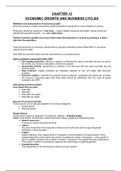
CHAPTER 12
ECONOMIC GROWTH AND BUSINESS CYCLES
Definition and measurement of economic growth:
Economic growth is usually measured by determining the annual growth in real production or income.
Production should be measured in real terms – means inflation should be eliminated. Figures should be
adjusted for population growth – on a per capita basis.
Positive economic growth only occurs when total real production or income is growing at a faster
rate than the population
Total real production is commonly represented by real gross domestic product (Real GDP) or real gross
national income (GNI).
Real GDP and real GNI means that the measurement is at constant prices.
Some problems associated with GDP:
Non-market production: difficult to measure or estimate the value of activities that are not sold in
the market. Eg: farmers consumption of their own produce.
Unrecorded activity: transactions or activities in the economy that are never recorded. Eg: the
informal sector.
Data revisions: original estimates are frequently adjusted as new and better data becomes
available.
Economic welfare: unwanted by products (such as pollution, congestion and noise) are not taken
into account. Economist argue that these bads should be subtracted from the value of goods
included in the GDP.
Calculating economic growth:
Four bases that are used:
Real GDP
Real GNI
Real GDP per capita
Real GNI per capita
Sources of economic growth:
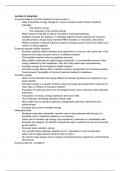
These sources can be grouped together in two broad categories:
Supply factors
Demand factors
Supply factors:
Factors which cause an expansion in production capacity – potential output
Relate to the factors of production: natural resources, labour, capital and entrepreneurship.
Natural resources:
A country’s natural resources are fixed.
Labour:
The size of the labour force depends on factors such as the size and the age and gender
distribution of the population.
Capital:
Capital widening: when capital stock is increased to accommodate an increasing labour force.
Capital deepening: Occurs when the amount of capital per worker is increased. – when growth in
stock of capital > growth in the number of workers. (increase in the capital intensity of production)
The quality of capital is increased by applying new technology to capital equipment.
Entrepreneurship:
The entrepreneur is the driving force behind economic growth.
ECONOMIC GROWTH AND BUSINESS CYCLES
Definition and measurement of economic growth:
Economic growth is usually measured by determining the annual growth in real production or income.
Production should be measured in real terms – means inflation should be eliminated. Figures should be
adjusted for population growth – on a per capita basis.
Positive economic growth only occurs when total real production or income is growing at a faster
rate than the population
Total real production is commonly represented by real gross domestic product (Real GDP) or real gross
national income (GNI).
Real GDP and real GNI means that the measurement is at constant prices.
Some problems associated with GDP:
Non-market production: difficult to measure or estimate the value of activities that are not sold in
the market. Eg: farmers consumption of their own produce.
Unrecorded activity: transactions or activities in the economy that are never recorded. Eg: the
informal sector.
Data revisions: original estimates are frequently adjusted as new and better data becomes
available.
Economic welfare: unwanted by products (such as pollution, congestion and noise) are not taken
into account. Economist argue that these bads should be subtracted from the value of goods
included in the GDP.
Calculating economic growth:
Four bases that are used:
Real GDP
Real GNI
Real GDP per capita
Real GNI per capita
Sources of economic growth:
These sources can be grouped together in two broad categories:
Supply factors
Demand factors
Supply factors:
Factors which cause an expansion in production capacity – potential output
Relate to the factors of production: natural resources, labour, capital and entrepreneurship.
Natural resources:
A country’s natural resources are fixed.
Labour:
The size of the labour force depends on factors such as the size and the age and gender
distribution of the population.
Capital:
Capital widening: when capital stock is increased to accommodate an increasing labour force.
Capital deepening: Occurs when the amount of capital per worker is increased. – when growth in
stock of capital > growth in the number of workers. (increase in the capital intensity of production)
The quality of capital is increased by applying new technology to capital equipment.
Entrepreneurship:
The entrepreneur is the driving force behind economic growth.