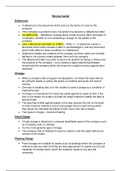
Raising Capital
Debentures
• A debenture is the document which sets out the terms of a loan to the
company
• If the company is granted a loan, the lender may become a debenture-holder
• CA 2006 s738 – ‘debenture’ includes stock, bonds and any other securities of
a company, whether or not constituting a charge on the assets of the
company
• Levy v Abercorris and Slab Co. [1883] – Chitty J – “a debenture means a
document which either creates a debt or acknowledges it, and any document
which fulfils either of these conditions is a debenture”
• Debenture-holders are creditors of the company and their rights are normally
defined in the contract made between them and the company
• The debenture-holder may wish to secure his position by taking a charge over
the property of the company – thus creating a legal relationship between
himself and the company which will ensure he is paid in priority against other
claimants
Charges
• When a company fails and goes into liquidation, it is likely that there will not
be sufficient assets to satisfy the claims of creditors and some will receive
nothing
• One way of avoiding this is for the creditor to seek a charge as a condition of
making the loan
• A charge is a mechanism for securing a debt against an asset so that, it the
loan is not repaid, the lender can take the asset instead to satisfy the debt (a
secured loan)
• The securing of debt against assets in this way reduces the risk for the bank
or other financial institution and so encourages them to lend money which
they would not otherwise be willing to lend, due to the risk of default
• Two types of charge – fixed and floating
Fixed Charge
• A fixed charge is attached to a physical identifiable asset of the company such
as a building, land, or vehicles
• It is the most powerful type of charge
• The company that is holding the asset is unable to sell the asset without the
consent of the lender
Floating Charge
• Fixed charges are suitable for assets such as buildings which the company is
unlikely to sell very often but they are less appropriate for assets such as raw
materials or finished stock, which the company needs to buy and sell
constantly
Debentures
• A debenture is the document which sets out the terms of a loan to the
company
• If the company is granted a loan, the lender may become a debenture-holder
• CA 2006 s738 – ‘debenture’ includes stock, bonds and any other securities of
a company, whether or not constituting a charge on the assets of the
company
• Levy v Abercorris and Slab Co. [1883] – Chitty J – “a debenture means a
document which either creates a debt or acknowledges it, and any document
which fulfils either of these conditions is a debenture”
• Debenture-holders are creditors of the company and their rights are normally
defined in the contract made between them and the company
• The debenture-holder may wish to secure his position by taking a charge over
the property of the company – thus creating a legal relationship between
himself and the company which will ensure he is paid in priority against other
claimants
Charges
• When a company fails and goes into liquidation, it is likely that there will not
be sufficient assets to satisfy the claims of creditors and some will receive
nothing
• One way of avoiding this is for the creditor to seek a charge as a condition of
making the loan
• A charge is a mechanism for securing a debt against an asset so that, it the
loan is not repaid, the lender can take the asset instead to satisfy the debt (a
secured loan)
• The securing of debt against assets in this way reduces the risk for the bank
or other financial institution and so encourages them to lend money which
they would not otherwise be willing to lend, due to the risk of default
• Two types of charge – fixed and floating
Fixed Charge
• A fixed charge is attached to a physical identifiable asset of the company such
as a building, land, or vehicles
• It is the most powerful type of charge
• The company that is holding the asset is unable to sell the asset without the
consent of the lender
Floating Charge
• Fixed charges are suitable for assets such as buildings which the company is
unlikely to sell very often but they are less appropriate for assets such as raw
materials or finished stock, which the company needs to buy and sell
constantly