tre
8 17 1 17 2 ·
.
, .
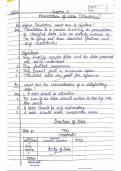
of concentration
change e
17 1- rate
change
in
.
of concentration rate at
averages rate
change
concentration
·
cug
:
which a molecule is produced, or change in
divided by elapsed time
units often se or
langchange
↳
e
↳ aka instantaneous rate of concentration
change; at some poticular instance in time ↳
change in time
Exump
·
(g)
(product) (product) Creatent)
knote negative in front of reactants #
all expressed in terms of 02(9)
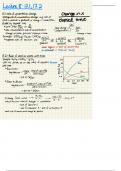
17. 2- Rate of reaction varies with time
-
Example N20s-2NO2 + 02 2S
·
:
.
With the
·
picture ,
we can see rate of reaction decreases 20 , NO2
with time
↳ first 10 min :
i 1 S
.
-OVO
X
1
argrate or
o
= .
0
A
o
10-M/min
0 S
=
32
.
.
.
↳ 10 min to 20 : 0 2040 60 80 100
min
Hmin
&.
.-092
68
=
argrate orm
-
= 2 4 10 - 4
.
-
Mlmin
Mr Mi
-1750 50
-
change-final-initial >
-
·
A - +f -
+i - .
rates of reaction rates of :
changes in concentration
=
rate of formation (
rate of consumption A rate of consumption B
:
+
overall rate of reaction must always be positive
, ↓
Lecture9-17 3. .
17 3-rate law of run determined initial rates
. can be
by
·
rate law relates concentration of reactants to rate of reaction
: * value of x must
N20s -2NO2 &02 +
rate of reaction [N20s]
< be determined
+
of reaction (N2Os) *
rate
experimentally
:
↓
rate constant
* there is no relationship between the balancing coefficients and the
reaction rate law *
·
method of initial rates rate of reaction : over initial time interval
↳ for c equation at + bB +
cC -
products
↳ we can write :
Crate of reactiolo =
KCA] [BJ [C] · ·
need more info
2A 3B - +
- nO x0x
What is the order of the reaction "A" ?
- M
in
↳rate ran must
always be positive -
raterm =
LAJY[iBJS
xryoveralor - corres from coefficientsin reactants
When concentration A doubles but concentration B remains unchanged ,
rate of ran doubles :
L
[A] 2[A] rate same
log 1 0
: = =
depend
,
0 mits ofK on the
logo. O
X =
(2) overall order of reaction
rateith
x= 2 second :
ne
aA bB + - C experimental
1
- [B]Y 0
order reactions at -bB
*
rate : =
KCA]
k[A] : ratern ==E
Method of
At
Initial Rates
rate = KIAJ [BJ ? order
a At
A)
[A] + -[A]o
=
-
E .
a
-
=
A+
-akt
ratez KCAJ[BJ2
-akat
[A]
: -
[A]
[A]
~
+
= -
k+ +
[A]o
① differential rate
&
(now)
② Xand y y = mx + b
[A]
biA
2
③ h-volume and units t In[A] - In[A]o -ht
,
:
K 5
8 17 1 17 2 ·
.
, .
of concentration
change e
17 1- rate
change
in
.
of concentration rate at
averages rate
change
concentration
·
cug
:
which a molecule is produced, or change in
divided by elapsed time
units often se or
langchange
↳
e
↳ aka instantaneous rate of concentration
change; at some poticular instance in time ↳
change in time
Exump
·
(g)
(product) (product) Creatent)
knote negative in front of reactants #
all expressed in terms of 02(9)
17. 2- Rate of reaction varies with time
-
Example N20s-2NO2 + 02 2S
·
:
.
With the
·
picture ,
we can see rate of reaction decreases 20 , NO2
with time
↳ first 10 min :
i 1 S
.
-OVO
X
1
argrate or
o
= .
0
A
o
10-M/min
0 S
=
32
.
.
.
↳ 10 min to 20 : 0 2040 60 80 100
min
Hmin
&.
.-092
68
=
argrate orm
-
= 2 4 10 - 4
.
-
Mlmin
Mr Mi
-1750 50
-
change-final-initial >
-
·
A - +f -
+i - .
rates of reaction rates of :
changes in concentration
=
rate of formation (
rate of consumption A rate of consumption B
:
+
overall rate of reaction must always be positive
, ↓
Lecture9-17 3. .
17 3-rate law of run determined initial rates
. can be
by
·
rate law relates concentration of reactants to rate of reaction
: * value of x must
N20s -2NO2 &02 +
rate of reaction [N20s]
< be determined
+
of reaction (N2Os) *
rate
experimentally
:
↓
rate constant
* there is no relationship between the balancing coefficients and the
reaction rate law *
·
method of initial rates rate of reaction : over initial time interval
↳ for c equation at + bB +
cC -
products
↳ we can write :
Crate of reactiolo =
KCA] [BJ [C] · ·
need more info
2A 3B - +
- nO x0x
What is the order of the reaction "A" ?
- M
in
↳rate ran must
always be positive -
raterm =
LAJY[iBJS
xryoveralor - corres from coefficientsin reactants
When concentration A doubles but concentration B remains unchanged ,
rate of ran doubles :
L
[A] 2[A] rate same
log 1 0
: = =
depend
,
0 mits ofK on the
logo. O
X =
(2) overall order of reaction
rateith
x= 2 second :
ne
aA bB + - C experimental
1
- [B]Y 0
order reactions at -bB
*
rate : =
KCA]
k[A] : ratern ==E
Method of
At
Initial Rates
rate = KIAJ [BJ ? order
a At
A)
[A] + -[A]o
=
-
E .
a
-
=
A+
-akt
ratez KCAJ[BJ2
-akat
[A]
: -
[A]
[A]
~
+
= -
k+ +
[A]o
① differential rate
&
(now)
② Xand y y = mx + b
[A]
biA
2
③ h-volume and units t In[A] - In[A]o -ht
,
:
K 5