Hurst Readiness Exam #2 Questions & Answers With Explained Rationales, Graded 100%
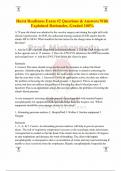
Hurst Readiness Exam #2 Questions & Answers With Explained Rationales, Graded 100% -A 70 year old client was admitted to the vascular surgery unit during the night shift with chronic hypertension. At 0830, the unlicensed nursing assistant (UAP) reports that the client's BP is 198/94. What would be the best action for the charge nurse to delegate at this time? 1. Ask the UAP to put the client back in bed immediately. 2. Tell the UAP to take the BP in the opposite arm in 15 minutes. 3. Have the LPN/LVN administer the 0900 furosemide and enalapril now. 4. Ask the LPN/LVN to assess the client for pain. Rationale 3. Correct: The nurse should recognize the need for measures to reduce the blood pressure. Administering the client's blood pressure medicine is aimed at correcting the problem. It is appropriate to administer the medications at this time in relation to the time that the next dose is due. 1. Incorrect: This is an appropriate action, but does not address the problem of lowering the client's blood pressure. 2. Incorrect: This is an appropriate action, but does not address the problem of lowering the client's blood pressure. 4. Incorrect: This is an appropriate action, but does not address the problem of lowering the client's blood pressure. A case manager is assessing an unresponsive client diagnosed with terminal hepatic encephalopathy for equipment needs upon discharge home for hospice care. Which equipment should the case manager obtain for this client? 1. Alternating pressure mattress 2. Hospital bed 3. Walker 4. Suction equipment 5. Oxygen Rationale 1., 2., 4., & 5. Correct: An alternating pressure mattress will help to prevent pressure ulcers. The risk of respiratory compromise increases as the neurologic status deteriorates. A hospital bed is needed so that the head of the client's bed can be elevated to 30 degrees to ease respirations and decrease the work of breathing. The client with hepatic encephalopathy is unresponsive due to accumulation of toxins and may need suctioning if unable to clear secretions from the oropharynx. Hepatic encephalopathy frequently has associated bleeding varices. The increasing ascites leads to hypovolemia. Both of these conditions can result in hypoxemia for the client at the end stages of liver disease; therefore, oxygen therapy is provided. 3. Incorrect: As hepatic encephalopathy progresses and toxins accumulate, the client lapses into a coma. Therefore, the unresponsive client will not be ambulatory and would not need a walker. A child is being admitted with possible rheumatic fever. What assessment data would be most important for the nurse to obtain from the parent? 1. 102° F (38.89° C) temperature that started 2 days previously. 2. History of pharyngitis approximately 4 weeks ago. 3. Vomiting for 3 days. 4. A cough that started about 1 week earlier. - Rationale 2. Correct: Rheumatic fever is often the result of untreated or improperly treated group A β-hemolytic streptococcal infections (GABHS), such as pharyngitis. Therefore, the history of pharyngitis or upper respiratory infection is a key assessment finding for establishing a diagnosis of rheumatic fever. Subsequent development of rheumatic fever usually occurs 2 to 6 weeks following the GABHS, so the assessment should include a remote history of pharyngitis. 1. Incorrect: The fever with rheumatic fever is usually low grade and is considered a minor manifestation of rheumatic fever. 3. Incorrect: Vomiting is not a commonly associated symptom with rheumatic fever and is not considered a major manifestation of rheumatic fever. Although the child may have a history of vomiting, this finding would not be specific to rheumatic fever. 4. Incorrect: A cough is not an associated symptom of rheumatic fever. The time frame for the development of rheumatic fever is not appropriate if the cough started 1 week earlier, even if it had been associated with an upper respiratory streptococcal infection.
Información del documento
- Subido en
- 4 de marzo de 2025
- Número de páginas
- 69
- Escrito en
- 2024/2025
- Tipo
- Examen
- Contiene
- Preguntas y respuestas