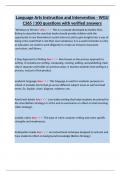
Language Arts Instruction and Intervention - WGU
C365 |100 questions with verified answers
"Windows & Mirrors" Ans✓✓✓ This is a concept developed by Rudine Sims
Bishop to describe the way that books should provide children with the
opportunity to see themselves in print (mirrors) and to gain insights into a way of
being in the world that is not their own (windows). It is a useful reminder on why
as educators we need to work diligently to create an inclusive classroom,
curriculum, and library.
5 Step Approach to Writing Ans✓✓✓ Also known as the process approach to
writing. It includes pre-writing, composing, revising, editing, and publishing. Each
step is separate and builds on previous steps. It teaches students that writing is a
process, not just a final product.
academic language Ans✓✓✓ This language is used for academic purposes in
school. It includes terms that go across different subject areas as well as broad
terms. Ex. Explain, chart, diagram, evidence, etc.
Admit/exit tickets Ans✓✓✓ Low stakes writing that helps students be primed for
the class (Before strategy) or at the end to summarize or reflect on their learning
(after strategy).
analytic rubric Ans✓✓✓ This type of rubric analyzes writing and notes specific
strengths and weaknesses.
Anticipation Guide Ans✓✓✓ an instructional technique designed to activate and
have students reflect on background knowledge (Before Strategy)
,Assimilation Ans✓✓✓ This is the process in which a minority group/culture
comes to resemble the majority group, including their values, behaviors, beliefs,
language, etc. It can mean a loss of traditions or language. Forced cultural
assimilation is not representative of a culturally inclusive or responsive pedagogy.
Authentic Assessments Ans✓✓✓ These assessments connect what a student is
being assessed on to skills that have real world application. For example, writing a
letter to the town board to approve a solar installation with facts and reasoned
analysis versus a test about solar power. Authentic assessments are also a
powerful tool in a culturally responsive and inclusive classroom.
Author's chair Ans✓✓✓ A special chair that students sit in to read their writing to
their peers.
Basal Literature Ans✓✓✓ This is an anthology of readings that are leveled for
students to progress through in a linear fashion. It also includes a workbook for
students, a teacher manual, and often includes extension activities and
modifications. It does not always appeal to student interest and can feel very 'lock
step' in its approach, but it does target specific reading skills helpful for emergent
readers.
basic interpersonal language Ans✓✓✓ This type of language is the language that
we use in our daily lives. Ex. Share, urge, grass, chair, etc.
Blog Ans✓✓✓ The creator of this tool periodically adds content, with the latest
content placed first.
bottoms up/heads together Ans✓✓✓ This strategy supports collaboration.
Teacher introduces a topic and question. Then says "Bottoms up, heads together".
, The students will frequently repeat the phrase back. Then they work together
with their group leaning into the middle of the grouped desk by sitting on their
knees with elbows on the table.
Call & Response Ans✓✓✓ This is a process where by the teacher calls out a
phrase which the students are taught to respond to. This can be done for gaining
attention and focus (Ex. All set?...You bet! Macaroni and Cheese!...Everybody
freeze! Hocus pocus...Everybody focus! It can also be used to build classroom
community and culture (Ex. What are we hear for?...To learn; Shark bait...Woo ha
ha; Stop...Collaborate and listen; Can we do this?...Yes, we can!)
Cause & effect Ans✓✓✓ This type of expository writing is fact based writing
about the relationship between the cause of an event and its effects. Ex. Erosion
or cause/effects to a particular historical event.
Challenges in using technology Ans✓✓✓ These can include students accessing
sites that might not be developmentally appropriate or have content that is not
suitable for school. Additionally, challenges related to student privacy are a
concern especially when utilizing various apps and sites (is student data and
information secure?).
cloze Ans✓✓✓ used to foster comprehension; exercise in which words are
deleted from a passage and students are asked to supply the missing words (No
word box given)
Co-shaping/Re-Voicing Ans✓✓✓ Co-shaping or re-voicing is a strategy used to
reframe student contributions to assist them in bridging the gap between what
they are saying and often the academic language we use to discuss the topic or
content. For example, Student: "Rabbits get eaten a lot by other animals, like
hawks". Teacher: "Yes, rabbits are prey animals".
C365 |100 questions with verified answers
"Windows & Mirrors" Ans✓✓✓ This is a concept developed by Rudine Sims
Bishop to describe the way that books should provide children with the
opportunity to see themselves in print (mirrors) and to gain insights into a way of
being in the world that is not their own (windows). It is a useful reminder on why
as educators we need to work diligently to create an inclusive classroom,
curriculum, and library.
5 Step Approach to Writing Ans✓✓✓ Also known as the process approach to
writing. It includes pre-writing, composing, revising, editing, and publishing. Each
step is separate and builds on previous steps. It teaches students that writing is a
process, not just a final product.
academic language Ans✓✓✓ This language is used for academic purposes in
school. It includes terms that go across different subject areas as well as broad
terms. Ex. Explain, chart, diagram, evidence, etc.
Admit/exit tickets Ans✓✓✓ Low stakes writing that helps students be primed for
the class (Before strategy) or at the end to summarize or reflect on their learning
(after strategy).
analytic rubric Ans✓✓✓ This type of rubric analyzes writing and notes specific
strengths and weaknesses.
Anticipation Guide Ans✓✓✓ an instructional technique designed to activate and
have students reflect on background knowledge (Before Strategy)
,Assimilation Ans✓✓✓ This is the process in which a minority group/culture
comes to resemble the majority group, including their values, behaviors, beliefs,
language, etc. It can mean a loss of traditions or language. Forced cultural
assimilation is not representative of a culturally inclusive or responsive pedagogy.
Authentic Assessments Ans✓✓✓ These assessments connect what a student is
being assessed on to skills that have real world application. For example, writing a
letter to the town board to approve a solar installation with facts and reasoned
analysis versus a test about solar power. Authentic assessments are also a
powerful tool in a culturally responsive and inclusive classroom.
Author's chair Ans✓✓✓ A special chair that students sit in to read their writing to
their peers.
Basal Literature Ans✓✓✓ This is an anthology of readings that are leveled for
students to progress through in a linear fashion. It also includes a workbook for
students, a teacher manual, and often includes extension activities and
modifications. It does not always appeal to student interest and can feel very 'lock
step' in its approach, but it does target specific reading skills helpful for emergent
readers.
basic interpersonal language Ans✓✓✓ This type of language is the language that
we use in our daily lives. Ex. Share, urge, grass, chair, etc.
Blog Ans✓✓✓ The creator of this tool periodically adds content, with the latest
content placed first.
bottoms up/heads together Ans✓✓✓ This strategy supports collaboration.
Teacher introduces a topic and question. Then says "Bottoms up, heads together".
, The students will frequently repeat the phrase back. Then they work together
with their group leaning into the middle of the grouped desk by sitting on their
knees with elbows on the table.
Call & Response Ans✓✓✓ This is a process where by the teacher calls out a
phrase which the students are taught to respond to. This can be done for gaining
attention and focus (Ex. All set?...You bet! Macaroni and Cheese!...Everybody
freeze! Hocus pocus...Everybody focus! It can also be used to build classroom
community and culture (Ex. What are we hear for?...To learn; Shark bait...Woo ha
ha; Stop...Collaborate and listen; Can we do this?...Yes, we can!)
Cause & effect Ans✓✓✓ This type of expository writing is fact based writing
about the relationship between the cause of an event and its effects. Ex. Erosion
or cause/effects to a particular historical event.
Challenges in using technology Ans✓✓✓ These can include students accessing
sites that might not be developmentally appropriate or have content that is not
suitable for school. Additionally, challenges related to student privacy are a
concern especially when utilizing various apps and sites (is student data and
information secure?).
cloze Ans✓✓✓ used to foster comprehension; exercise in which words are
deleted from a passage and students are asked to supply the missing words (No
word box given)
Co-shaping/Re-Voicing Ans✓✓✓ Co-shaping or re-voicing is a strategy used to
reframe student contributions to assist them in bridging the gap between what
they are saying and often the academic language we use to discuss the topic or
content. For example, Student: "Rabbits get eaten a lot by other animals, like
hawks". Teacher: "Yes, rabbits are prey animals".