

Escrito por estudiantes que aprobaron Inmediatamente disponible después del pago Leer en línea o como PDF ¿Documento equivocado? Cámbialo gratis 4,6 TrustPilot
logo-home
Document preview thumbnail
Vista previa 2 fuera de 10 páginas
Examen

NCSO COMPLETE EXAM QUESTIONS AND CORRECT ANSWERS

Document preview thumbnail
Vista previa 2 fuera de 10 páginas

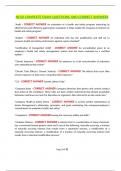
NCSO COMPLETE EXAM QUESTIONS AND CORRECT ANSWERS "Audit - CORRECT ANSWER An evaluation of a health and safety program measuring its effectiveness and efficiency against given standards. it helps enable the company to improve its health and safety program." "Auditor - CORRECT ANSWER An individual who has the qualification and skill set to measure health and safety performance against a given standard" "Certification of Recognition (COR) - CORRECT ANSWER An accreditation given to an employer's health and safety management system that has been evaluated by a certified auditor." "Chronic Exposure - CORRECT ANSWER An exposure to a low concentration of substance over extended period of time" "Chronic Toxic Effects ( Chronic Toxicity) - CORRECT ANSWER The effects that occur after chronic exposure or that occur a long time after exposure." "CLC - CORRECT ANSWER Canada Labour Code" "Company Rules - CORRECT ANSWER Company directives that govern and control conduct that action at the workplace. These rules are basic written statements that dictate acceptable behaviour and leave no room for discretion or argument. Also referred to as safe work rules." "Company Health & Safety Policy - CORRECT ANSWER A current written statement(s) of Senior Management's philosophy, principles, and goals embodying the company/employer's commitments to workplace health and safety" "Competent - CORRECT ANSWER Having the necessary ability and skills." "Complex Mixture - CORRECT ANSWER A mixture that is a combination of many chemicals, has a commonly known generic name and is any of the following: naturally occurring, a fraction of naturally occuring mixture that results from a separation process, a modification of a naturally occurring mixture, a modification of a fraction of naturally occurring mixture that results from a chemical modification process." "Constructor - CORRECT ANSWER The contractor, employer or other person who enters into an agreement with the owner of the work site to be the prime contractor. The constructor has the overall responsibility for health and safety on the worksite." "Critical Task - CORRECT ANSWER A task that has the potential to produce major loss to people, equipment, process or the environment." "Employee - CORRECT ANSWER An individual who works for an employer or organization and is compensated for their services. This person may be full-time, part-time or retained on a contractual basis." "Engineering Controls - CORRECT ANSWER Measures for eliminating or reducing hazards to which workers may be exposed. Examples include: the substitution of less hazardous products, enclosure of processes to prevent the release of hazardous materials, or installation of local exhaust ventilation to remove air borne contaminants at their point(s) of generation." "Frequency - CORRECT ANSWER Is how often a person would be exposed to a given hazard." "Generic WHMIS Worker Education - CORRECT ANSWER The component of the WHMIS worker education program that includes a general introduction to WHMIS, training in the required content of WHMIS labels and SDSs, and training in the purpose and significance of that information to workers' health and safety on the job." "GHS - CORRECT ANSWER Globally Harmonized System of Classification and Labelling of Chemicals" "Hazard Assessment - CORRECT ANSWER An evaluation used to assess and document hazards, prioritize them and determine hazard controls." "Hazard Controls - CORRECT ANSWER These are the measures put into place to protect workers from known hazards. The typical hierarchy of control measures are elimination, substitution, engineering, administrative and as a last line of defense, personnel protective equipment. An accumulation of all tasks involved in the worksite." "Hazard Recognition - CORRECT ANSWER Seeing or becoming aware of a hazardous situation or condition." "Hazardous Product - CORRECT ANSWER Materials, products or substances that meet the criteria for one or more of the WHMIS product classes." "Hazardous Product Act (HPA) - CORRECT ANSWER Federal legislation that specifies suppliers' responsibilities regarding "prohibited products," "restricted products" and "hazardous products." WHMIS applies only to hazardous products." "Hazardous Product Regulations - CORRECT ANSWER Federal regulations written under the authority of the Hazardous Products Act. These regulations contain the details of suppliers' WHMIS responsibilities, including classification, supplier labels and WHMIS SDSs." "Health and Safety Activity Summaries - CORRECT ANSWER These include information that can help companies measure, review and address health and safety concerns at the workplace. These summaries may include: -Injury statistics -Near miss reports -Injury reports -Safety meeting minutes -Inspection and hazard reports Summaries are not limited to internal information. Companies may find it beneficial to review provincial or national reports on health and safety matters." "Health and Safety Program (also - Occupational Health and Safety Program) - CORRECT ANSWER A structured program containing specific elements that is aimed at reducing incidents and costs, resulting in a safer place of employment." "Health and Safety Rules - CORRECT ANSWER An internally developed set of standards regarding policies and requirements for safety and general workplace conduct." "IDLH - CORRECT ANSWER Immediately Dangerous of Life and Health" "Immediate (Direct) Caude - CORRECT ANSWER The harmful transfer of energy that causes the injury, illness or property damage. The energies can include acoustic, chemical, electrical, kinetic, mechanical, potential, radiant, and thermal." "Importer - CORRECT ANSWER A person or company that brings a controlled product into Canada for sale to, or use at, a work site. Importers have the same WHMIS responsibilities as suppliers." "Inspection (Safety Inspection) - CORRECT ANSWER The act of examining worksites and/or equipment, and comparing conditions and activities observed against standards. Inspections identify hazards and determine if safety legislation and health and safety policies are being followed by looking for unsafe practices and conditions. The inspection should also be used to reinforce and promote safe work practices." "Inspection Report - CORRECT ANSWER A document containing the findings of an inspection. Causes and preventative measures are identified." "Intermediate (Indirect) Causes - CORRECT ANSWER The hazards that existed immediately prior to the incident that lead up to the Immediate Causes. They can be thought of as the unsafe conditions and unsafe practices that existed due to deficiencies in the Safety Management System, i.e., the Root (Basic) Causes." "Investigation Report - CORRECT ANSWER A document containing the information and facts about a specific incident. The events are put into chronological order to give a complete picture of what occurred. Causes and preventive measures are identified." "Job - CORRECT ANSWER A segment of work, a specific work assignment or a set of actions required to complete a specific work objective." "Job Hazard Analysis (JHA) - CORRECT ANSWER The process of evaluating a specific task (job) to identify all hazards or potential hazards that the individuals performing the job (task) may be exposed to." "Joint Health and Safety Committee (JHSC) - CORRECT ANSWER A group comprised of management and worker representatives that work together to identify deficiencies in the safety management system, and then recommend solutions to correct identified deficiencies. The JHSC plays a key role in the development, implementation, and maintenance of a health and safety program." "Management - CORRECT ANSWER Those people that have some level of authority, responsibility and accountability within the firm." "OHSMS - CORRECT ANSWER Occupational Health and Safety Management" "Performance-based - CORRECT ANSWER A requirement stating desired results or outcomes." "Personal Protective Equipment (PPE) - CORRECT ANSWER Protective gear designed to reduce or eliminate injuries to a worker. Basic PPE includes steel toed boots, gloves, hard hats, safety clothing and safety glasses." "Physical State - CORRECT ANSWER An indicator of whether a product is a solid, liquid or gas." "Policy - CORRECT ANSWER Written statement that expresses the wisdom, philosophy, experience and or belief of an organization's senior management and guides actions." "Prescriptive-based - CORRECT ANSWER A requirement stating specific actions." "Qualified - CORRECT ANSWER Being knowledgeable of the work, the hazards involved and the means to control the hazards, by reason of education, training, experience or a combination thereof. (CLC)" "Risk - CORRECT ANSWER The chance of loss based on exposure to a hazard, probability of occurrence, and the resulting consequences of exposure to the hazard." "RSI - CORRECT ANSWER Repetitive Strain Injury" "RTW - CORRECT ANSWER Return to Work" "Rule - CORRECT ANSWER Can be defined as: a) Prescribed for conduct or action, or b) A bylaw governing procedures or controlling conduct, instituted by the organization involved." "Safe Job Procedures - CORRECT ANSWER A written, specific step-by-step description of how to complete a job safely and efficiently from start to finish." "Safe Work Practices - CORRECT ANSWER A set of positive guidelines or "Do's and Don'ts" on how to perform a specific task that may not always be done in a certain way." "Safety Management System - CORRECT ANSWER The planning, leading, organizing and controlling of activities at all levels in the organization necessary to achieve safety goals." "Senior Management - CORRECT ANSWER Personnel in a company or a department who directly control the overall operation of the company or department, and are in a position to make decisions for the entire company or department." "Severity - CORRECT ANSWER Is the level of harm that could reasonably be expected to be inflicted in the case of an occurrence." "Threshold Limit Values (TLVs) - CORRECT ANSWER Airborne concentrations of substances. TLVs represent conditions to which it is believed that nearly all workers may be exposed day after day without suffering adverse effects. The ACGIH developed this term." "Toxicity - CORRECT ANSWER A substance's ability to cause adverse health effects in persons exposed to it." "Training - CORRECT ANSWER A process by which someone is taught the skills that are needed for an art, profession, or job." "Transportation of Dangerous Goods Legislation (TDG) - CORRECT ANSWER Federal legislation that controls the conditions under which dangerous materials may be transported on public roads, in the air, by rail or by ship. Its purpose is to protect the health and safety of persons in the vicinity of transport accidents involving those materials." "Unsafe Condition - CORRECT ANSWER A condition in which something exists that varies from a normal, accepted safe condition and, if not corrected, could cause injury, occupational illness, and death or property damage." "Unsafe Practice - CORRECT ANSWER The actions of a person in a manner which varies from the accepted or legislated safe practice, and which creates a hazard with potential for injury, occupational illness, death or property damage." "Worker - CORRECT ANSWER An individual employed by a company, whether full-time, part-time, volunteer or on a contractual basis. Workers may include owners, management and subcontractors; for the purposes of the COR audit this term will be used to define individuals that do not have management or supervisor responsibilities." "Workplace - CORRECT ANSWER Any place where a worker is or is likely to be engaged in any work. This includes any vessel, vehicle or mobile equipment used by a worker in work. Also referred to as a worksite." “Accident - CORRECT ANSWER An unplanned, undesired event that results in property or equipment damage, injury, death or occupational illness." "Accident investigation - CORRECT ANSWER The determination of fats of an accident by inquiry, observation and examination" "Acute exposure - CORRECT ANSWER A single exposure or exposure over a short time" "Acute Toxic Effects (accute Toxicity) - CORRECT ANSWER Effects that take place after a single exposure or after a short series of exposures within 24hrs" "America Conference of Government industrial Hygienist (ACGIH) - CORRECT ANSWER International association of occupational hygienists that develops many guidelines of the practice of occupational hygiene. One of the most important of theses guidelines is Threshold Limit Values and Biological Exposure Indices. This publication serves as the basis for occupational exposure limits in many jurisdictions around the world." "Cumulative Toxic Effects - CORRECT ANSWER Effects that usually occur after long term exposure to a substance. Individual exposures occur many times and the effects accumulate. Even very small individual exposures may result in a toxic effect." "Decomposition - CORRECT ANSWER The breakdown of a material into two or more different materials." "Documentation, Observations and Interviews (DOI) - CORRECT ANSWER These are the techniques used to verify the effectiveness of a health and safety program (also referred to as verification techniques)" "Due Diligence - CORRECT ANSWER In legal terms, this is the requirement of a company/employer to provide safe work conditions through taking reasonable steps to prevent incidents from occurring." "Excavation - CORRECT ANSWER Any cut, cavity, trench or depression in the earth's surface resulting from rock or soil removal." "Exposure Limits - CORRECT ANSWER The concentrations of airborne chemicals and materials that worker exposure may not exceed. Exposure limits have various names and often have different numerical values in different jurisdictions. In Ontario these are called Occupational Exposure Limits (OELs)." "First Aid Measures - CORRECT ANSWER The main first aid actions to be taken if a worker is seriously overexposed, often described in a section of the WHMIS SDS." "Follow-Up - CORRECT ANSWER The term used to indicate an action (usually hazard control) that should take place based on the recommendations in accident/incident reports and hazard assessments." "Incident - CORRECT ANSWER An occurrence which resulted in or had the potential for causing an injury or occupational disease or damage to anything in the work or external environment (includes both Accident and Near Miss)." "Incident Investigation - CORRECT ANSWER The finding of the facts about an incident by inquiry, observation and examination." "Incident Records - CORRECT ANSWER Recorded information (reports and record books) detailing what incidents, injuries, occupational illnesses or damages occurred." "Incompatible Substances - CORRECT ANSWER Materials that, when combined with a specific product, cause: the production of toxic or corrosive materials, excessive heat or an explosion." "Ingredient Disclosure List (IDL) - CORRECT ANSWER A list of 1,736 chemicals, any one of which, if present as an ingredient in a controlled product at a concentration greater than the cut off concentration specified on the list, must be revealed on a SDS. The Ingredient Disclosure List is not a list of hazardous products. (There is no comprehensive list of hazardous products)." "Lagging Indicators - CORRECT ANSWER Measure the end result of OHS processes, policies and procedures. They're a record of things that have already happened. Since they record things after the fact, they inform a reactive health and safety culture." "Leading Indicators - CORRECT ANSWER Focus on future health and safety performance with the intent of continuous improvement. They are a signal and monitor of what is being done on an ongoing basis to prevent worker illness and injury." "Lockout - CORRECT ANSWER A positive method for disconnecting power, or making machinery, equipment or a process inoperative. Normally, this is done with locks attached to electrical plugs, breakers or switches, control units, valves, or levers. The person placing the lock at the lockout point must be identified. A numbered tag can also be affixed to the lockout point showing the reason for the lockout, the date and the worker's name." "Lockout Procedure - CORRECT ANSWER A written procedure describing step-by-step how the positive locking out of equipment, machinery or a process is to be done." "Manager - CORRECT ANSWER An employee of a company who is responsible for planning, or directing a department or a group of individuals and monitoring their work. Managers have the authority to change the work assignments of staff and have some control over resources and expenditures. hey are responsible for ensuring the company or department is complying with the OHSR and there applicable safety legislation." "Meetings - CORRECT ANSWER Meetings may include but are not limited to JHSC meetings, toolbox talks, management meetings and informal safety meetings. They may or may not include an agenda but should include a record of attendance." "MDS - CORRECT ANSWER Musculoskeletal Disorders" "Near Miss - CORRECT ANSWER An incident that did not result in an injury or property damage, but which under slightly different circumstances could have." "Occupational Illness - CORRECT ANSWER Physical condition or medical disorder caused by exposure to workplace environmental factors such as silica, dusts, heat, cold, hazardous materials, etc." "Odour Threshold - CORRECT ANSWER The lowest concentration of a substance that most people can smell." "Restricted Products - CORRECT ANSWER The products that must be labelled in a particular way if they are to be sold in Canada. They are dealt with in Part I of the Hazardous Products Act. Restricted products that are packaged in sizes appropriate for the general public, labelled as required by the Consumer Packaging and Labelling Act and offered for sale in ordinary retail outlets are considered, for the purposes of WHMIS, to be "consumer products."" "Root (Basic) Causes - CORRECT ANSWER The deficiencies in carrying out safety policies, programs, plans, processes, procedures or practices that allowed the intermediate and immediate causes to exist. Root causes are often the result of: Inadequate system to control hazards through activities such as safety leadership, training, planned inspections, maintenance, hazard analysis and procedures, incident investigation and analysis, emergency preparedness, and/or rules and procedures. Inadequate performance standards that are not specific enough, not clear enough and/or not high enough. Inadequate compliance with standards because standards are not communicated and/or enforced." "Route of Entry - CORRECT ANSWER The way a product enters the body. The most common routes for workplace chemicals to enter the body are inhalation, ingestion and skin absorption. Contact between a product and skin does not necessarily result in the body absorbing the material. The material could cause a chemical burn or a rash on the surface of the skin or eye and never enter the body." "Site Specific WHMIS - CORRECT ANSWER The portion of the WHMIS worker education program that includes hazard information applicable to the hazardous products they work with or near, and about work procedures applicable to those products." "Subcontractor - CORRECT ANSWER Subcontractors are not limited to trade contractors and may include delivery people, traffic controllers, service technicians, first aid, temporary labor and cleaning services." "Supervisor - CORRECT ANSWER A person, who instructs, directs and controls workers in the performance of their duties. This includes foremen, supervisors, and superintendents; however, the function of supervision is independent of job title or position (i.e. people who direct work are Supervisors)." "Supplier - CORRECT ANSWER A person or company that manufactures, processes or packages a controlled product, or that sells or imports a controlled product." "Terms of Reference - CORRECT ANSWER A description of the objectives and structure of a meeting, committee, projects, etc."

Vista previa del contenido

NCSO COMPLETE EXAM QUESTIONS AND CORRECT ANSWERS
"Audit - CORRECT ANSWER An evaluation of a health and safety program measuring its
effectiveness and efficiency against given standards. it helps enable the company to improve its
health and safety program."

"Auditor - CORRECT ANSWER An individual who has the qualification and skill set to
measure health and safety performance against a given standard"

"Certification of Recognition (COR) - CORRECT ANSWER An accreditation given to an
employer's health and safety management system that has been evaluated by a certified
auditor."

"Chronic Exposure - CORRECT ANSWER An exposure to a low concentration of substance
over extended period of time"

"Chronic Toxic Effects ( Chronic Toxicity) - CORRECT ANSWER The effects that occur after
chronic exposure or that occur a long time after exposure."

"CLC - CORRECT ANSWER Canada Labour Code"

"Company Rules - CORRECT ANSWER Company directives that govern and control conduct
that action at the workplace. These rules are basic written statements that dictate acceptable
behaviour and leave no room for discretion or argument. Also referred to as safe work rules."

"Company Health & Safety Policy - CORRECT ANSWER A current written statement(s) of
Senior Management's philosophy, principles, and goals embodying the company/employer's
commitments to workplace health and safety"

"Competent - CORRECT ANSWER Having the necessary ability and skills."

"Complex Mixture - CORRECT ANSWER A mixture that is a combination of many chemicals,
has a commonly known generic name and is any of the following: naturally occurring, a fraction
of naturally occuring mixture that results from a separation process, a modification of a
naturally occurring mixture, a modification of a fraction of naturally occurring mixture that
results from a chemical modification process."


Page 1 of 10

, "Constructor - CORRECT ANSWER The contractor, employer or other person who enters into
an agreement with the owner of the work site to be the prime contractor. The constructor has
the overall responsibility for health and safety on the worksite."

"Critical Task - CORRECT ANSWER A task that has the potential to produce major loss to
people, equipment, process or the environment."


"Employee - CORRECT ANSWER An individual who works for an employer or organization
and is compensated for their services. This person may be full-time, part-time or retained on a
contractual basis."

"Engineering Controls - CORRECT ANSWER Measures for eliminating or reducing hazards to
which workers may be exposed. Examples include: the substitution of less hazardous products,
enclosure of processes to prevent the release of hazardous materials, or installation of local
exhaust ventilation to remove air borne contaminants at their point(s) of generation."


"Frequency - CORRECT ANSWER Is how often a person would be exposed to a given
hazard."

"Generic WHMIS Worker Education - CORRECT ANSWER The component of the WHMIS
worker education program that includes a general introduction to WHMIS, training in the
required content of WHMIS labels and SDSs, and training in the purpose and significance of that
information to workers' health and safety on the job."

"GHS - CORRECT ANSWER Globally Harmonized System of Classification and Labelling of
Chemicals"

"Hazard Assessment - CORRECT ANSWER An evaluation used to assess and document
hazards, prioritize them and determine hazard controls."

"Hazard Controls - CORRECT ANSWER These are the measures put into place to protect
workers from known hazards. The typical hierarchy of control measures are elimination,
substitution, engineering, administrative and as a last line of defense, personnel protective
equipment. An accumulation of all tasks involved in the worksite."

"Hazard Recognition - CORRECT ANSWER Seeing or becoming aware of a hazardous
situation or condition."

Page 2 of 10

Información del documento

Subido en
28 de febrero de 2025
Número de páginas
10
Escrito en
2024/2025
Tipo
Examen
Contiene
Preguntas y respuestas
$12.49

¿Documento equivocado? Cámbialo gratis Dentro de los 14 días posteriores a la compra y antes de descargarlo, puedes elegir otro documento. Puedes gastar el importe de nuevo.
Escrito por estudiantes que aprobaron
Inmediatamente disponible después del pago
Leer en línea o como PDF

Seller avatar
Los indicadores de reputación están sujetos a la cantidad de artículos vendidos por una tarifa y las reseñas que ha recibido por esos documentos. Hay tres niveles: Bronce, Plata y Oro. Cuanto mayor reputación, más podrás confiar en la calidad del trabajo del vendedor.
Andreas4114
3.8
(4)
Vendido
36
Seguidores
1
Artículos
771
Última venta
1 mes hace


Por qué los estudiantes eligen Stuvia

Creado por compañeros estudiantes, verificado por reseñas

Calidad en la que puedes confiar: escrito por estudiantes que aprobaron y evaluado por otros que han usado estos resúmenes.

¿No estás satisfecho? Elige otro documento

¡No te preocupes! Puedes elegir directamente otro documento que se ajuste mejor a lo que buscas.

Paga como quieras, empieza a estudiar al instante

Sin suscripción, sin compromisos. Paga como estés acostumbrado con tarjeta de crédito y descarga tu documento PDF inmediatamente.

Student with book image

“Comprado, descargado y aprobado. Así de fácil puede ser.”

Alisha Student

Preguntas frecuentes
