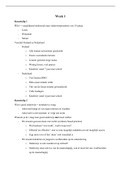
Descriptive Statistics : Observes, summarizes what has already
happened
Two Types
Central Tendency: Commonality of the points to fall towards
the middle/center.
- Consist of the mean, mode and median
Variability: To vary. The points tend to fall away from the
center.
-
Types of Data
Tabular Charts (Table):
- Descriptive charts
- Frequency charts
Graphical Methods:
- Bar charts:
- Histograms:
- Line Graphs:
- Pie Charts:
Chapter 1: IV’s, DV’s hypothesis & six research and stage methods
Chapter 2:
Proportion, percentages, rates, ratios, tables and charts.
Proportion & Percentages
- Proportion are the decimal points, (move the decimal point to
the right two times to get you percentage)
, How to interpret: “out of 40 (the total), only 15% ( number of
percentage) took math.”
Frequency distribution using nominal data:
● Use the total and then do the interpretation. “ 10 out of 30
people are single, while the other 20 are either married or
divorced”
How to get percentages:
- You are going to get the number of the column and divide that
by the total.
Group frequency: ( INTERVAL RATIO)
- Out of the (total) 1 person scored between 75-79 ( have to be
between so and so) on the grading scale.
- To get the percentage you get the Frequency by getting the
number that given and dividing it by the total
- Interpretation: “ out of 40 students 2.5% student scored
between “blank and blank”
Cumulative frequency: **** on quiz ****
- CF means cumulative frequency.
- In order to get the CF, you get the last number/data from the F
column. Copy that last number to the CF and add that to the
upper left number and add.
Chapter 3 :
Mean, Mode & Median
Mode: Finding the most FREQUENT number.
- IF there are 2 repeated number it is called BIMODAL
Distribution
- IF there are 3 repeated number it is TRIMODAL Distribution
Mode INTERPRETATION : There are more students who scored (the
common number) than on any other score OR Most common score
was (whatever the common # is )
happened
Two Types
Central Tendency: Commonality of the points to fall towards
the middle/center.
- Consist of the mean, mode and median
Variability: To vary. The points tend to fall away from the
center.
-
Types of Data
Tabular Charts (Table):
- Descriptive charts
- Frequency charts
Graphical Methods:
- Bar charts:
- Histograms:
- Line Graphs:
- Pie Charts:
Chapter 1: IV’s, DV’s hypothesis & six research and stage methods
Chapter 2:
Proportion, percentages, rates, ratios, tables and charts.
Proportion & Percentages
- Proportion are the decimal points, (move the decimal point to
the right two times to get you percentage)
, How to interpret: “out of 40 (the total), only 15% ( number of
percentage) took math.”
Frequency distribution using nominal data:
● Use the total and then do the interpretation. “ 10 out of 30
people are single, while the other 20 are either married or
divorced”
How to get percentages:
- You are going to get the number of the column and divide that
by the total.
Group frequency: ( INTERVAL RATIO)
- Out of the (total) 1 person scored between 75-79 ( have to be
between so and so) on the grading scale.
- To get the percentage you get the Frequency by getting the
number that given and dividing it by the total
- Interpretation: “ out of 40 students 2.5% student scored
between “blank and blank”
Cumulative frequency: **** on quiz ****
- CF means cumulative frequency.
- In order to get the CF, you get the last number/data from the F
column. Copy that last number to the CF and add that to the
upper left number and add.
Chapter 3 :
Mean, Mode & Median
Mode: Finding the most FREQUENT number.
- IF there are 2 repeated number it is called BIMODAL
Distribution
- IF there are 3 repeated number it is TRIMODAL Distribution
Mode INTERPRETATION : There are more students who scored (the
common number) than on any other score OR Most common score
was (whatever the common # is )