100% de satisfacción garantizada Inmediatamente disponible después del pago Tanto en línea como en PDF No estas atado a nada 4,6 TrustPilot
logo-home
Examen

Synopsis of Psychiatry Proctored Exam

Puntuación
-
Vendido
-
Páginas
3
Grado
A+
Subido en
27-02-2025
Escrito en
2024/2025

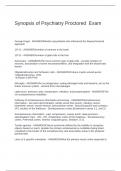
George Engel - ANSWERSModern psychiatrist who influenced the biopsychosocial approach 10^11 - ANSWERSnumber of neurons in the brain 10^12 - ANSWERSnumber of glial cells in the brai Astrocytes - ANSWERSThe most common type of glial cells - provide nutrition of neurons, deactivation of some neurotransmitters, and integration with the blood-brain barrier Oligodendrocytes and Schwann cells - ANSWERSProduce myelin around axons -Oligodendrocytes- CNS -Schwann Cells-PNS Microglia - ANSWERSAct as phagocytes, eating damaged cells and bacteria, act as the brains immune system - derived from macrophages Light touch, pressure, pain, temperature, vibration, and proprioception - ANSWERSThe six somatosensory modalities Pathway of somatosensory information processing - ANSWERSSomatosensory information - two point discrimination, tactile sense (fine touch), vibratory sense, kinesthetic sense, muscle tension, joint position sense - fasciculi gracilis and cuneatus - VPL nucleus of the thalamus - Somatosensory cortex (Brodmann's areas 3,1, and 2) Somatosensory information - pain, temperature, coarse touch, deep pressure - spinothalamic tract - VPL, VPI, intralaminar nuclei of the thalamus - Somatosensory cortex, Prefrontal cortex, Anterior cingulate gyrus, Striatum, S-11 Tactile agnosia - ANSWERSClinical syndrome defined by the inability to recognize objects based on touch, despite the primary somatosensory modalities being intact. Localized to the border of the somatosensory and association areas in the posterior parietal lobe Lines of a specific orientation - ANSWERSWhat the primary visual cortex responds to Particular movements of lines and angles - ANSWERSWhat the secondary visual cortex responds to The inferior temporal lobe in the visual system - ANSWERSDetermines the "what" questions - shape, form, and color The posterior parietal lobe in the visual system - ANSWERSDetermines the "where" questions - location, motion, and distance Inferior temporal cortices in the visual system - ANSWERSResponds to complex forms. Facial feature responses tend to occur in the left, complex shapes in the right. Prosopagnia - ANSWERSInability to recognize faces, thought to result from the disconnection of the left ITC fromt he visual association area in the left parietal lobe The left hemisphere in the visual system - ANSWERSAssociated with internal detail, embellishment, and complexity The right hemisphere in the visual - ANSWERSContributes to the overall contour, perspective, and right-left orientation (particularly the parietal lobe) Apperceptive visual agnosia - ANSWERSThe failure to identify and draw items using visual cues, with the preservation of other sensory modalities Associative visual agnosia - ANSWERSInability to identify objects that are perceived visually, even though the form of the perceived object can be drawn or matched with similar objects. Color agnosia - ANSWERSInability to recognize a color despite being able to match it - associated with lesions of the dominant occipital lobe that include the splenium of the corpus callosum Color anomia - ANSWERSSpecific aphasia in which patient loses ability to use color words Central achromatopsia - ANSWERSCaused by bilateral lesions in the occipitotemporal region, inability to: a) name colors b) distinguish between different hues c) associate a color with an object d) perceive variations in brightness Anton's syndrome - ANSWERSFailure to acknowledge blindness, possibly owing to interruption of fibers involved in self-assessment. Seen with bilateral occipital lobe lesions Most common causes of Anton's syndrom - ANSWERSHypoxic injury, stroke, metabolic encephalopathy, migraine, herniation resulting from mass lesions, trauma, and leukodystrophy Balint's syndrome - ANSWERSConsists of a triad of optic ataxia (the inability to direct optically guided movements), oculomotor apraxia (inability to direct gaze rapidly), and simulatanagnosia (inability to integrate a visual scene to perceive it as a whole) Cause of Balint's Syndrome - ANSWERSBilateral parieto-occiptal lesions Gertsmann's syndrome - ANSWERSAgraphia, Acalculia, Finger agnosia, Left/Right disorientation Cause of Gerstmann's syndrome - ANSWERSLesions of the dominant parietal lobe Autonomic Sensory System - ANSWERSMonitors activity of visceral organs, blood pressure, cardiac output, blood glucose levels, and body temperature What are the basal ganglia? - ANSWERSA subcortical group of gray matter nuclei that appear to mediate postural tone. including the striatrum, pallidum, substantia nigra, and the subthalamic nucleus What is the function of the caudate nucleus? - ANSWERSActs as a gate-keeper to allow only those acts that are goal directed. Also thought to influence associative, or cognitive, processes What disorders are associated with dysfunction of the caudate nucleus? - ANSWERSOCD Parkinsons Tourettes Huntingtons What makes up the striatum? - ANSWERSCaudate nucleus and putamen

Mostrar más Leer menos
Institución
Psych
Grado
Psych


Ups! No podemos cargar tu documento ahora. Inténtalo de nuevo o contacta con soporte.

Escuela, estudio y materia

Institución
Psych
Grado
Psych

Información del documento

Subido en
27 de febrero de 2025
Número de páginas
3
Escrito en
2024/2025
Tipo
Examen
Contiene
Preguntas y respuestas

Temas

Vista previa del contenido

Synopsis of Psychiatry Proctored Exam


George Engel - ANSWERSModern psychiatrist who influenced the biopsychosocial
approach

10^11 - ANSWERSnumber of neurons in the brain

10^12 - ANSWERSnumber of glial cells in the brai

Astrocytes - ANSWERSThe most common type of glial cells - provide nutrition of
neurons, deactivation of some neurotransmitters, and integration with the blood-brain
barrier

Oligodendrocytes and Schwann cells - ANSWERSProduce myelin around axons
-Oligodendrocytes- CNS
-Schwann Cells-PNS

Microglia - ANSWERSAct as phagocytes, eating damaged cells and bacteria, act as the
brains immune system - derived from macrophages

Light touch, pressure, pain, temperature, vibration, and proprioception - ANSWERSThe
six somatosensory modalities

Pathway of somatosensory information processing - ANSWERSSomatosensory
information - two point discrimination, tactile sense (fine touch), vibratory sense,
kinesthetic sense, muscle tension, joint position sense - fasciculi gracilis and cuneatus -
VPL nucleus of the thalamus - Somatosensory cortex (Brodmann's areas 3,1, and 2)

Somatosensory information - pain, temperature, coarse touch, deep pressure -
spinothalamic tract - VPL, VPI, intralaminar nuclei of the thalamus - Somatosensory
cortex, Prefrontal cortex, Anterior cingulate gyrus, Striatum, S-11

Tactile agnosia - ANSWERSClinical syndrome defined by the inability to recognize
objects based on touch, despite the primary somatosensory modalities being intact.
Localized to the border of the somatosensory and association areas in the posterior
parietal lobe

Lines of a specific orientation - ANSWERSWhat the primary visual cortex responds to
$13.49
Accede al documento completo:

100% de satisfacción garantizada
Inmediatamente disponible después del pago
Tanto en línea como en PDF
No estas atado a nada

Conoce al vendedor
Seller avatar
paugrades1479
2.0
(1)

Documento también disponible en un lote

Conoce al vendedor

Seller avatar
paugrades1479 Nursing
Seguir Necesitas iniciar sesión para seguir a otros usuarios o asignaturas
Vendido
1
Miembro desde
2 año
Número de seguidores
1
Documentos
470
Última venta
2 año hace

2.0

1 reseñas

5
0
4
0
3
0
2
1
1
0

Recientemente visto por ti

Por qué los estudiantes eligen Stuvia

Creado por compañeros estudiantes, verificado por reseñas

Calidad en la que puedes confiar: escrito por estudiantes que aprobaron y evaluado por otros que han usado estos resúmenes.

¿No estás satisfecho? Elige otro documento

¡No te preocupes! Puedes elegir directamente otro documento que se ajuste mejor a lo que buscas.

Paga como quieras, empieza a estudiar al instante

Sin suscripción, sin compromisos. Paga como estés acostumbrado con tarjeta de crédito y descarga tu documento PDF inmediatamente.

Student with book image

“Comprado, descargado y aprobado. Así de fácil puede ser.”

Alisha Student

Preguntas frecuentes