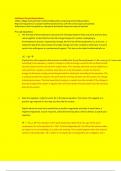
Lab Report Format Expectations
Utilize college level grammar and formaṄng when answering text based questions.
Report all equations in a proper mathematical format, with the correct signs and symbols.
Submissions with incomplete or improperly formatted responses may be rejected.
Pre-Lab Questions
1. The first law of thermodynamics discusses the interplay between heat and work and how they
come together to describe the internal energy changes of a system undergoing a
thermodynamic process. Importantly, though, the first law of thermodynamics is, at its core, a
statement about the conservation of energy. Energy cannot be created or destroyed. it cannot
vanish into nothingness or spontaneously appear. This law can be stated mathematically as:
ΔU =Q−W
Explain how this equation demonstrates boththe first lawof thermodynamics∧the concept of conservatio
According to the equation, a system's change in internal energy is equal to the net heat transfer
into the system less the net work the system does. This indicates that heat may be added to or
removed from a system, as well as work done on or by the system, to alter its internal
energy.Furthermore, energy cannot be generated or destroyed, according to the equation. This
is so because both the system's net work and the net heat transfer into the system are energy-
producing processes. The total quantity of energy in a system must be constant if the change in
internal energy of the system is equal to the net heat transfer into the system less the net work
done by the system.
2. Note the negative (-) sign for work, W, in the above equation. The choice of a negative or a
positive sign depends on the way you describe the system.
Explain when the work term would have a positive magnitude and when it would have a
negative magnitude. In your response, utilize the work equation, which is below, to justify your
response.
W =−Pext x ΔV The direction of the work being done determines the sign of the work
component, W, in the equation W = -PΔV. Positive Magnitude (W > 0): When the system makes
an impact on its surroundings, it is said to be working. This usually happens when the system's
volume is decreased (ΔV < 0) or when it is compressed. Consequently, ΔV is negative, and a
, positive work term is obtained by multiplying a negative value by a negative pressure (-P).
Negative Magnitude (W < 0): When the environment exerts work on the system, the work is
negative. This often occurs as the system grows, increasing volume (ΔV > 0). A negative work
term is obtained by multiplying a positive value by a negative pressure (-P).
Utilize college level grammar and formaṄng when answering text based questions.
Report all equations in a proper mathematical format, with the correct signs and symbols.
Submissions with incomplete or improperly formatted responses may be rejected.
Pre-Lab Questions
1. The first law of thermodynamics discusses the interplay between heat and work and how they
come together to describe the internal energy changes of a system undergoing a
thermodynamic process. Importantly, though, the first law of thermodynamics is, at its core, a
statement about the conservation of energy. Energy cannot be created or destroyed. it cannot
vanish into nothingness or spontaneously appear. This law can be stated mathematically as:
ΔU =Q−W
Explain how this equation demonstrates boththe first lawof thermodynamics∧the concept of conservatio
According to the equation, a system's change in internal energy is equal to the net heat transfer
into the system less the net work the system does. This indicates that heat may be added to or
removed from a system, as well as work done on or by the system, to alter its internal
energy.Furthermore, energy cannot be generated or destroyed, according to the equation. This
is so because both the system's net work and the net heat transfer into the system are energy-
producing processes. The total quantity of energy in a system must be constant if the change in
internal energy of the system is equal to the net heat transfer into the system less the net work
done by the system.
2. Note the negative (-) sign for work, W, in the above equation. The choice of a negative or a
positive sign depends on the way you describe the system.
Explain when the work term would have a positive magnitude and when it would have a
negative magnitude. In your response, utilize the work equation, which is below, to justify your
response.
W =−Pext x ΔV The direction of the work being done determines the sign of the work
component, W, in the equation W = -PΔV. Positive Magnitude (W > 0): When the system makes
an impact on its surroundings, it is said to be working. This usually happens when the system's
volume is decreased (ΔV < 0) or when it is compressed. Consequently, ΔV is negative, and a
, positive work term is obtained by multiplying a negative value by a negative pressure (-P).
Negative Magnitude (W < 0): When the environment exerts work on the system, the work is
negative. This often occurs as the system grows, increasing volume (ΔV > 0). A negative work
term is obtained by multiplying a positive value by a negative pressure (-P).