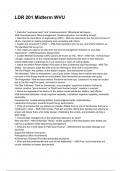
LDR 201 Midterm WVU
1. Describe "oversupervision" and "undersupervision" (Situational technique) -
ANS-Oversupervision- Micromanagement, Undersupervision- not handling enough
1. Describe the importance of angle-taking (LMX). - ANS-It's essential to see the point of view of
others, important in making judgments and connecting with others.
1. Explain the concept of "t-shirts." - ANS-They represent who we are, and what's critical to us.
The identities that we put on.
1. How might you observe an idea from this kind of management theories on your daily
interactions? - ANS-Perspective taking (LMX)
1. Leader-Member Exchange (LMX) used to be known as VDL. Why? - ANS-VDL- Vertical Dyad
Linkage- cognizance on the vertical linkages leaders fashioned with each in their followers,
chief's relationship to paintings as a unit viewed as a chain of vertical dyads.
1. Name and define Robert Kelley's five types of fans (Leadership and Psychology) - ANS-The
Sheep - Are passive, await the chief to do the thinking for them and to motivate them.
The Yes People- Are positive, at the leader's aspect. See themselves as Doers
The Alienated- Think for themselves, Lots of poor power, Always have motives why ideas may
not work or why things should not move ahead. See themselves as mavericks and gutsy.
The Pragmatics- Wait-and-see method, Preserve the fame-quo, Cautious-in no way too excited
due to the fact might be upset. Just want to survive.
The Star Followers- Think for themselves, very energetic, supportive however inclined to
mission, positive, "go-to humans" or "Right hand human beings", Leaders in conceal
1. Name and apprehend the factors of the abilties model (attributes, abilties, and effects) -
ANS-Individual attributes- trendy cognitive capability, crystallized cognitive capability, motivation,
personality
Competencies- trouble-solving abilities, social judgment skills, understanding
Leadership Outcomes- powerful trouble fixing, performance.
1. Think of someone that you admire as a leader. Relate them to one of the theories that we've
mentioned in class. - ANS-Herb brooks- Path aim principle. Being fast, passing well, playing as
a team will deliver them a far better danger of defeating the soviets, and probable winning a
gold medal.
1. Trait principle changed into at the beginning referred to as what?
Why was this? - ANS-Great Man Theory- Innate qualities of the best leaders were tested and
used as a guideline whilst determining management
1. What are the 4 chief styles in Path-Goal Theory? - ANS-Directive (provides steerage and
structure)
Supportive (affords nurturance)
Participative (offers involvement)
Achievement Oriented (Provides demanding situations)
1. What are the professionals and cons of trait leadership? - ANS-Pros: sure tendencies are
crucial, attention on leader, benchmarks
1. Describe "oversupervision" and "undersupervision" (Situational technique) -
ANS-Oversupervision- Micromanagement, Undersupervision- not handling enough
1. Describe the importance of angle-taking (LMX). - ANS-It's essential to see the point of view of
others, important in making judgments and connecting with others.
1. Explain the concept of "t-shirts." - ANS-They represent who we are, and what's critical to us.
The identities that we put on.
1. How might you observe an idea from this kind of management theories on your daily
interactions? - ANS-Perspective taking (LMX)
1. Leader-Member Exchange (LMX) used to be known as VDL. Why? - ANS-VDL- Vertical Dyad
Linkage- cognizance on the vertical linkages leaders fashioned with each in their followers,
chief's relationship to paintings as a unit viewed as a chain of vertical dyads.
1. Name and define Robert Kelley's five types of fans (Leadership and Psychology) - ANS-The
Sheep - Are passive, await the chief to do the thinking for them and to motivate them.
The Yes People- Are positive, at the leader's aspect. See themselves as Doers
The Alienated- Think for themselves, Lots of poor power, Always have motives why ideas may
not work or why things should not move ahead. See themselves as mavericks and gutsy.
The Pragmatics- Wait-and-see method, Preserve the fame-quo, Cautious-in no way too excited
due to the fact might be upset. Just want to survive.
The Star Followers- Think for themselves, very energetic, supportive however inclined to
mission, positive, "go-to humans" or "Right hand human beings", Leaders in conceal
1. Name and apprehend the factors of the abilties model (attributes, abilties, and effects) -
ANS-Individual attributes- trendy cognitive capability, crystallized cognitive capability, motivation,
personality
Competencies- trouble-solving abilities, social judgment skills, understanding
Leadership Outcomes- powerful trouble fixing, performance.
1. Think of someone that you admire as a leader. Relate them to one of the theories that we've
mentioned in class. - ANS-Herb brooks- Path aim principle. Being fast, passing well, playing as
a team will deliver them a far better danger of defeating the soviets, and probable winning a
gold medal.
1. Trait principle changed into at the beginning referred to as what?
Why was this? - ANS-Great Man Theory- Innate qualities of the best leaders were tested and
used as a guideline whilst determining management
1. What are the 4 chief styles in Path-Goal Theory? - ANS-Directive (provides steerage and
structure)
Supportive (affords nurturance)
Participative (offers involvement)
Achievement Oriented (Provides demanding situations)
1. What are the professionals and cons of trait leadership? - ANS-Pros: sure tendencies are
crucial, attention on leader, benchmarks