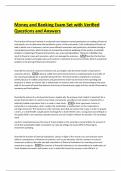
Money and Banking Exam 1 Questions
And Answers Rated A+.
Financial Markets - Answer Markets in which funds are transferred from people who have an excess of
funds to people who have a shortage
Role of the Financial System - Answer 1. Provides individual firms and gov with the capital to do things
now that they otherwise could not
2. Store, protect, and provide profitable uses for excess capital
3. Insurance against risk
4. Speculation
Security - Answer A claim on the issuer's future income
- EX: stocks, bonds
Assets - Answer Any financial claim or piece of property that is subject to ownership
Interest Rate - Answer Cost of borrowing/price paid for the rental of funds
Common Stock - Answer A share of ownership in a corporation
Financial Intermediaries - Answer institutions that borrow funds from people who have saved and in
turn make loans to people who need funds
- ex: commercial bank, mutual fund, etc.
Functions of the Financial Intermediaries - Answer 1. Reduce transaction costs through economies of
scale (increased production)
2. Reduce information costs
, Financial Crises - Answer Major disruptions in financial markets that are characterized by sharp declines
in asset prices and the failures of many financial and non-financial firms
Money Supply - Answer Anything generally accepted as payment for goods or in the repayment of
debts
Business Cycles - Answer Upward and downward movement of aggregate output produced in the
economy
Recessions - Answer Period of declining output
Inflation and Inflation Rate - Answer Continual increase in the price level
- rate: rate of change of the price level usually measured as a percentage per year
GDP (Gross Domestic Product) - Answer a measure of aggregate output
Direct Finance - Answer Borrow funds directly from lenders by selling the lenders securities (AKA
financial instruments)
- ex: stock market, bond market, foreign exchange
Indirect Finance - Answer Borrower uses financial intermediary to borrow funds
Maturity of a Debt Instrument - Answer Short term: less than a year to maturity
Intermediate term: 1-10 years to maturity
Long term: 10 years or longer to maturity
Equities - Answer Claims to share in the net income and assets of a business
- make periodic payments (dividends) to shareholders (considered long term securities because they
never mature)
- Ex: common stock
And Answers Rated A+.
Financial Markets - Answer Markets in which funds are transferred from people who have an excess of
funds to people who have a shortage
Role of the Financial System - Answer 1. Provides individual firms and gov with the capital to do things
now that they otherwise could not
2. Store, protect, and provide profitable uses for excess capital
3. Insurance against risk
4. Speculation
Security - Answer A claim on the issuer's future income
- EX: stocks, bonds
Assets - Answer Any financial claim or piece of property that is subject to ownership
Interest Rate - Answer Cost of borrowing/price paid for the rental of funds
Common Stock - Answer A share of ownership in a corporation
Financial Intermediaries - Answer institutions that borrow funds from people who have saved and in
turn make loans to people who need funds
- ex: commercial bank, mutual fund, etc.
Functions of the Financial Intermediaries - Answer 1. Reduce transaction costs through economies of
scale (increased production)
2. Reduce information costs
, Financial Crises - Answer Major disruptions in financial markets that are characterized by sharp declines
in asset prices and the failures of many financial and non-financial firms
Money Supply - Answer Anything generally accepted as payment for goods or in the repayment of
debts
Business Cycles - Answer Upward and downward movement of aggregate output produced in the
economy
Recessions - Answer Period of declining output
Inflation and Inflation Rate - Answer Continual increase in the price level
- rate: rate of change of the price level usually measured as a percentage per year
GDP (Gross Domestic Product) - Answer a measure of aggregate output
Direct Finance - Answer Borrow funds directly from lenders by selling the lenders securities (AKA
financial instruments)
- ex: stock market, bond market, foreign exchange
Indirect Finance - Answer Borrower uses financial intermediary to borrow funds
Maturity of a Debt Instrument - Answer Short term: less than a year to maturity
Intermediate term: 1-10 years to maturity
Long term: 10 years or longer to maturity
Equities - Answer Claims to share in the net income and assets of a business
- make periodic payments (dividends) to shareholders (considered long term securities because they
never mature)
- Ex: common stock