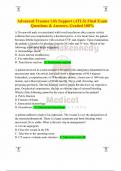
Advanced Trauma Life Support (ATLS) Final Exam Questions & Answers, Graded 100%
Advanced Trauma Life Support (ATLS) Final Exam Questions & Answers, Graded 100%-A 26-year-old male is resuscitated with blood transfusion after a motor vehicle collision that was complicated by a fractured pelvis. A few hours later, the patient becomes febrile, hypotensive with a normal CVP, and oliguric. Upon examination, the patient is found to be bleeding from the NG tube and IV sites. Which of the following is the most likely diagnosis? A. Hemorrhagic shock B. Acute adrenal insufficiency C. Fat embolism syndrome D. Transfusion reaction - D. Transfusion reaction A patient involved in a road accident is brought to the emergency department in an unconscious state. On arrival, her vitals show a temperature of 96.4 degrees Fahrenheit, a respiration rate of 24 breaths per minute, a heart rate of 140 beats per minute, and a blood pressure of 80/40 mm Hg. She is cold, shivering, and perspiring profusely. She has bilateral reactive pupils but she does not respond to pain. On physical examination, she has no obvious sign of external bleeding. Which of the following cannot be the cause of hypotension in this patient? A. Pelvic fracture B. Fracture of femur C. Intracranial hemorrhage D. Hemothorax - C. Intracranial hemorrhage A patient suffered a slash to his right neck. The wound is over the mid-portion of the sternocleidomastoid. There is a large hematoma and brisk bleeding when uncovered. He is stable. What is the next step in management? A. Get an angiogram B. Close the wound in the ER C. Take him to the operating room D. CT scan to evaluate neck structure - C. Take him to the OR After abdominal injury, which of the following urinalysis findings would be an indication for further testing? A. 0-5 casts/HPF B. 5-10 WBC/HPF C. 10-20 RBC/HPF D. Gross hematuria - D. Gross hematuria Not recommended as a mode of ventilation for a patient with a diaphragmatic hernia A. Bag and mask B. LMA C. Endotracheal intubation D. Jet ventilation - A. Bag and mask Which of the following is the least preferred method of administering IV fluids? A. Cubital veins B. Cephalic veins C. Subclavian veins D. Saphenous vein - Subclavian veins A patient with which condition should be triaged to receive medical attention first? A. Choking B. Dizziness C. Leg cramp D. Vomiting - A. Choking For pediatric patients, what volume of fluid resuscitation should be given initially in the setting of shock? A. 750 mL of saline uniformly B. 1 liter of saline C. 20 mL/kg of 0.45% NaCl with 5% glucose D. 10 to 20 mL/kg of Ringers lactate - D. 10 to 20 mL/kg of Ringers lactate A patient is found unconscious after a fire in his bedroom. He is found to have severe burns around his face. What is the first aspect of treatment? A. Tetanus toxoid B. Cover the wound C. Airway D. Obtain blood work - C. Airway A patient with von Willebrand disease is bleeding after sustaining a knife wound. Which of the following is most appropriate for the treatment of this patient? A. Vitamin K B. Cryoprecipitate C. Protamine D. DDAVP - D. DDAVP Which injury is most common in rear end motor vehicle accidents? A. Cervical fractures B. Hypextension-hyperflexion neck injuries C. Forearm fractures D. Rotational neck injuries - B. Hypextension-hyperflexion neck injuries What is true about an unrestrained pregnant driver? A. She is at increased risk of placenta previa B. She is at increased risk of placental abruption C. At 33 weeks, her fetus is well protected by an amniotic fluid cushion and thus the pregnancy is not at risk D. If the mother's vital signs are stable, complications are unlikely - B. She is at increased risk of placental abruption In adults, an aspirated foreign body is most likely to get stuck in the: A. Left main bronchus B. Carina C. Right main bronchus D. Esophagus - C. Right main bronchus Which is true regarding cervical spine fractures? A. Seen most commonly in elderly females B. Athletic activities are the most common cause C. Falls are the most common cause D. Methylprednisolone should not be used in associated spinal cord injury in the first 48 hours - D. Methylprednisolone should not be used in associated spinal cord injury in the first 48 hours
Información del documento
- Subido en
- 24 de febrero de 2025
- Número de páginas
- 43
- Escrito en
- 2024/2025
- Tipo
- Examen
- Contiene
- Preguntas y respuestas