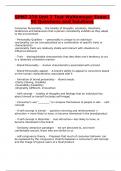
SPMT 370 Unit 2 Test Waltemeyer Exam |
90 Questions and Solutions
Consumer Personality - -the totality of thoughts, emotions, intentions,
tendencies and behaviours that a person consistently exhibits as they adapt
to the environment
- Personality Qualities - --personality is unique to an indvidual
-personality can be conceptualized as a combination of specific traits or
characteristics
-personality traits are relatively stable and interact with situations to
influence behavior
- Trait - -distinguishable characteristic that describes one's tendency to act
in a relatively consistent manner
- Brand Personality - -human characteristics associated with a brand
- Brand Personality appeal - -A brand's ability to appeal to consumers based
on the human characteristics associated with it
- formation of brand personality - -Brand needs:
-Clarity (Strong, Credible)
-Favorability (Likability)
-Originality (different, innovative)
- Self-concept - -totality of thoughts and feelings that an individual has
about himself or herself (includes self-image)
- Consumer's use "_________" to compare themselves to people in ads - -self-
concept
- If self-concept is similar - -positive mirroring and reinforcement =
attraction = more likely to have, or become interested in the brand/product
- if self-concept is dissimilar - -less attraction= less likely to have, or
become interested in the brand
- Similarity attraction paradigm - -we are attracted to, and more
comfortable around, those who are similar to us
- self-congruency theory - -Proposes that much of consumer behavior can
be explained by the congruence (match) between a consumer's self-concept
and the image of typical users of a focal product.
, - How do marketers use self congruency theory? - -by segmenting markets
into groups of consumers who perceive high self-concept congruence with
product user image
- Attitude - -the relatively enduring overall evaluations of objects, products,
services, issues, or people
- ABC approach to attitudes - -an approach that suggests that attitudes
encompass and influence ones Affect (feelings, behavior (actions), and
cognitions (beliefs, thoughts) toward and object, product, service, or person
- hierarchy of effects - -the attitude approach that suggests that affect,
behavior, and cognitions form in a sequential order
1) high involvement (standard learning)
2)Low involvement
3)experiential
4)behavioral influence
- Functional theory of attitudes - -the theory suggests that attitudes perform
four basic functions related to consumer behavior
- Utilitarian function of attributes - -the function of attitudes in which
consumers use attitudes as ways to maximize rewards and minimize
punishment
- knowledge function of attitudes - -function of attitudes whereby attitudes
allow consumers to simplify decision-making processes (the more
experience, the more knowledge, affect attitude)
- ego-defensive function of attitudes - -function of attitudes whereby
attitudes work as a defense mechanism for consumers
- Behavioral intentions model - -theory of reasoned action (TORA): model
that provides an explanation of how, when, and why attitudes affect behavior
-intention is the greatest prediction of actual behavior
-attitudes change-persuasion
- Persuasion - -attempt to change attitudes
- Elaboration likelihood model - -the attitudual change model that shows
attitudes are changed based on differing levels of consumer involvement
- What two routes does the persuasion process follow? - -a central route and
peripheral route
90 Questions and Solutions
Consumer Personality - -the totality of thoughts, emotions, intentions,
tendencies and behaviours that a person consistently exhibits as they adapt
to the environment
- Personality Qualities - --personality is unique to an indvidual
-personality can be conceptualized as a combination of specific traits or
characteristics
-personality traits are relatively stable and interact with situations to
influence behavior
- Trait - -distinguishable characteristic that describes one's tendency to act
in a relatively consistent manner
- Brand Personality - -human characteristics associated with a brand
- Brand Personality appeal - -A brand's ability to appeal to consumers based
on the human characteristics associated with it
- formation of brand personality - -Brand needs:
-Clarity (Strong, Credible)
-Favorability (Likability)
-Originality (different, innovative)
- Self-concept - -totality of thoughts and feelings that an individual has
about himself or herself (includes self-image)
- Consumer's use "_________" to compare themselves to people in ads - -self-
concept
- If self-concept is similar - -positive mirroring and reinforcement =
attraction = more likely to have, or become interested in the brand/product
- if self-concept is dissimilar - -less attraction= less likely to have, or
become interested in the brand
- Similarity attraction paradigm - -we are attracted to, and more
comfortable around, those who are similar to us
- self-congruency theory - -Proposes that much of consumer behavior can
be explained by the congruence (match) between a consumer's self-concept
and the image of typical users of a focal product.
, - How do marketers use self congruency theory? - -by segmenting markets
into groups of consumers who perceive high self-concept congruence with
product user image
- Attitude - -the relatively enduring overall evaluations of objects, products,
services, issues, or people
- ABC approach to attitudes - -an approach that suggests that attitudes
encompass and influence ones Affect (feelings, behavior (actions), and
cognitions (beliefs, thoughts) toward and object, product, service, or person
- hierarchy of effects - -the attitude approach that suggests that affect,
behavior, and cognitions form in a sequential order
1) high involvement (standard learning)
2)Low involvement
3)experiential
4)behavioral influence
- Functional theory of attitudes - -the theory suggests that attitudes perform
four basic functions related to consumer behavior
- Utilitarian function of attributes - -the function of attitudes in which
consumers use attitudes as ways to maximize rewards and minimize
punishment
- knowledge function of attitudes - -function of attitudes whereby attitudes
allow consumers to simplify decision-making processes (the more
experience, the more knowledge, affect attitude)
- ego-defensive function of attitudes - -function of attitudes whereby
attitudes work as a defense mechanism for consumers
- Behavioral intentions model - -theory of reasoned action (TORA): model
that provides an explanation of how, when, and why attitudes affect behavior
-intention is the greatest prediction of actual behavior
-attitudes change-persuasion
- Persuasion - -attempt to change attitudes
- Elaboration likelihood model - -the attitudual change model that shows
attitudes are changed based on differing levels of consumer involvement
- What two routes does the persuasion process follow? - -a central route and
peripheral route