One important aim of science is to try and explain what happens in the world around us. Modern
science is quite successful in its aim of supplying explanations.
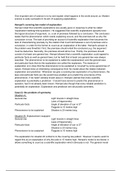
Hempel's covering law model of explanation
Hempel noted that scientific explanations are usually given in response to what he called
'explanation-seeking-why-questions'. He suggested that scientific explanations typically have
the logical structure of argument, i.e. a set of premises followed by a conclusion. The conclusion
states that the phenomenon which needs explaining occurs, and the premises tell us why the
conclusion is true. The task of providing an account of scientific explanation then becomes the
task of characterizing precisely by the relation that must hold between a set of premises and a
conclusion, in order for the former to count as an explanation of the latter. Hempel's answer to
the problem was threefold. First, the premises should entail the conclusion,e.g. the argument
must be deductive. Secondly, the premises should all be true. Thirdly, the premises should
consist of at least one general law. Hempel allowed that a scientific explanation could appeal to
particular facts as well as general laws, but he held that at least one general law was always
essential. The phenomenon to be explained is called the explanandum and the general laws
and particular facts that do the explanation are called the explanans. The essence of
explanation is to show that the phenomenon to be explained is 'covered' by some general law of
nature. Hempel drew an interesting consequence from his model about the relation between
explanation and prediction. Whenever we give a covering law explanation of a phenomenon, the
laws and particular facts we cite would have enabled us to predict the occurrence of the
phenomenon, if we hadn't already known about it. Hempel claimed that every scientific
explanation is potentially a prediction - it would have served to predict the phenomenon in
question, had it not already been known. Hempel also though that every reliable prediction is
potentially an explanation. Explanation and prediction are structurally symmetric.
Case (i): the problem of symmetry
Situation A:
General law Light travels in straight lines
Laws of trigonometry
Particular facts Angle of elevation of sun is 37'
Flagpole is 15 metres high
Phenomenon to be explained Shadow is 20 metres long
Situation B: Explanandum swapped
General law Light travels in straight lines
Laws of trigonometry
Particular facts Angle of elevation of sun is 37'
Shadow is 20 metres long
Phenomenon to be explained Flagpole is 15 metres high
The explanation for situation B conforms to the covering law pattern. However it seems weird to
regard this as an explanation of why the pole is 15 metres high. Hempel's model is too liberal: it
allows something to count as a scientific explanation which obviously is not. The general moral
science is quite successful in its aim of supplying explanations.
Hempel's covering law model of explanation
Hempel noted that scientific explanations are usually given in response to what he called
'explanation-seeking-why-questions'. He suggested that scientific explanations typically have
the logical structure of argument, i.e. a set of premises followed by a conclusion. The conclusion
states that the phenomenon which needs explaining occurs, and the premises tell us why the
conclusion is true. The task of providing an account of scientific explanation then becomes the
task of characterizing precisely by the relation that must hold between a set of premises and a
conclusion, in order for the former to count as an explanation of the latter. Hempel's answer to
the problem was threefold. First, the premises should entail the conclusion,e.g. the argument
must be deductive. Secondly, the premises should all be true. Thirdly, the premises should
consist of at least one general law. Hempel allowed that a scientific explanation could appeal to
particular facts as well as general laws, but he held that at least one general law was always
essential. The phenomenon to be explained is called the explanandum and the general laws
and particular facts that do the explanation are called the explanans. The essence of
explanation is to show that the phenomenon to be explained is 'covered' by some general law of
nature. Hempel drew an interesting consequence from his model about the relation between
explanation and prediction. Whenever we give a covering law explanation of a phenomenon, the
laws and particular facts we cite would have enabled us to predict the occurrence of the
phenomenon, if we hadn't already known about it. Hempel claimed that every scientific
explanation is potentially a prediction - it would have served to predict the phenomenon in
question, had it not already been known. Hempel also though that every reliable prediction is
potentially an explanation. Explanation and prediction are structurally symmetric.
Case (i): the problem of symmetry
Situation A:
General law Light travels in straight lines
Laws of trigonometry
Particular facts Angle of elevation of sun is 37'
Flagpole is 15 metres high
Phenomenon to be explained Shadow is 20 metres long
Situation B: Explanandum swapped
General law Light travels in straight lines
Laws of trigonometry
Particular facts Angle of elevation of sun is 37'
Shadow is 20 metres long
Phenomenon to be explained Flagpole is 15 metres high
The explanation for situation B conforms to the covering law pattern. However it seems weird to
regard this as an explanation of why the pole is 15 metres high. Hempel's model is too liberal: it
allows something to count as a scientific explanation which obviously is not. The general moral