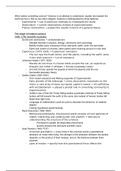
What makes something science? Science is an attempt to understand, explain and explain the
world we live in. But so are other subjects. Science is distinguished by three features
- Experiments → use of particular methods to investigate the world
- Observation → careful observations instead of experimentation
- Theory construction → explain the results in terms of a general theory
The origin of modern science
1500- 1750: Scientific revolution
- Dominant worldview → Aristotelianism
- Detailed theories in physics, biology, astronomy and cosmology
- Earthly bodies were composed of four elements: earth, wind, fire and water
- Earth was centre of universe, other plants were revolving around it in the orbit
- Copernicus (1473-1543) → Copernican revolution
- The sun was the fixed centre, and the plants, including the earth, were
in the orbit around it → Lot of resistance
- Johannes Kepler (1571-1630)
- Planets do not move in circular orbits around the sun, as copernicus
thought, but rather in ellipses → first law of planetary motion
- 2nd and 3rd law: specify the speeds at which the planets orbit the sun
- Successful planetary theory
- Galileo Galilei (1564-1642)
- First modern physicist and lifelong supporter of Copernicanism
- Early pioneer of the telescope → many discoveries: mountains on the
moon; a vast array of stars; sun-spots; jupiter's moons → all conflicting
with aristotelianism → played a pivotal role in converting community to
Copernicanism
- Galileo's law of free fall: Freely falling bodies accelerate uniformly & Freely falling
bodies will fall towards the earth at the same rate instead of heavier bodies fall
faster than light ones
- Language of mathematics could be used to describe the behaviour of material
objects
- Testing hypothesis experimentally
- René Descartes (1596-1650)
- Mechanical philosophy: the physical world consists of inert particles of
matter interacting and colliding with one another → held key to
understanding the structure of the universe
- Promised to explain all observable phenomena
- Quickly became the dominant scientific vision
- Isaac Newton (1643-1727)
- Universal gravitation → every body in the universe exerts a gravitational
attraction on every other body; the strength of the attraction between two bodies
depends on the product of their masses, and on the distance between them
squared
- Laws of motion → specify how this gravitational force affects the
world we live in. But so are other subjects. Science is distinguished by three features
- Experiments → use of particular methods to investigate the world
- Observation → careful observations instead of experimentation
- Theory construction → explain the results in terms of a general theory
The origin of modern science
1500- 1750: Scientific revolution
- Dominant worldview → Aristotelianism
- Detailed theories in physics, biology, astronomy and cosmology
- Earthly bodies were composed of four elements: earth, wind, fire and water
- Earth was centre of universe, other plants were revolving around it in the orbit
- Copernicus (1473-1543) → Copernican revolution
- The sun was the fixed centre, and the plants, including the earth, were
in the orbit around it → Lot of resistance
- Johannes Kepler (1571-1630)
- Planets do not move in circular orbits around the sun, as copernicus
thought, but rather in ellipses → first law of planetary motion
- 2nd and 3rd law: specify the speeds at which the planets orbit the sun
- Successful planetary theory
- Galileo Galilei (1564-1642)
- First modern physicist and lifelong supporter of Copernicanism
- Early pioneer of the telescope → many discoveries: mountains on the
moon; a vast array of stars; sun-spots; jupiter's moons → all conflicting
with aristotelianism → played a pivotal role in converting community to
Copernicanism
- Galileo's law of free fall: Freely falling bodies accelerate uniformly & Freely falling
bodies will fall towards the earth at the same rate instead of heavier bodies fall
faster than light ones
- Language of mathematics could be used to describe the behaviour of material
objects
- Testing hypothesis experimentally
- René Descartes (1596-1650)
- Mechanical philosophy: the physical world consists of inert particles of
matter interacting and colliding with one another → held key to
understanding the structure of the universe
- Promised to explain all observable phenomena
- Quickly became the dominant scientific vision
- Isaac Newton (1643-1727)
- Universal gravitation → every body in the universe exerts a gravitational
attraction on every other body; the strength of the attraction between two bodies
depends on the product of their masses, and on the distance between them
squared
- Laws of motion → specify how this gravitational force affects the