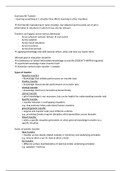
Summary #6 Transfer
= learning something in 1 situation that affects learning in other situations
Not literally reproducing in same situation, but adjusted and focussed use of prior
information in situations in which it may also be relevant
Transfer can happen across various dimension
- Across physical contexts (School real world)
- Across subjects
- Across social situations
- Across functions
- Across time periods
applying knowledge and skills beyond where, when and how you learnt them.
Ultimate goal in education should be
transference of school information/knowledge to real-life (DOESN’T HAPPEN regularly)
superficial knowledge makes transfer hard
dissimilar context make transfer + complex
Types of transfer
- Negative transfer
= Knowledge that inhibits performance on transfer task.
- Positive transfer
= knowledge that promotes performance on transfer task
- Vertical transfer
= knowledge that has to be build up hierarchically
- Lateral transfer
= prior knowledge is not necessary, but can be helpful for understanding transfer task
- Specific transfer
= transfer between 2 overlapping situations
e.g.; dog anatomy helps understand human anatomy
- general/generic transfer
= original and transfer tasks have different contexts
e.g.; practicing Greeks requires discipline which generalizes across domains.
- Mixed transfer
= when a specific situation generalizes or when general knowledge transfers to a
specific situation.
Forms of specific transfer:
- Near transfer
= transfer across closely related contexts (+ Common) and underlying principles
e.g.; how to drive a car VS. how to drive a truck
- Far transfer
= different surface manifestations of task but similar underlying principles
e.g. radiation + fortress
, - Low road transfer/reflexive transfer
= Transfer that happens because a stimulus is similar to the original stimulus
presented whilst learning brings about a basic automated response
Near transfer
- High road transfer/mindful transfer
= actively looking for connection between two situations (mindful about underlying
abstract principles) deciding what previously learned course of action fits this new
situation
Thoughtful transfer
a. Initial learning (by mindful abstraction)
b. Reusing & applying
Theories of transfer (increasing in modernity)
1. Formal discipline
= idea that the brain is a muscle that can be trained. Thus learning in general
transfers to other domains.
attempts to account for general transfer
mixed results (e.g.; no better at learning after learning many poems, but more post-
mortem neural connections in nuns who trained their minds extensively)
2. Thorndike’s Identical elements (behaviorist)
= idea that transfer only occurs when 2 domains have similar characteristics
accounts for specific transfer
about association between stimuli and leanerd responses = behaviorist
3. Similarity of stimuli and responses (behaviors)
= idea that transfer is affected by similarities between stimuli and response across
domains
similar stimuli + different responses confusion = little transfer
different stimuli + similar response discrimination = transfer
similar stimuli + similar response = maximum transfer
4. Importance of Retrieval (information processing model)
= in order to match old info with new situation; both need to be present in WM
WM has limited capacity, THEREFORE transfer is hard and uncommon
retrieval cues make it easier to get old information into WM too, THUS enhance transfer
5. Situated learning
= what we learn is tied to the situation, environment, context we learn it in.
transfer is difficult; doesn’t happen unless extremely similar situation
6. Metacognitive transfer (contemporary)
= if one knows how to learn/has learnt how to learn transfer to other domains
Learning improves in other domains once this is mastered.
general transfer
learning at 1 time can facilitate learning at other time
7. Emotional reaction, motivation & attitudes.
= learning something in 1 situation that affects learning in other situations
Not literally reproducing in same situation, but adjusted and focussed use of prior
information in situations in which it may also be relevant
Transfer can happen across various dimension
- Across physical contexts (School real world)
- Across subjects
- Across social situations
- Across functions
- Across time periods
applying knowledge and skills beyond where, when and how you learnt them.
Ultimate goal in education should be
transference of school information/knowledge to real-life (DOESN’T HAPPEN regularly)
superficial knowledge makes transfer hard
dissimilar context make transfer + complex
Types of transfer
- Negative transfer
= Knowledge that inhibits performance on transfer task.
- Positive transfer
= knowledge that promotes performance on transfer task
- Vertical transfer
= knowledge that has to be build up hierarchically
- Lateral transfer
= prior knowledge is not necessary, but can be helpful for understanding transfer task
- Specific transfer
= transfer between 2 overlapping situations
e.g.; dog anatomy helps understand human anatomy
- general/generic transfer
= original and transfer tasks have different contexts
e.g.; practicing Greeks requires discipline which generalizes across domains.
- Mixed transfer
= when a specific situation generalizes or when general knowledge transfers to a
specific situation.
Forms of specific transfer:
- Near transfer
= transfer across closely related contexts (+ Common) and underlying principles
e.g.; how to drive a car VS. how to drive a truck
- Far transfer
= different surface manifestations of task but similar underlying principles
e.g. radiation + fortress
, - Low road transfer/reflexive transfer
= Transfer that happens because a stimulus is similar to the original stimulus
presented whilst learning brings about a basic automated response
Near transfer
- High road transfer/mindful transfer
= actively looking for connection between two situations (mindful about underlying
abstract principles) deciding what previously learned course of action fits this new
situation
Thoughtful transfer
a. Initial learning (by mindful abstraction)
b. Reusing & applying
Theories of transfer (increasing in modernity)
1. Formal discipline
= idea that the brain is a muscle that can be trained. Thus learning in general
transfers to other domains.
attempts to account for general transfer
mixed results (e.g.; no better at learning after learning many poems, but more post-
mortem neural connections in nuns who trained their minds extensively)
2. Thorndike’s Identical elements (behaviorist)
= idea that transfer only occurs when 2 domains have similar characteristics
accounts for specific transfer
about association between stimuli and leanerd responses = behaviorist
3. Similarity of stimuli and responses (behaviors)
= idea that transfer is affected by similarities between stimuli and response across
domains
similar stimuli + different responses confusion = little transfer
different stimuli + similar response discrimination = transfer
similar stimuli + similar response = maximum transfer
4. Importance of Retrieval (information processing model)
= in order to match old info with new situation; both need to be present in WM
WM has limited capacity, THEREFORE transfer is hard and uncommon
retrieval cues make it easier to get old information into WM too, THUS enhance transfer
5. Situated learning
= what we learn is tied to the situation, environment, context we learn it in.
transfer is difficult; doesn’t happen unless extremely similar situation
6. Metacognitive transfer (contemporary)
= if one knows how to learn/has learnt how to learn transfer to other domains
Learning improves in other domains once this is mastered.
general transfer
learning at 1 time can facilitate learning at other time
7. Emotional reaction, motivation & attitudes.