GLYCOGENESIS (Glycogen Synthesis)
Definition:
• Is the formation of glycogen,
• Occurs in all tissues of the body, but in large amount in liver and muscles.
• Very small amount in the central nervous system; this is why it is completely
dependent on blood glucose as a source of energy.
Site:
• Cytosol of all cells particularly liver and muscles.
Sources of glucose:
a. For liver glycogen:
• Blood glucose
• Other hexoses: fructose and galactose
• Non-carbohydrate sources: “gluconeogenesis”, e.g., amino acids, glycerol and lactate
during fed state.
b. For muscle glycogen:
• Blood glucose only.
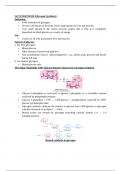
The Sugar Nucleotide UDP-Glucose Donates Glucose for Glycogen Synthesis
• Glucose 6-phosphate is converted to glucose 1-phosphate in a reversible reaction
catalyzed by phosphoglucomutase
• Glucose 1-phosphate + UTP → UDP-glucose + pyrophosphate catalyzed by UDP-
glucose pyrophosphorylase
• Glycogen synthase catalyzes the transfer of glucose from UDP-glucose to glycogen
with the formation of an alpha 1→ 4 link.
• Branch points are formed by glycogen branching enzyme (amylo 1-4 → 1-6
transglucosylase).
Branch synthesis in glycogen
, Why is glycogen branched?
• Make the glycogen molecule more soluble.
• Increase the number of reducing ends, the ends where glycogen synthase adds more
glucose residues and where glycogen phosphorylase removes glucose residues.
• A branching enzyme transfers a segment from the end of a glycogen chain to the C6
hydroxyl of a glucose residue of glycogen to yield a branch with an α (1→6) linkage.
Regulation of Glycogen Synthesis
Adrenaline, Glucagon, Thyroxine Insulin
+ +
Adenylate Cyclase
cAMP-
ATP phosphodiesterase
cAMP AMP
+
Glycogen synthase I Protein Kinase(s) Glycogen synthase D
(Active) (Inactive)
(or a, or Dephospho) Mg+2
ATP ADP (or b, or Phospho)
- Synthase Phosphatase
+
Glycogen Glucos-6-phosphate
Pi H2O
- +
cAMP + Phosphatase Insulin
Inhibitor-I
• Glycogen metabolism is regulated by the activities of glycogen synthase and glycogen
phosphorylase.
• Phosphorylation by protein kinases activates glycogen phosphorylase and inactivates
glycogen synthase.
Definition:
• Is the formation of glycogen,
• Occurs in all tissues of the body, but in large amount in liver and muscles.
• Very small amount in the central nervous system; this is why it is completely
dependent on blood glucose as a source of energy.
Site:
• Cytosol of all cells particularly liver and muscles.
Sources of glucose:
a. For liver glycogen:
• Blood glucose
• Other hexoses: fructose and galactose
• Non-carbohydrate sources: “gluconeogenesis”, e.g., amino acids, glycerol and lactate
during fed state.
b. For muscle glycogen:
• Blood glucose only.
The Sugar Nucleotide UDP-Glucose Donates Glucose for Glycogen Synthesis
• Glucose 6-phosphate is converted to glucose 1-phosphate in a reversible reaction
catalyzed by phosphoglucomutase
• Glucose 1-phosphate + UTP → UDP-glucose + pyrophosphate catalyzed by UDP-
glucose pyrophosphorylase
• Glycogen synthase catalyzes the transfer of glucose from UDP-glucose to glycogen
with the formation of an alpha 1→ 4 link.
• Branch points are formed by glycogen branching enzyme (amylo 1-4 → 1-6
transglucosylase).
Branch synthesis in glycogen
, Why is glycogen branched?
• Make the glycogen molecule more soluble.
• Increase the number of reducing ends, the ends where glycogen synthase adds more
glucose residues and where glycogen phosphorylase removes glucose residues.
• A branching enzyme transfers a segment from the end of a glycogen chain to the C6
hydroxyl of a glucose residue of glycogen to yield a branch with an α (1→6) linkage.
Regulation of Glycogen Synthesis
Adrenaline, Glucagon, Thyroxine Insulin
+ +
Adenylate Cyclase
cAMP-
ATP phosphodiesterase
cAMP AMP
+
Glycogen synthase I Protein Kinase(s) Glycogen synthase D
(Active) (Inactive)
(or a, or Dephospho) Mg+2
ATP ADP (or b, or Phospho)
- Synthase Phosphatase
+
Glycogen Glucos-6-phosphate
Pi H2O
- +
cAMP + Phosphatase Insulin
Inhibitor-I
• Glycogen metabolism is regulated by the activities of glycogen synthase and glycogen
phosphorylase.
• Phosphorylation by protein kinases activates glycogen phosphorylase and inactivates
glycogen synthase.