The Photoelectric Effect
The photoelectric effect is a phenomenon where electrons are emitted from a material
(usually a metal) when it is exposed to light of a certain frequency. It played a crucial
role in the development of quantum mechanics and was explained by Albert Einstein in 1905,
earning him the Nobel Prize in Physics in 1921.
1. Discovery and Observation:
- First observed by Heinrich Hertz in 1887, studied by Philipp Lenard.
- Shining light on certain metals caused electron emission, contradicting classical physics.
2. Experimental Setup:
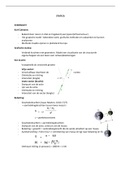
- A light source is directed onto a metal surface.
- A vacuum tube contains the metal surface (cathode) and another electrode (anode).
- A voltmeter and ammeter measure the emitted electron current.
3. Observations:
- Electrons are emitted instantly when light is shone on metal.
- Increasing light intensity increases the number of electrons but not their energy.
- There is a threshold frequency; below it, no electrons are emitted.
- Kinetic energy of electrons depends on frequency, not intensity.
4. Einstein's Explanation:
- Light consists of particles called photons.
- Photon energy: E = h f (h = Planck's constant, f = frequency of light).
- If E is greater than the work function (W) of the metal, an electron is ejected.
- Kinetic Energy of the electron: K_max = h f - W.
- If h f < W, no electron is emitted.
5. Applications:
- Solar cells, photodiodes, night vision devices, electron microscopes, etc.
The photoelectric effect is a phenomenon where electrons are emitted from a material
(usually a metal) when it is exposed to light of a certain frequency. It played a crucial
role in the development of quantum mechanics and was explained by Albert Einstein in 1905,
earning him the Nobel Prize in Physics in 1921.
1. Discovery and Observation:
- First observed by Heinrich Hertz in 1887, studied by Philipp Lenard.
- Shining light on certain metals caused electron emission, contradicting classical physics.
2. Experimental Setup:
- A light source is directed onto a metal surface.
- A vacuum tube contains the metal surface (cathode) and another electrode (anode).
- A voltmeter and ammeter measure the emitted electron current.
3. Observations:
- Electrons are emitted instantly when light is shone on metal.
- Increasing light intensity increases the number of electrons but not their energy.
- There is a threshold frequency; below it, no electrons are emitted.
- Kinetic energy of electrons depends on frequency, not intensity.
4. Einstein's Explanation:
- Light consists of particles called photons.
- Photon energy: E = h f (h = Planck's constant, f = frequency of light).
- If E is greater than the work function (W) of the metal, an electron is ejected.
- Kinetic Energy of the electron: K_max = h f - W.
- If h f < W, no electron is emitted.
5. Applications:
- Solar cells, photodiodes, night vision devices, electron microscopes, etc.