MEDICAL TECHNOLOGY LICENSURE EXAM - ISBB
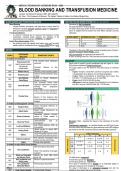
BLOOD BANKING AND TRANSFUSION MEDICINE
Lecturer: Sir Edmund Francisco, RMT, MLS (ASCPi)
By: Xiao - The Conqueror of Demons, The Vigilant Yaksha, & Alatus, the Golden-Winged King
BLOOD BANKING AND TRANSFUSION MEDICINE ABO AND H BLOOD GROUP SYSTEM (ISBT No. 001 and 018)
- Blood Banking - Discovered by Karl Landsteiner
o includes activities, procedures, and tests done to ensure blood for - The most important of all blood groups
transfusion is properly collected, preserved, stored, and dispensed for - The ONLY blood group system in which individuals have antibodies in their
later use in blood transfusion. serum to antigens that are absent from their RBCs (naturally occurring
- Transfusion Medicine antibodies)
o is a branch of medicine that is concerned with transfusion of blood
components, including proper selection and utilization of the BLOOD GROUP ANTIGENS ON CELL ANTIBODIES IN PLASMA
aforementioned in the treatment or prevention of disease. A A Anti-B
- Food & Drug Administration (FDA) B B Anti-A
o the governing body that inspects blood banks every year (annually) AB A and B None
because blood is considered both as a biologic product and as a drug O None Anti-A and B
HISTORY - Transfusion of the wrong ABO group remains the leading cause of death in
hemolytic transfusion reaction fatalities (FDA)
PERSONAGE - ABO incompatibility can cause the most severe HTR
YEAR/S SIGNIFICANT EVENTS
INVOLVED - In 2009, according to the FDA, TRALI was the most common cause of death
In relation to Transfusion
First recorded blood transfusion ABO GENES
Pope Innocent VII
performed - Genes code for specific glycosyl transferases that add sugars to a basic
(died of severe massive
1492 (PS) precursor substance (paragloboside/glycan).
intravascular
Physician: Giacomo di San - The sugars added to the PS determine what blood group an individual
coagulopathy)
Genesio acquires:
1616 William Harvey Discovery of the circulatory system o O gene: Amorphic; It does NOT code for any enzymes and is merely
Animal to Animal transfusion (Dog a representation of the absence of A and B genes/antigens
1665 Richard Lower
to Dog) o A gene: Higher concentrations of transferases than B gene. Has
Jean Baptiste Animal to Human transfusion 810,000 to 1,170,000 Ag sites on an A1 adult RBC.
1667
Denis/Denys (Sheep to Human) o B gene: has 610,000 to 830,000 Ag sites
First successful human blood o A&B genes: B enzyme compete more efficiently for the H substance
1818/ transfusion performed on a woman than the A enzyme; A-600,000 sites & B - 720,000 sites
James Blundell
1829 suffering from postpartum
hemorrhage INHERITANCE OF ABO BLOOD GROUPS
First to work on blood transfusion
and blood preservation techniques
1941 Charles Drew
Director of first American Red
Cross blood bank at Presbyterian
Hospital
In relation to Anticoagulants / Devices
Sodium Phosphate (Na3PO4) as
1869 Braxton Hicks
anticoagulant
Sodium Citrate (Na2C6H3O7) as
1914 Albert Hustin
anticoagulant
Determined minimum non-toxic
1915 Richard Lewisohn amount of Citrate needed to
prevent coagulation
Citrate-Dextrose (CD) as - Bernstein (1924) – described the theory for the inheritance of the ABO
1916 Rous and Turner
anticoagulant groups
Acid Citrate Dextrose (ACD) as - Codominance expression - an individual inherits one ABO type B gene
1943 Loutit and Mollison
anticoagulant from each parent and that these two genes determine which ABO antigens
Utilized glycerol to extend RBC are present on the RBC membrane (follows simple Mendelian genetics)
1950 Audrey Smith
lifespan by 10 years
Citrate Phosphate Dextrose (CPD) Father’s blood type
1957 Gibson A B AB O
as standard preservative at present
First Vein-Vein Transfusion using A, O
Edward Lindemann A A, B, AB, O A, B, AB A, O
special cannulas and syringes
Mother’s blood type
Child’s blood type
A, B, AB, O
Unger Syringe valve apparatus B B, O A, B, AB B, O
In relation to major Blood Group Systems A, B, AB
ABO blood groups discovered AB A, B, AB A, B, AB A, B
1901 Karl Landsteiner
Wrote “The specificity of serologic O A, O B, O A, B O
reactions”
Alfred von Decastello Defined the fourth ABO blood
1902
and Adriano Sturli group: AB - The ABO gene is: autosomal
Karl Landsteiner and MN and P systems discovered - A and B blood groups are: dominant
1927
Philip Levine - A and B group genes are: codominant
Karl Landsteiner Rh blood group discovered - The O gene is considered as an amorph, as no detectable antigen is
1940
Alexander Wiener produced in response to the inheritance of this gene
Others - The group O phenotype is an autosomal recessive trait with the
1937 Cook County Hospital 1st blood bank (Chicago) inheritance of two genes that are non-functional
,PHENOTYPE VS GENOTYPE NOMENCLATURE
- Genotype: is the sequence of DNA that is inherited (individual’s pair of allele BLOOD GROUP JANSKY (CZECH) MOSS (US)
genes together). O I IV
o Homozygous genotype: the presence of two identical alleles A II II
o Heterozygous phenotype: the inheritance of different alleles B III III
- Phenotype: is anything that is produced by the genotype, including an AB IV I
enzyme to control a blood group antigen (individual’s outward
characteristics). ABO ANTIGENS
- Form as early as the 37th day of fetal life, though RBCs of neonates carry
GENE CHROMOSOME only 25-50% of the number of antigenic sites found on adult RBCs
ABO 9 - Full expression of antigens is found at 2-4 years of age and remains
H 19 constant throughout life
Se 19 - The antigens can be found on RBCs, endothelial cells, platelets,
lymphocytes, epithelial cells, and secretions (plasma soluble substances)
PHENOTYPE POSSIBLE GENOTYPES
O OO ABO Antigens ABO Antigens
A1 A1A1, A1A2, A1O on RBCS on Soluble Substances
A2 A2A2, A2O Glycoproteins, Glycolipids or Glycoproteins
B BB, BO Glycosphingolipids
A1B A1B Synthesized only on Primarily synthesized on
A2B A2B type 2 precursor chains - type 1 precursor chains - refer to a
- Example: refer to a β1→4 linkage β1→3 linkage
o Phenotype: Type B Blood Controlled by A,B,H genes Controlled by A, B, H, Se, & Lewis genes
o Genotype: Could be BO or BB depending on parents
- The number one carbon of the galactose is attached to the number three
(type 1) / four (type 2) carbon of the N-acetylglucosamine sugar of the
precursor substance
- Most common to least common blood types: Type O > A > B > AB SECRETOR GENE
- Responsible for the secretion of ABH antigens in the body fluids
FORMATION OF A, B, AND H ANTIGENS - Individuals with the secretor gene (Sese or SeSe) aptly called ‘secretors’,
comprise 80% of the population
- Those who do not have the gene (sese) are called “non-secretors” and
Immunodominant
Gene
Glycosyltransferase Ag comprise of the remaining 20%
Sugar
- ABH substances can be found in DUBSTAMP
H α-2-L-fucosyltransferase L-fucose H o Digestive juices
A α-3-N-acetylgalactosaminyltransferase N-acetyl-D- A o Urine
galactosamine o Bile
(GalNac) o Saliva
B α-3-D-galactosyltransferase D-galactose B o Tears
o Amniotic fluid
- These genes (H, A, & B genes) DO NOT actually code for the production of o Milk
antigens but rather PRODUCE specific glycosyltransferases that ADD o Pathological fluids (pleural, peritoneal, pericardial, ovarian cyst fluid)
SUGARS to a basic precursor substance - Excessive ABH substances in secretions can be observed in:
o Pseudomucinous ovarian cyst
o Intestinal obstruction
o Carcinoma of stomach and pancreas
- Determination of Secretor Status: Hemagglutination Inhibition
o Specimen: saliva
o The principle of the test is that if ABH antigens are present in a soluble
form in a fluid they will neutralize their corresponding antibodies and
the antibodies will no longer be able to agglutinate red cells possessing
the same antigens
If antigen is present = no agglutination
If antigen is absent = agglutination
No No
(+) A Ag Anti-A + (+) B Ag Anti-B +
Saliva
Saliva
agglutination agglutination
A cells B cells
(-) A Ag Agglutination (-) B Ag Agglutination
H ANTIGEN
- The H gene must be inherited to form the ABO antigens on the RBCs
- H antigen
o Produced by the HH or Hh gene
o H gene is found in > 99.99% of the population
o Forms of H antigens:
- A, B, and H antigens are formed from the same basic precursor material- H1 and H2: unbranched straight chains
, Reactivity of anti-H Antisera or anti-H Lectin with ABO Blood Groups - No H antigens formed (absence of H enzyme) = no A or B antigens
formed
o NO AGGLUTINATION with anti-H, anti-A, or anti-B lectin
- Presence of A or B enzymes in serum
- Anti-A, Anti-B, Anti-AB, and Anti-H present in the serum
- Bombay phenotype can donate to any ABO blood group but can only be
transfused with blood from another Bombay (Oh)
Mnemonic: Oh (O), Eto (A2) ba (B), Eto ba (A2B), Ewan (A1), Ewan ba (A1B) - Phenotypes as blood group O
Greatest amount of H antigen: has the strongest reaction with anti-H lectin Group O (OH) vs Bombay Phenotype (Oh)
Lowest amount of H antigen: has the weakest reaction with anti-H lectin Blood group Blood Forward Grouping Reverse Grouping
Anti- Anti-B Anti- Anti-H A1 B O
ABO SUBGROUPS A A,B cells cells cells
O (OH) - - - + + + -
A SUBGROUPS Bombay (Oh) - - - - + + +
Subgroup Notable characteristics Para-Bombay Phenotype (hh secretor)
A1 React with anti-A, and anti A - Absent or only trace A, B and H antigens on RBCs with normal expression
A2 React with anti-A only in secretions and body fluids
A3 MF reaction with anti-A and anti-AB 1. hh genotype
Ax React with Anti-AB, No reaction with anti-A 2. Caused by:
MF reaction with anti-A and anti-AB; but with only few a. Silenced/Mutated FUT 1 gene (H gene) with or without an active
Aend FUT2 gene (Se gene); or
agglutinates (<10% of cells)
Am Weak/No reaction with anti-A and anti-AB b. Silenced FUT1 gene (H gene) with an active FUT2 gene (Se
gene)
Ay & Ael No reaction with anti A and anti-AB
3. RBCs are completely devoid of H antigens or have small amounts of
No reaction with anti A and anti-AB
Ay H antigen present = RBCs express weak forms of A and B antigens
Observed in siblings; A germline mutation of an A gene
4. Absence of H enzyme in serum even though there is limited production
*Mixed field is defined as small agglutinates within predominantly unagglutinated
of H antigen on the RBC; Presence of A or B enzymes in serum
red cells
5. Anti-H is present in the serum
- Adsorption and Elution of anti-A is the method used to confirm the
6. Ah serum: anti-B, anti-A1, and no anti-A
presence of Am, Ay, and Ael antigens 7. Bh serum: anti-A and anti-B
A1 VS A2 PHENOTYPES
ABO ANTIBODIES
- A1 cells contain "A1" antigen and "A" antigen.
- A2 is not really a unique antigen. It is thought to be simply "A" antigen with - Naturally occurring antibodies: individuals normally produce antibodies
no "A1" antigen. directed against the A and/or B antigens absent from their RBCs
- Produced at birth but detected only at 3-6 months of age
- Not normally present or detected at birth
Anti-A Anti-
Antigenic Antigen - Predominantly IgM (can be IgM, IgG, IgA)
Abs
Blood Group (Anti-A with A1
sites Present Anti-A1) - React at room temperature (20-24oC) or below after an immediate spin
Lectin
- Activate complement at 37°C and can cause in-vitro/vivo hemolysis
More
A1
antigenic
80% of all A (or
Anti-B
Anti-A & Anti-B Anti-A,B
sites for A A & A1 + +
AB) are A1 (or Primarily IgM IgG
and less for
A1B) IgG may be found in O individuals Found in O individuals only
H
*Anti-A,B - is not a combination of anti-A and anti-B but is a "cross-reacting"
Less antibody
Anti-B, Anti-A1
A2
antigenic
20% are A2 (or LECTINS
sites for A A + -
A2B) or weaker
and more for - Lectins are plants or seed extracts that agglutinate human cells with some
subgroups
H degree of specificity.
o Prolectins: derived from snails
- These proteins bind specifically to carbohydrate determinants and
Structural Characteristics of A1 and A2 RBCs agglutinate RBCs through their cell surface of oligosaccharide determinants
- A2 RBCs: Predominantly Aa and Ab and unconverted H3 and H4 antigen
sites LECTINS USED IN BLOOD BANKING
- A1 RBCs: Aa, Ab, Ac, and Ad determinants and no unconverted H3 and H4 Anti-A1 Dolichos biflorus
antigen sites Anti-B Bandeiraea (Griffonia) simplicifolia
Anti-H Ulex Europaeus
B SUBGROUPS Anti-N Vicia graminea
- Subgroups of B are very rare and much less frequent than A subgroups Anti-M Iberis amara
Anti-T,Th Arachis hypogea
Subgroup Notable characteristics Anti-Tn Salvia sclarea
MF reaction with anti-B and anti-AB
B3
Most frequent B subtype
ABO ANTIGEN AND ANTIBODY DETECTION
Bx Weak reaction with anti-B and anti-AB
No/Weak reaction with anti-B and anti-AB
Bm Appear as early as Peak at Decline
Converted to B if incubated with Uracil diphosphate
2-4 Remains
No reaction with anti-B and anti-AB ABO
Bel 37th day of fetal life years constant
Extremely rare phenotype Antigens
old throughout life
- Adsorption and Elution of anti-B is the method used to confirm the
Appear as early as BIRTH 5-10
presence of Bm and Bel antigen ABO After 10 years
BUT detected only 3-6 years
Antibodies old
months after birth old
NULL PHENOTYPES
Bombay Phenotype (Oh/Hnull/hh non-secretor)
- First reported by Dr. Y.M. Bhende in 1952 in Bombay (Mumbai), India
BLOOD BANKING AND TRANSFUSION MEDICINE
Lecturer: Sir Edmund Francisco, RMT, MLS (ASCPi)
By: Xiao - The Conqueror of Demons, The Vigilant Yaksha, & Alatus, the Golden-Winged King
BLOOD BANKING AND TRANSFUSION MEDICINE ABO AND H BLOOD GROUP SYSTEM (ISBT No. 001 and 018)
- Blood Banking - Discovered by Karl Landsteiner
o includes activities, procedures, and tests done to ensure blood for - The most important of all blood groups
transfusion is properly collected, preserved, stored, and dispensed for - The ONLY blood group system in which individuals have antibodies in their
later use in blood transfusion. serum to antigens that are absent from their RBCs (naturally occurring
- Transfusion Medicine antibodies)
o is a branch of medicine that is concerned with transfusion of blood
components, including proper selection and utilization of the BLOOD GROUP ANTIGENS ON CELL ANTIBODIES IN PLASMA
aforementioned in the treatment or prevention of disease. A A Anti-B
- Food & Drug Administration (FDA) B B Anti-A
o the governing body that inspects blood banks every year (annually) AB A and B None
because blood is considered both as a biologic product and as a drug O None Anti-A and B
HISTORY - Transfusion of the wrong ABO group remains the leading cause of death in
hemolytic transfusion reaction fatalities (FDA)
PERSONAGE - ABO incompatibility can cause the most severe HTR
YEAR/S SIGNIFICANT EVENTS
INVOLVED - In 2009, according to the FDA, TRALI was the most common cause of death
In relation to Transfusion
First recorded blood transfusion ABO GENES
Pope Innocent VII
performed - Genes code for specific glycosyl transferases that add sugars to a basic
(died of severe massive
1492 (PS) precursor substance (paragloboside/glycan).
intravascular
Physician: Giacomo di San - The sugars added to the PS determine what blood group an individual
coagulopathy)
Genesio acquires:
1616 William Harvey Discovery of the circulatory system o O gene: Amorphic; It does NOT code for any enzymes and is merely
Animal to Animal transfusion (Dog a representation of the absence of A and B genes/antigens
1665 Richard Lower
to Dog) o A gene: Higher concentrations of transferases than B gene. Has
Jean Baptiste Animal to Human transfusion 810,000 to 1,170,000 Ag sites on an A1 adult RBC.
1667
Denis/Denys (Sheep to Human) o B gene: has 610,000 to 830,000 Ag sites
First successful human blood o A&B genes: B enzyme compete more efficiently for the H substance
1818/ transfusion performed on a woman than the A enzyme; A-600,000 sites & B - 720,000 sites
James Blundell
1829 suffering from postpartum
hemorrhage INHERITANCE OF ABO BLOOD GROUPS
First to work on blood transfusion
and blood preservation techniques
1941 Charles Drew
Director of first American Red
Cross blood bank at Presbyterian
Hospital
In relation to Anticoagulants / Devices
Sodium Phosphate (Na3PO4) as
1869 Braxton Hicks
anticoagulant
Sodium Citrate (Na2C6H3O7) as
1914 Albert Hustin
anticoagulant
Determined minimum non-toxic
1915 Richard Lewisohn amount of Citrate needed to
prevent coagulation
Citrate-Dextrose (CD) as - Bernstein (1924) – described the theory for the inheritance of the ABO
1916 Rous and Turner
anticoagulant groups
Acid Citrate Dextrose (ACD) as - Codominance expression - an individual inherits one ABO type B gene
1943 Loutit and Mollison
anticoagulant from each parent and that these two genes determine which ABO antigens
Utilized glycerol to extend RBC are present on the RBC membrane (follows simple Mendelian genetics)
1950 Audrey Smith
lifespan by 10 years
Citrate Phosphate Dextrose (CPD) Father’s blood type
1957 Gibson A B AB O
as standard preservative at present
First Vein-Vein Transfusion using A, O
Edward Lindemann A A, B, AB, O A, B, AB A, O
special cannulas and syringes
Mother’s blood type
Child’s blood type
A, B, AB, O
Unger Syringe valve apparatus B B, O A, B, AB B, O
In relation to major Blood Group Systems A, B, AB
ABO blood groups discovered AB A, B, AB A, B, AB A, B
1901 Karl Landsteiner
Wrote “The specificity of serologic O A, O B, O A, B O
reactions”
Alfred von Decastello Defined the fourth ABO blood
1902
and Adriano Sturli group: AB - The ABO gene is: autosomal
Karl Landsteiner and MN and P systems discovered - A and B blood groups are: dominant
1927
Philip Levine - A and B group genes are: codominant
Karl Landsteiner Rh blood group discovered - The O gene is considered as an amorph, as no detectable antigen is
1940
Alexander Wiener produced in response to the inheritance of this gene
Others - The group O phenotype is an autosomal recessive trait with the
1937 Cook County Hospital 1st blood bank (Chicago) inheritance of two genes that are non-functional
,PHENOTYPE VS GENOTYPE NOMENCLATURE
- Genotype: is the sequence of DNA that is inherited (individual’s pair of allele BLOOD GROUP JANSKY (CZECH) MOSS (US)
genes together). O I IV
o Homozygous genotype: the presence of two identical alleles A II II
o Heterozygous phenotype: the inheritance of different alleles B III III
- Phenotype: is anything that is produced by the genotype, including an AB IV I
enzyme to control a blood group antigen (individual’s outward
characteristics). ABO ANTIGENS
- Form as early as the 37th day of fetal life, though RBCs of neonates carry
GENE CHROMOSOME only 25-50% of the number of antigenic sites found on adult RBCs
ABO 9 - Full expression of antigens is found at 2-4 years of age and remains
H 19 constant throughout life
Se 19 - The antigens can be found on RBCs, endothelial cells, platelets,
lymphocytes, epithelial cells, and secretions (plasma soluble substances)
PHENOTYPE POSSIBLE GENOTYPES
O OO ABO Antigens ABO Antigens
A1 A1A1, A1A2, A1O on RBCS on Soluble Substances
A2 A2A2, A2O Glycoproteins, Glycolipids or Glycoproteins
B BB, BO Glycosphingolipids
A1B A1B Synthesized only on Primarily synthesized on
A2B A2B type 2 precursor chains - type 1 precursor chains - refer to a
- Example: refer to a β1→4 linkage β1→3 linkage
o Phenotype: Type B Blood Controlled by A,B,H genes Controlled by A, B, H, Se, & Lewis genes
o Genotype: Could be BO or BB depending on parents
- The number one carbon of the galactose is attached to the number three
(type 1) / four (type 2) carbon of the N-acetylglucosamine sugar of the
precursor substance
- Most common to least common blood types: Type O > A > B > AB SECRETOR GENE
- Responsible for the secretion of ABH antigens in the body fluids
FORMATION OF A, B, AND H ANTIGENS - Individuals with the secretor gene (Sese or SeSe) aptly called ‘secretors’,
comprise 80% of the population
- Those who do not have the gene (sese) are called “non-secretors” and
Immunodominant
Gene
Glycosyltransferase Ag comprise of the remaining 20%
Sugar
- ABH substances can be found in DUBSTAMP
H α-2-L-fucosyltransferase L-fucose H o Digestive juices
A α-3-N-acetylgalactosaminyltransferase N-acetyl-D- A o Urine
galactosamine o Bile
(GalNac) o Saliva
B α-3-D-galactosyltransferase D-galactose B o Tears
o Amniotic fluid
- These genes (H, A, & B genes) DO NOT actually code for the production of o Milk
antigens but rather PRODUCE specific glycosyltransferases that ADD o Pathological fluids (pleural, peritoneal, pericardial, ovarian cyst fluid)
SUGARS to a basic precursor substance - Excessive ABH substances in secretions can be observed in:
o Pseudomucinous ovarian cyst
o Intestinal obstruction
o Carcinoma of stomach and pancreas
- Determination of Secretor Status: Hemagglutination Inhibition
o Specimen: saliva
o The principle of the test is that if ABH antigens are present in a soluble
form in a fluid they will neutralize their corresponding antibodies and
the antibodies will no longer be able to agglutinate red cells possessing
the same antigens
If antigen is present = no agglutination
If antigen is absent = agglutination
No No
(+) A Ag Anti-A + (+) B Ag Anti-B +
Saliva
Saliva
agglutination agglutination
A cells B cells
(-) A Ag Agglutination (-) B Ag Agglutination
H ANTIGEN
- The H gene must be inherited to form the ABO antigens on the RBCs
- H antigen
o Produced by the HH or Hh gene
o H gene is found in > 99.99% of the population
o Forms of H antigens:
- A, B, and H antigens are formed from the same basic precursor material- H1 and H2: unbranched straight chains
, Reactivity of anti-H Antisera or anti-H Lectin with ABO Blood Groups - No H antigens formed (absence of H enzyme) = no A or B antigens
formed
o NO AGGLUTINATION with anti-H, anti-A, or anti-B lectin
- Presence of A or B enzymes in serum
- Anti-A, Anti-B, Anti-AB, and Anti-H present in the serum
- Bombay phenotype can donate to any ABO blood group but can only be
transfused with blood from another Bombay (Oh)
Mnemonic: Oh (O), Eto (A2) ba (B), Eto ba (A2B), Ewan (A1), Ewan ba (A1B) - Phenotypes as blood group O
Greatest amount of H antigen: has the strongest reaction with anti-H lectin Group O (OH) vs Bombay Phenotype (Oh)
Lowest amount of H antigen: has the weakest reaction with anti-H lectin Blood group Blood Forward Grouping Reverse Grouping
Anti- Anti-B Anti- Anti-H A1 B O
ABO SUBGROUPS A A,B cells cells cells
O (OH) - - - + + + -
A SUBGROUPS Bombay (Oh) - - - - + + +
Subgroup Notable characteristics Para-Bombay Phenotype (hh secretor)
A1 React with anti-A, and anti A - Absent or only trace A, B and H antigens on RBCs with normal expression
A2 React with anti-A only in secretions and body fluids
A3 MF reaction with anti-A and anti-AB 1. hh genotype
Ax React with Anti-AB, No reaction with anti-A 2. Caused by:
MF reaction with anti-A and anti-AB; but with only few a. Silenced/Mutated FUT 1 gene (H gene) with or without an active
Aend FUT2 gene (Se gene); or
agglutinates (<10% of cells)
Am Weak/No reaction with anti-A and anti-AB b. Silenced FUT1 gene (H gene) with an active FUT2 gene (Se
gene)
Ay & Ael No reaction with anti A and anti-AB
3. RBCs are completely devoid of H antigens or have small amounts of
No reaction with anti A and anti-AB
Ay H antigen present = RBCs express weak forms of A and B antigens
Observed in siblings; A germline mutation of an A gene
4. Absence of H enzyme in serum even though there is limited production
*Mixed field is defined as small agglutinates within predominantly unagglutinated
of H antigen on the RBC; Presence of A or B enzymes in serum
red cells
5. Anti-H is present in the serum
- Adsorption and Elution of anti-A is the method used to confirm the
6. Ah serum: anti-B, anti-A1, and no anti-A
presence of Am, Ay, and Ael antigens 7. Bh serum: anti-A and anti-B
A1 VS A2 PHENOTYPES
ABO ANTIBODIES
- A1 cells contain "A1" antigen and "A" antigen.
- A2 is not really a unique antigen. It is thought to be simply "A" antigen with - Naturally occurring antibodies: individuals normally produce antibodies
no "A1" antigen. directed against the A and/or B antigens absent from their RBCs
- Produced at birth but detected only at 3-6 months of age
- Not normally present or detected at birth
Anti-A Anti-
Antigenic Antigen - Predominantly IgM (can be IgM, IgG, IgA)
Abs
Blood Group (Anti-A with A1
sites Present Anti-A1) - React at room temperature (20-24oC) or below after an immediate spin
Lectin
- Activate complement at 37°C and can cause in-vitro/vivo hemolysis
More
A1
antigenic
80% of all A (or
Anti-B
Anti-A & Anti-B Anti-A,B
sites for A A & A1 + +
AB) are A1 (or Primarily IgM IgG
and less for
A1B) IgG may be found in O individuals Found in O individuals only
H
*Anti-A,B - is not a combination of anti-A and anti-B but is a "cross-reacting"
Less antibody
Anti-B, Anti-A1
A2
antigenic
20% are A2 (or LECTINS
sites for A A + -
A2B) or weaker
and more for - Lectins are plants or seed extracts that agglutinate human cells with some
subgroups
H degree of specificity.
o Prolectins: derived from snails
- These proteins bind specifically to carbohydrate determinants and
Structural Characteristics of A1 and A2 RBCs agglutinate RBCs through their cell surface of oligosaccharide determinants
- A2 RBCs: Predominantly Aa and Ab and unconverted H3 and H4 antigen
sites LECTINS USED IN BLOOD BANKING
- A1 RBCs: Aa, Ab, Ac, and Ad determinants and no unconverted H3 and H4 Anti-A1 Dolichos biflorus
antigen sites Anti-B Bandeiraea (Griffonia) simplicifolia
Anti-H Ulex Europaeus
B SUBGROUPS Anti-N Vicia graminea
- Subgroups of B are very rare and much less frequent than A subgroups Anti-M Iberis amara
Anti-T,Th Arachis hypogea
Subgroup Notable characteristics Anti-Tn Salvia sclarea
MF reaction with anti-B and anti-AB
B3
Most frequent B subtype
ABO ANTIGEN AND ANTIBODY DETECTION
Bx Weak reaction with anti-B and anti-AB
No/Weak reaction with anti-B and anti-AB
Bm Appear as early as Peak at Decline
Converted to B if incubated with Uracil diphosphate
2-4 Remains
No reaction with anti-B and anti-AB ABO
Bel 37th day of fetal life years constant
Extremely rare phenotype Antigens
old throughout life
- Adsorption and Elution of anti-B is the method used to confirm the
Appear as early as BIRTH 5-10
presence of Bm and Bel antigen ABO After 10 years
BUT detected only 3-6 years
Antibodies old
months after birth old
NULL PHENOTYPES
Bombay Phenotype (Oh/Hnull/hh non-secretor)
- First reported by Dr. Y.M. Bhende in 1952 in Bombay (Mumbai), India