Public Health 150 Midterm || ALREADY PASSED!!
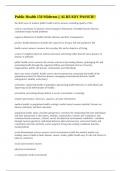
the third wave of modern public health correct answers extending quality of life
used to concentrate on disease control (negative dimension of health) because that has
constituted major health problems
negative dimension of health includes diseases and their consequences
positive health dimension includes the capacity for living a full and productive life
health correct answers resource for everyday life not he objective of living
a state of complete physical, mental and social well being rather than the mere absence of
disease or infirmity
public health correct answers the science and art of preventing disease, prolonging life and
promoting health through the organized efforts and informed choices of society,
organizations, public and private, communities and individuals
three core areas of public health correct answers protection: protecting the health of the
population (control of infectious disease, managing environmental hazards, health
emergencies, healthy work place)
promotion: improving health of population (promoting health behaviors in individuals and
improving social determinants of health)
prevention: preventing disease before it occurs (vaccination, screening)
requires governance, advocacy, capacity, accurate information
medical model vs population health/ ecologic model correct answers medical: focuses on
disease and injury and their outcomes
population health: takes a broader perspective; examines the relationship between individuals
and their interactions w their peers, families, communities, schools and workplaces; also
examines broad economic, cultural, social, and physical environment conditions - considers
biologic factors (genetics), individual behavior (diet and exercise), and social family and
community networks (schools, social support), living and working conditions (income,
transportation)
social determinants correct answers social environment (while the medical model says
leading cause of death is heart disease, cancer, stroke; public health says it's the risk factors ie
tobacco, nutrition)
social and economic factors
physical environment
a community's built environment
,3 core functions of public health correct answers assessment: the ability to conduct public
health surveillance to measure the health of the population; investigate health problems and
identify causes
policy development: the ability to inform leaders and the general population about health; to
develop policy solutions and mobilize support
assurance: the ability to ensure the health of the population by having a competent workforce
to enforce laws; tot have medical care available o all; to evaluate progress and part of a cycle
of quality improvement (plan, do, study, act)
10 essential public health services correct answers monitor health status to identify and solve
community health problems
diagnose and investigate health problems and health hazards in the community
inform, educate, and empower people about health issues
develop policies and plans that support individual and community health efforts
enforce laws and regulations that protect health and ensure safety
link people to needed personal health services and assure the provision of health care when
otherwise unavailable
assure a competent public and personal healthcare workforce
evaluate effectiveness, accessibility, and quality of personal and population based health
services
research for new insights and innovative solutions to health problems
10 essential again correct answers assessment:
monitor health
diagnose and investigate
policy development:
inform, educate, empower
mobilize community partnership
develop policies
assurance:
enforce laws
link to/ provide care
assure competent workforce
evaluate
all: research
, surveillance provides correct answers essential information for establishing public health
priorities, planning programs and services, allocating resources, developing public health
policies
Why do we do public health surveillance? correct answers we want to be able to detect
outbreaks quickly to prevent spread and contain the outbreak
detecting and responding to outbreaks and measuring patterns of illness within populations -
dramatic change over time
detection and control of disease outbreaks (communicable disease, other illness ie lead
poisoning, drug overdose)
identification of emerging health problems (new threats ie HIV, resurgence of old threats ie
TB, STDs)
health promotion and disease prevention (heart disease, cancer, smoking)
characterization of disease (person, place, time ie at risk groups, geographic distribution,
temporal trends, plausible modes of transmission/ causal factors, disease manifestations and
severity, identify research needs and facilitate this research)
quantification of population health and disease burden
to evaluate the quality of services and effectiveness of programs and policies
public health surveillance correct answers the ongoing systematic collection, analysis, and
interpretation of health data essential to the planning, implementation, and evaluation of
public health practice, closely integrated w the timely dissemination of these data to those
who need to know
closely linked to specific disease prevention and control measures, other public health
programs and activities, community health improvement efforts
crude death rate correct answers rate is different than a number; rate is a number divided by
he size of the population - you can compare two communities of different sizes with rates
the number of deaths occurring among the population of a given geographical area divided by
the population size of that area
What are the sources of data for surveillance? correct answers vital statistics (births and
deaths), reportable disease data (medical charts, labs), sentinel surveillance systems,
administrative data (hospital discharge data, pharmacy data), disease registries (birth defects,
cancer), surveys (LA County Health Survey, CA Health Interview Survey), census, other
(non health sectors, social media and big data)
What measures are used to determine whether the quality of data is appropriate for
surveillance purposes? correct answers timeliness, accuracy, completeness,
representativeness
the third wave of modern public health correct answers extending quality of life
used to concentrate on disease control (negative dimension of health) because that has
constituted major health problems
negative dimension of health includes diseases and their consequences
positive health dimension includes the capacity for living a full and productive life
health correct answers resource for everyday life not he objective of living
a state of complete physical, mental and social well being rather than the mere absence of
disease or infirmity
public health correct answers the science and art of preventing disease, prolonging life and
promoting health through the organized efforts and informed choices of society,
organizations, public and private, communities and individuals
three core areas of public health correct answers protection: protecting the health of the
population (control of infectious disease, managing environmental hazards, health
emergencies, healthy work place)
promotion: improving health of population (promoting health behaviors in individuals and
improving social determinants of health)
prevention: preventing disease before it occurs (vaccination, screening)
requires governance, advocacy, capacity, accurate information
medical model vs population health/ ecologic model correct answers medical: focuses on
disease and injury and their outcomes
population health: takes a broader perspective; examines the relationship between individuals
and their interactions w their peers, families, communities, schools and workplaces; also
examines broad economic, cultural, social, and physical environment conditions - considers
biologic factors (genetics), individual behavior (diet and exercise), and social family and
community networks (schools, social support), living and working conditions (income,
transportation)
social determinants correct answers social environment (while the medical model says
leading cause of death is heart disease, cancer, stroke; public health says it's the risk factors ie
tobacco, nutrition)
social and economic factors
physical environment
a community's built environment
,3 core functions of public health correct answers assessment: the ability to conduct public
health surveillance to measure the health of the population; investigate health problems and
identify causes
policy development: the ability to inform leaders and the general population about health; to
develop policy solutions and mobilize support
assurance: the ability to ensure the health of the population by having a competent workforce
to enforce laws; tot have medical care available o all; to evaluate progress and part of a cycle
of quality improvement (plan, do, study, act)
10 essential public health services correct answers monitor health status to identify and solve
community health problems
diagnose and investigate health problems and health hazards in the community
inform, educate, and empower people about health issues
develop policies and plans that support individual and community health efforts
enforce laws and regulations that protect health and ensure safety
link people to needed personal health services and assure the provision of health care when
otherwise unavailable
assure a competent public and personal healthcare workforce
evaluate effectiveness, accessibility, and quality of personal and population based health
services
research for new insights and innovative solutions to health problems
10 essential again correct answers assessment:
monitor health
diagnose and investigate
policy development:
inform, educate, empower
mobilize community partnership
develop policies
assurance:
enforce laws
link to/ provide care
assure competent workforce
evaluate
all: research
, surveillance provides correct answers essential information for establishing public health
priorities, planning programs and services, allocating resources, developing public health
policies
Why do we do public health surveillance? correct answers we want to be able to detect
outbreaks quickly to prevent spread and contain the outbreak
detecting and responding to outbreaks and measuring patterns of illness within populations -
dramatic change over time
detection and control of disease outbreaks (communicable disease, other illness ie lead
poisoning, drug overdose)
identification of emerging health problems (new threats ie HIV, resurgence of old threats ie
TB, STDs)
health promotion and disease prevention (heart disease, cancer, smoking)
characterization of disease (person, place, time ie at risk groups, geographic distribution,
temporal trends, plausible modes of transmission/ causal factors, disease manifestations and
severity, identify research needs and facilitate this research)
quantification of population health and disease burden
to evaluate the quality of services and effectiveness of programs and policies
public health surveillance correct answers the ongoing systematic collection, analysis, and
interpretation of health data essential to the planning, implementation, and evaluation of
public health practice, closely integrated w the timely dissemination of these data to those
who need to know
closely linked to specific disease prevention and control measures, other public health
programs and activities, community health improvement efforts
crude death rate correct answers rate is different than a number; rate is a number divided by
he size of the population - you can compare two communities of different sizes with rates
the number of deaths occurring among the population of a given geographical area divided by
the population size of that area
What are the sources of data for surveillance? correct answers vital statistics (births and
deaths), reportable disease data (medical charts, labs), sentinel surveillance systems,
administrative data (hospital discharge data, pharmacy data), disease registries (birth defects,
cancer), surveys (LA County Health Survey, CA Health Interview Survey), census, other
(non health sectors, social media and big data)
What measures are used to determine whether the quality of data is appropriate for
surveillance purposes? correct answers timeliness, accuracy, completeness,
representativeness