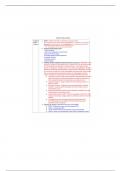
EXAM 3 Study Fall 2022
Evidence 1. PICOT - Patient, Intervention, Comparison, Outcome, Time.
Based Ex: In adult patients with total hip replacements (Population), how effective is pain medication
Practice (Intervention) compared to aerobic stretching (Comparison) in controlling postoperative pain
(Outcome) during the perioperative and recovery time (Time)?
● picot questions do not have to be in perfect order.
2. Evidence based practice steps -
1.Spirit of inquiry
2.ask a clinical question in picot format
3.search for best evidence
4.critically appraise evidence gathered
5.integrate evidence
6.evaluate outcome
7.share findings.
3. Research types (longitudinal, randomized control, survey, etc) Longitudinal- same
research on a group of same people over a long period of time, possibly decades.
RCT double blinded, randomized, 1 treatment group, 1 control group. Expert
opinion- possible bias, normally used for review articles and guidelines. Practice
guidelines- adopted by nonprofit agencies and government. Qualitative research (
non numerical, unspecific) includes ethnography, phenomenology, and grounded
theory, normally patients' perceptions, feelings, etc. Ethnography- study the
culture of people over long periods of time, normally researchers join study.
● exploratory research- Initial nonexperimental study designed to develop or
refine the dimensions of phenomena (facts or events) or to develop or
refine a hypothesis about the relationships among phenomena.
● evaluation research-. Study that tests how well a program, practice, or
policy is working.
● descriptive research-: Study that measures characteristics of people,
situations, or groups and the frequency with which certain events or
characteristics occur
● historical research:Descriptive research designed to establish facts and
relationships concerning past events.
● experimental research: Study in which the investigator controls the study
variable and randomly assigns subjects to different conditions to test the
variable.
● Correlational research: Nonexperimental study that explores the
interrelationships among variables of interest without any active
intervention by the researcher.
4. Hierarchy of research - starting from the top ( most reliable)
● LEVEL 1-systematic review and meta analysis (RCT),
● LEVEL 2-well designed RCT
● LEVEL 3-Control without randomization (quasi experimental)
● LEVEL 4- Single non experimental ( case control, correlational, cohort
, studies)
● LEVEL 5- systematic reviews of descriptive and qualitative studies
● Level 6- Single descriptive or qualitative studies
● Level 7- opinion of authorities and/or expert opinion.
5. Qualitative versus Qualitative -
➔ Qualitative ( grounded theory, phenomenology, ethnography) is non
specific, cannot be put into numerical format, non measurable, normally
perceptions of patients and their families.
➔ Quantitative ( experimental, nonexperimental, and survey)- specific,
statistics, numerical and measurable.
6. Informed consent- The “researcher” must get informed consent from the
participants before conducting the study.. The participant has the ability to quit
the study at any time, must have complete confidentiality, know the harms and
benefits, be able to fully understand the study, and must know methods and
purpose.
According to Potter: Informed consent means that research subjects (1) are given
full and complete information about the purpose of a study, procedures, data
collection, potential harm and benefits, and alternative methods of treatment; (2)
are capable of understanding the research and the implications of participation;
(3) have the power of free choice to voluntarily consent or decline participation in
the research; and (4) understand how the researcher maintains confidentiality or
anonymity.
7. Next step in evidence-based changes-
(ASK)- Identify clinical problem
(Attain)- review relevant literature
(Appraise) critically appraise the evidence
(Apply) evaluate the need for practice change and potential implementation,
(Assess) Evaluate outcomes.
8. Barriers of EBP- resistance to change, lack of time, lack of organizational support,
lack of ability to read research.
Approx 11 Questions
Nursing 1. Evaluating care (immobility/wound healing/falls)- Evaluating care for
Process immobility- skin breakdown, contractures, decreased peristalsis. Evaluate
patients' response to interventions.
2. Evaluating care for wound healing- Measure the wound and assess for
swelling, redness, and drainage., Evaluate wound for color, size, depth,
odor, location, drainage. Is there granulation tissue forming (healing)?,
pain? edges approximated? If the plan and interventions aren't working,
reassess and make a new plan.
3. Evaluating falls- are interventions implemented as planned? Is the care plan
effective? Are there enough mats, alarms, equipment, and are they
applied properly? Expected outcomes- patient will remain free of falls,
Evidence 1. PICOT - Patient, Intervention, Comparison, Outcome, Time.
Based Ex: In adult patients with total hip replacements (Population), how effective is pain medication
Practice (Intervention) compared to aerobic stretching (Comparison) in controlling postoperative pain
(Outcome) during the perioperative and recovery time (Time)?
● picot questions do not have to be in perfect order.
2. Evidence based practice steps -
1.Spirit of inquiry
2.ask a clinical question in picot format
3.search for best evidence
4.critically appraise evidence gathered
5.integrate evidence
6.evaluate outcome
7.share findings.
3. Research types (longitudinal, randomized control, survey, etc) Longitudinal- same
research on a group of same people over a long period of time, possibly decades.
RCT double blinded, randomized, 1 treatment group, 1 control group. Expert
opinion- possible bias, normally used for review articles and guidelines. Practice
guidelines- adopted by nonprofit agencies and government. Qualitative research (
non numerical, unspecific) includes ethnography, phenomenology, and grounded
theory, normally patients' perceptions, feelings, etc. Ethnography- study the
culture of people over long periods of time, normally researchers join study.
● exploratory research- Initial nonexperimental study designed to develop or
refine the dimensions of phenomena (facts or events) or to develop or
refine a hypothesis about the relationships among phenomena.
● evaluation research-. Study that tests how well a program, practice, or
policy is working.
● descriptive research-: Study that measures characteristics of people,
situations, or groups and the frequency with which certain events or
characteristics occur
● historical research:Descriptive research designed to establish facts and
relationships concerning past events.
● experimental research: Study in which the investigator controls the study
variable and randomly assigns subjects to different conditions to test the
variable.
● Correlational research: Nonexperimental study that explores the
interrelationships among variables of interest without any active
intervention by the researcher.
4. Hierarchy of research - starting from the top ( most reliable)
● LEVEL 1-systematic review and meta analysis (RCT),
● LEVEL 2-well designed RCT
● LEVEL 3-Control without randomization (quasi experimental)
● LEVEL 4- Single non experimental ( case control, correlational, cohort
, studies)
● LEVEL 5- systematic reviews of descriptive and qualitative studies
● Level 6- Single descriptive or qualitative studies
● Level 7- opinion of authorities and/or expert opinion.
5. Qualitative versus Qualitative -
➔ Qualitative ( grounded theory, phenomenology, ethnography) is non
specific, cannot be put into numerical format, non measurable, normally
perceptions of patients and their families.
➔ Quantitative ( experimental, nonexperimental, and survey)- specific,
statistics, numerical and measurable.
6. Informed consent- The “researcher” must get informed consent from the
participants before conducting the study.. The participant has the ability to quit
the study at any time, must have complete confidentiality, know the harms and
benefits, be able to fully understand the study, and must know methods and
purpose.
According to Potter: Informed consent means that research subjects (1) are given
full and complete information about the purpose of a study, procedures, data
collection, potential harm and benefits, and alternative methods of treatment; (2)
are capable of understanding the research and the implications of participation;
(3) have the power of free choice to voluntarily consent or decline participation in
the research; and (4) understand how the researcher maintains confidentiality or
anonymity.
7. Next step in evidence-based changes-
(ASK)- Identify clinical problem
(Attain)- review relevant literature
(Appraise) critically appraise the evidence
(Apply) evaluate the need for practice change and potential implementation,
(Assess) Evaluate outcomes.
8. Barriers of EBP- resistance to change, lack of time, lack of organizational support,
lack of ability to read research.
Approx 11 Questions
Nursing 1. Evaluating care (immobility/wound healing/falls)- Evaluating care for
Process immobility- skin breakdown, contractures, decreased peristalsis. Evaluate
patients' response to interventions.
2. Evaluating care for wound healing- Measure the wound and assess for
swelling, redness, and drainage., Evaluate wound for color, size, depth,
odor, location, drainage. Is there granulation tissue forming (healing)?,
pain? edges approximated? If the plan and interventions aren't working,
reassess and make a new plan.
3. Evaluating falls- are interventions implemented as planned? Is the care plan
effective? Are there enough mats, alarms, equipment, and are they
applied properly? Expected outcomes- patient will remain free of falls,