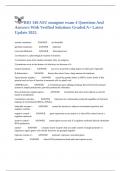
BIO 340 ASU mangone exam 4 Questions And
Answers With Verified Solutions Graded A+ Latest
Update 2025.
somatic mutations - ANSWER not heritable
germline mutations - ANSWER inherited
Luria and Delbruck - ANSWER Fluctuation test:
1) resistance is a physiological response to bacteria
2) resistance arises from random mutation only, not adaptive
3) mutations occur in the absence of selection, not because of it
neutral mutations - ANSWER can occur in protein coding region or other part of genome
B-thalassemia - ANSWER disease that arises from a large amount of mutations
Spinal muscle atrophy - ANSWER caused by genetic defect in SMN1; lower levels of this
protein result in loss of function in neuronal cells in spinal cord
CRISPR/Cas9 - ANSWER a revolutionary gene editing technique derived from the immune
system of simple prokaryotes; provides prokaryotic immunity
How prokaryotes regulate genes - ANSWER mechanism that turns transcription on and off
based on metabolism
Constitutive enzymes - ANSWER Enzymes are continuously produced regardless of chemical
makeup of environment (tRNAs, rRNAs)
Inducible enzymes - ANSWER created by bacteria to adapt to environment (positive and
negative control)
negative control - ANSWER gene expression occurs unless it is shut off by some form of a
regulator molecule
positive control - ANSWER transcription occurs only if a regulator molecule directly stimulates
RNA production
operon - ANSWER contains cluster of genes that are under control of single promoter or
regulatory signal; genes with similar functions are grouped together
Operons consist of - ANSWER promoter, repressor, structural genes
promoter - ANSWER where RNA polymerase binds and transcription occurs
Answers With Verified Solutions Graded A+ Latest
Update 2025.
somatic mutations - ANSWER not heritable
germline mutations - ANSWER inherited
Luria and Delbruck - ANSWER Fluctuation test:
1) resistance is a physiological response to bacteria
2) resistance arises from random mutation only, not adaptive
3) mutations occur in the absence of selection, not because of it
neutral mutations - ANSWER can occur in protein coding region or other part of genome
B-thalassemia - ANSWER disease that arises from a large amount of mutations
Spinal muscle atrophy - ANSWER caused by genetic defect in SMN1; lower levels of this
protein result in loss of function in neuronal cells in spinal cord
CRISPR/Cas9 - ANSWER a revolutionary gene editing technique derived from the immune
system of simple prokaryotes; provides prokaryotic immunity
How prokaryotes regulate genes - ANSWER mechanism that turns transcription on and off
based on metabolism
Constitutive enzymes - ANSWER Enzymes are continuously produced regardless of chemical
makeup of environment (tRNAs, rRNAs)
Inducible enzymes - ANSWER created by bacteria to adapt to environment (positive and
negative control)
negative control - ANSWER gene expression occurs unless it is shut off by some form of a
regulator molecule
positive control - ANSWER transcription occurs only if a regulator molecule directly stimulates
RNA production
operon - ANSWER contains cluster of genes that are under control of single promoter or
regulatory signal; genes with similar functions are grouped together
Operons consist of - ANSWER promoter, repressor, structural genes
promoter - ANSWER where RNA polymerase binds and transcription occurs