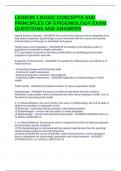
LESSON 1 BASIC CONCEPTS AND
PRINCIPLES OF EPIDEMIOLOGY EXAM
QUESTIONS AND ANSWERS
natural history of disease - ANSWER-The course of the disease from its beginning to its
final clinical endpoints. Epidemiology is also concerned with the course and outcome
(natural history) of diseases in individuals and groups
Health status of the population - ANSWER-Ø Knowledge of the disease burden in
populations is essential for health authorities
Ø To use limited resources to the best possible effect by identifying priority health
programs for prevention and care
Evaluation of interventions - ANSWER-To evaluate the effectiveness and efficiency of
health services
- Preventing Disease and Promoting health
- Community health assessment
- Improving diagnosis, treatment, and prognosis
- Evaluating health interventions - ANSWER-Applications of Epidemiology in Public
Health
Public Health - ANSWER-Ø Collective actions to improve population health
Epidemiology - ANSWER-the branch of medicine that deals with the incidence,
distribution, and possible control of diseases and other factors relating to health. One of
the tools for improving public health
1. In Clinical Medicine, the unit of study is the case. In Epidemiology, the unit of study is
defined as population or population at risk
Ø Physician - concerned with the disease in the individual patient
Ø Epidemiologist - concern with the pattern in entire population
Ø Epidemiology - concern with both Sick and Healthy - ANSWER-EPIDEMIOLOGY vs
CLINICAL MEDICINE #1
2. In Clinical Medicine, the physician seeks to diagnosis for which he derives prognosis
and prescribes specific treatment
Ø The Epidemiologist is confronted with the relevant data derived from the particular
epidemiological study (Community Diagnosis).
Ø seeks to identify the source of infection, mode of transmission, and an etiological
factor to determine the future trends, prevention and control measure - ANSWER-
EPIDEMIOLOGY vs CLINICAL MEDICINE #2
PRINCIPLES OF EPIDEMIOLOGY EXAM
QUESTIONS AND ANSWERS
natural history of disease - ANSWER-The course of the disease from its beginning to its
final clinical endpoints. Epidemiology is also concerned with the course and outcome
(natural history) of diseases in individuals and groups
Health status of the population - ANSWER-Ø Knowledge of the disease burden in
populations is essential for health authorities
Ø To use limited resources to the best possible effect by identifying priority health
programs for prevention and care
Evaluation of interventions - ANSWER-To evaluate the effectiveness and efficiency of
health services
- Preventing Disease and Promoting health
- Community health assessment
- Improving diagnosis, treatment, and prognosis
- Evaluating health interventions - ANSWER-Applications of Epidemiology in Public
Health
Public Health - ANSWER-Ø Collective actions to improve population health
Epidemiology - ANSWER-the branch of medicine that deals with the incidence,
distribution, and possible control of diseases and other factors relating to health. One of
the tools for improving public health
1. In Clinical Medicine, the unit of study is the case. In Epidemiology, the unit of study is
defined as population or population at risk
Ø Physician - concerned with the disease in the individual patient
Ø Epidemiologist - concern with the pattern in entire population
Ø Epidemiology - concern with both Sick and Healthy - ANSWER-EPIDEMIOLOGY vs
CLINICAL MEDICINE #1
2. In Clinical Medicine, the physician seeks to diagnosis for which he derives prognosis
and prescribes specific treatment
Ø The Epidemiologist is confronted with the relevant data derived from the particular
epidemiological study (Community Diagnosis).
Ø seeks to identify the source of infection, mode of transmission, and an etiological
factor to determine the future trends, prevention and control measure - ANSWER-
EPIDEMIOLOGY vs CLINICAL MEDICINE #2