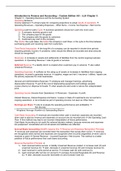
Introduction to Finance and Accounting – Custom Edition UU – LLH Chapter 4:
Chapter 4 – Adjustments, Financial Statements, and the Quality of Earnings
Presenting Financial Information internal management and external auditors of companies make
critical evaluations before the financial statements are distributed to external investors and creditors
correct amounts must be reported, timing and value must be estimated, accuracy of records have to
be ensured and the GAAPs must be evaluated statements are of high quality (free from error and
relevant) when the past can be analysed and the future can be predicted.
Accounting Cycle process followed by entities to analyse and record transactions, adjust the
records at the end of the period, prepare financial statements and prepare records for the upcoming
period journal entries in the general journal and T-accounts in the general ledger.
End-of-Period Steps focus on adjustments to record revenues and expenses in the proper period,
and updating balance sheet accounts for reporting purposes.
Entries must be adjusted when cash receipts and payments occur in different periods than the
activities which produce their revenues and expenses revenue and expense recognition principle,
assets are probable future benefits and liabilities are probable future sacrifices companies wait until
the end of an accounting period to adjust the accounts these adjusting entries are necessary to
measure income properly, correct errors and provide valuation of balance sheet accounts.
Definitions earned = good / service provided, recorded = cash has been paid or received.
1) Deferred (Unearned) Revenues = previously recorded liabilities that were created when cash
was received from customers in advance of being earned payments received in advance,
for goods / services which have not yet been performed or delivered.
2) Accrued Revenues = revenues that have been earned but not yet recorded because cash will
be received later, after the services have been performed.
3) Deferred Expenses = previously recorded assets that were created when cash was paid by
the company in advance of the asset being used.
4) Accrued Expenses = expenses that have been incurred but not yet recorded because cash
will be paid later, after the services have been used.
Guidelines / Steps
1) Was revenue earned or an expense incurred that is not yet recorded?
IF Yes: credit revenue or debit expense in the adjusting entry
2) Was the related cash received or paid in the past or will it be received or paid in the future?
- Cash received in past = Deferred Revenue liability account was recorded in the past
now, debit the Unearned Revenue liability account to decrease it and credit Revenue.
- Cash to be received in future = Accrued Revenue asset account will be recorded debit
the Receivable asset account and credit Revenue.
- Cash paid in past = Deferred (Prepaid) Expense asset account was recorded in past
now, credit the Prepaid asset account and debit Expense to increase it.
- Cash to be paid in future = Accrued Expense account will be recorded credit Payable
liability account and debit Expense account.
3) Calculate or estimate the amount of revenue (earned) or expense (incurred).
Recording adjusting entries has no effect on the Cash (asset) account.
Adjusted Account Balances are used for:
- Income Statements R – E = NI
- Statements of Stockholders’ Equity Beginning Balance of Common Stock and APIC +
Stock Issuances – Stock Repurchases = Ending Balance, and Beginning Balance
Retained Earnings + Net Income NI – Dividends DIV = Ending Balance
- Balance Sheets A = L + SE
Total Asset Turnover Ratio Operating Revenues / Average Total Assets this measures the sales
generated per dollar of assets when this ratio is rising, assets are managed more efficiently.
Chapter 4 – Adjustments, Financial Statements, and the Quality of Earnings
Presenting Financial Information internal management and external auditors of companies make
critical evaluations before the financial statements are distributed to external investors and creditors
correct amounts must be reported, timing and value must be estimated, accuracy of records have to
be ensured and the GAAPs must be evaluated statements are of high quality (free from error and
relevant) when the past can be analysed and the future can be predicted.
Accounting Cycle process followed by entities to analyse and record transactions, adjust the
records at the end of the period, prepare financial statements and prepare records for the upcoming
period journal entries in the general journal and T-accounts in the general ledger.
End-of-Period Steps focus on adjustments to record revenues and expenses in the proper period,
and updating balance sheet accounts for reporting purposes.
Entries must be adjusted when cash receipts and payments occur in different periods than the
activities which produce their revenues and expenses revenue and expense recognition principle,
assets are probable future benefits and liabilities are probable future sacrifices companies wait until
the end of an accounting period to adjust the accounts these adjusting entries are necessary to
measure income properly, correct errors and provide valuation of balance sheet accounts.
Definitions earned = good / service provided, recorded = cash has been paid or received.
1) Deferred (Unearned) Revenues = previously recorded liabilities that were created when cash
was received from customers in advance of being earned payments received in advance,
for goods / services which have not yet been performed or delivered.
2) Accrued Revenues = revenues that have been earned but not yet recorded because cash will
be received later, after the services have been performed.
3) Deferred Expenses = previously recorded assets that were created when cash was paid by
the company in advance of the asset being used.
4) Accrued Expenses = expenses that have been incurred but not yet recorded because cash
will be paid later, after the services have been used.
Guidelines / Steps
1) Was revenue earned or an expense incurred that is not yet recorded?
IF Yes: credit revenue or debit expense in the adjusting entry
2) Was the related cash received or paid in the past or will it be received or paid in the future?
- Cash received in past = Deferred Revenue liability account was recorded in the past
now, debit the Unearned Revenue liability account to decrease it and credit Revenue.
- Cash to be received in future = Accrued Revenue asset account will be recorded debit
the Receivable asset account and credit Revenue.
- Cash paid in past = Deferred (Prepaid) Expense asset account was recorded in past
now, credit the Prepaid asset account and debit Expense to increase it.
- Cash to be paid in future = Accrued Expense account will be recorded credit Payable
liability account and debit Expense account.
3) Calculate or estimate the amount of revenue (earned) or expense (incurred).
Recording adjusting entries has no effect on the Cash (asset) account.
Adjusted Account Balances are used for:
- Income Statements R – E = NI
- Statements of Stockholders’ Equity Beginning Balance of Common Stock and APIC +
Stock Issuances – Stock Repurchases = Ending Balance, and Beginning Balance
Retained Earnings + Net Income NI – Dividends DIV = Ending Balance
- Balance Sheets A = L + SE
Total Asset Turnover Ratio Operating Revenues / Average Total Assets this measures the sales
generated per dollar of assets when this ratio is rising, assets are managed more efficiently.