RST2603 NEW RELIGIOUS MOVEMENTS
ASSIGNMENT 07
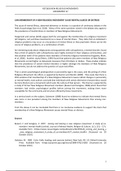
CAN MEMBERSHIP OF A NEW RELIGIOUS MOVEMENT CAUSE MENTAL ILLNESS OR DISTRESS
The cause of mental illness, abnormal behaviour or distress is a question of continuous debate in the
field of psychology (Sue et al, 2014). Many of the same questions raised in the debate also apply to
the prevalence of mental illness in members of New Religious Movements.
Pargament and Lomax (2013) argues both for and against the membership of a religious movement
(all religions, not just New movements) as a cause of mental illness. They state that an individual’s
religious problems may occur as a by-product of mental illness or that psychiatric illness can be the
source of religious problems, or a combination of both.
An interesting study about religiousness among patients with schizophrenia, a mental disorder, found
that a third of patients with schizophrenia were highly involved in their religious communities, and
that another tenth of the patients were members of minority religious movements (Huguelet, Mohr,
et al, 2006). Another study (Peters, 1999) found that patients who were members of New Religious
Movements scored higher on delusional measures than Christians or Hindus. These studies indicate
that the prevalence of certain mental disorders is higher amongst the members of New Religious
Movements, but do not address the question of cause and effect.
That a certain psychological predisposition or personality type is the cause, and the joining of a New
Religious Movement the effect, is supported by Namini and Murkin (2009). They state that there is
little evidence that membership of a New Religious Movement causes radical changes in personality
or mental health, most authors conclude that individuals with certain distinctive characteristics would
be more likely to join a movement which suits the culture of that person. This theory is supported by
a study of former New Religious Movement members (Buxant and Saroglou, 2008) which found that
members had similar psychological profiles before joining the movement, making them more
susceptible for the community and structure offered by these movements.
In a seminal work on the subject, Galantner (1989) found no evidence to indicate that mental illness
was more or less prevalent among the members of New Religious Movements than among non-
members.
From the above it can be concluded that there is no conclusive evidence to support the claim that
membership of a New Religious Movement causes mental illness or distress.
Sources
Buxant, C and Saroglou, V. 2007. Joining and leaving a new religious movement: A study of ex-
members' mental health [online]. Journal of Mental Health, Religion & Culture, 11:3, 251 – 271.
Available from: <https://www.researchgate.net/publication/242559126_Joining_and_leaving_a
_new_religious_movement_A_study_of_ex-members%27_mental_health> [Accessed on: 20
October 2019].
Galanter, M. 1989. Cults: Faith, healing, and coercion [online]. New York, NY, US: Oxford University
Press. Available from: <https://psycnet.apa.org/record/1989-97621-000> [Accessed on: 20
October 2019]
1
ASSIGNMENT 07
CAN MEMBERSHIP OF A NEW RELIGIOUS MOVEMENT CAUSE MENTAL ILLNESS OR DISTRESS
The cause of mental illness, abnormal behaviour or distress is a question of continuous debate in the
field of psychology (Sue et al, 2014). Many of the same questions raised in the debate also apply to
the prevalence of mental illness in members of New Religious Movements.
Pargament and Lomax (2013) argues both for and against the membership of a religious movement
(all religions, not just New movements) as a cause of mental illness. They state that an individual’s
religious problems may occur as a by-product of mental illness or that psychiatric illness can be the
source of religious problems, or a combination of both.
An interesting study about religiousness among patients with schizophrenia, a mental disorder, found
that a third of patients with schizophrenia were highly involved in their religious communities, and
that another tenth of the patients were members of minority religious movements (Huguelet, Mohr,
et al, 2006). Another study (Peters, 1999) found that patients who were members of New Religious
Movements scored higher on delusional measures than Christians or Hindus. These studies indicate
that the prevalence of certain mental disorders is higher amongst the members of New Religious
Movements, but do not address the question of cause and effect.
That a certain psychological predisposition or personality type is the cause, and the joining of a New
Religious Movement the effect, is supported by Namini and Murkin (2009). They state that there is
little evidence that membership of a New Religious Movement causes radical changes in personality
or mental health, most authors conclude that individuals with certain distinctive characteristics would
be more likely to join a movement which suits the culture of that person. This theory is supported by
a study of former New Religious Movement members (Buxant and Saroglou, 2008) which found that
members had similar psychological profiles before joining the movement, making them more
susceptible for the community and structure offered by these movements.
In a seminal work on the subject, Galantner (1989) found no evidence to indicate that mental illness
was more or less prevalent among the members of New Religious Movements than among non-
members.
From the above it can be concluded that there is no conclusive evidence to support the claim that
membership of a New Religious Movement causes mental illness or distress.
Sources
Buxant, C and Saroglou, V. 2007. Joining and leaving a new religious movement: A study of ex-
members' mental health [online]. Journal of Mental Health, Religion & Culture, 11:3, 251 – 271.
Available from: <https://www.researchgate.net/publication/242559126_Joining_and_leaving_a
_new_religious_movement_A_study_of_ex-members%27_mental_health> [Accessed on: 20
October 2019].
Galanter, M. 1989. Cults: Faith, healing, and coercion [online]. New York, NY, US: Oxford University
Press. Available from: <https://psycnet.apa.org/record/1989-97621-000> [Accessed on: 20
October 2019]
1