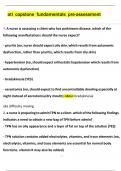
ati capstone fundamentals pre-assessment
1. A nurse is assessing a client who has parkinsons disease. which of the
following manifestations should the nurse expect?
- pruritis (no, nurse should expect oily skin, which results from autonomic
dysfunction, rather than pruritis, which results from dry skin)
- hypertension (no, should expect orthostatic hypotension which results from
autonomic dysfunction)
- bradykinesia (YES)
- xerostomia (no, should expect to find uncontrollable drooling especially at
night instead of xerostomia/dry mouth) <Ans> bradykinesia
aka difficulty moving
2. a nurse is preparing to adminTPN to a client. which of the following findings
indicates a need to obtain a new bag of TPN before admin?
- TPN has an oily appearance and a layer of fat on top of the solution (YES)
- TPN solution contains added electrolytes, vitamins, and trace elements (no,
electrolytes, vitamins, and trace elements are essential for normal body
functions. vitamin K may also be added)
,- bag of TPN was prepared by the pharmacy 12 hours prior (no, to prevent
interruption of therapy the next bag SHOULD be available prior to previous
bags completion)
- bag of TPN is labeled with the pt's name, medical record number & prescrip-
tion (no, this should be done) <Ans> TPN has an oily appearance and a layer of
fat on top of the solution
Before admin, nurse should look for "cracking" of TPN solution. this occurs if the
calcium or phosphorus content is high or if poor-salt albumin is added. A
"cracked" TPN solution has an oily appearance or a layer of fat on top of the
solution and should not be used
3. a nurse is caring for a client who is admitted for observation and has full
ROM. Which is the best manner to encourage the client to void?
- urinal
- bedpan
, - bedside commode
- client bathroom <Ans> client bathroom
4. a nurse is reviewing psychosocial stages of development for a school-age
child. What would be an expected behavioral finding for this child?
- personalize values and beliefs and base reasoning on ethical fairness prin-
ciples. Establish close relationships. Have influences that help with formation
of healthy self-concept, such as family & friends (no, this is young adults 20-35
years)
- develop sense of personal identity that family expectations influence. peer
relationships develop as support system. concerned with body images that
media portray (no, this is adolescents 12-20 years)
- develop sense of industry through advances in learning. strive to develop
healthy self-respect by finding out in what areas they excel. peer groups play
important role in social development (YES)
- take on new experiences and when unable to accomplish task may feel guilty
or misbehave. generally dont exhibit stranger anxiety. understood behavior
in terms of what is socially acceptable. (no, this is pre-schoolers 3-6 years)-
1. A nurse is assessing a client who has parkinsons disease. which of the
following manifestations should the nurse expect?
- pruritis (no, nurse should expect oily skin, which results from autonomic
dysfunction, rather than pruritis, which results from dry skin)
- hypertension (no, should expect orthostatic hypotension which results from
autonomic dysfunction)
- bradykinesia (YES)
- xerostomia (no, should expect to find uncontrollable drooling especially at
night instead of xerostomia/dry mouth) <Ans> bradykinesia
aka difficulty moving
2. a nurse is preparing to adminTPN to a client. which of the following findings
indicates a need to obtain a new bag of TPN before admin?
- TPN has an oily appearance and a layer of fat on top of the solution (YES)
- TPN solution contains added electrolytes, vitamins, and trace elements (no,
electrolytes, vitamins, and trace elements are essential for normal body
functions. vitamin K may also be added)
,- bag of TPN was prepared by the pharmacy 12 hours prior (no, to prevent
interruption of therapy the next bag SHOULD be available prior to previous
bags completion)
- bag of TPN is labeled with the pt's name, medical record number & prescrip-
tion (no, this should be done) <Ans> TPN has an oily appearance and a layer of
fat on top of the solution
Before admin, nurse should look for "cracking" of TPN solution. this occurs if the
calcium or phosphorus content is high or if poor-salt albumin is added. A
"cracked" TPN solution has an oily appearance or a layer of fat on top of the
solution and should not be used
3. a nurse is caring for a client who is admitted for observation and has full
ROM. Which is the best manner to encourage the client to void?
- urinal
- bedpan
, - bedside commode
- client bathroom <Ans> client bathroom
4. a nurse is reviewing psychosocial stages of development for a school-age
child. What would be an expected behavioral finding for this child?
- personalize values and beliefs and base reasoning on ethical fairness prin-
ciples. Establish close relationships. Have influences that help with formation
of healthy self-concept, such as family & friends (no, this is young adults 20-35
years)
- develop sense of personal identity that family expectations influence. peer
relationships develop as support system. concerned with body images that
media portray (no, this is adolescents 12-20 years)
- develop sense of industry through advances in learning. strive to develop
healthy self-respect by finding out in what areas they excel. peer groups play
important role in social development (YES)
- take on new experiences and when unable to accomplish task may feel guilty
or misbehave. generally dont exhibit stranger anxiety. understood behavior
in terms of what is socially acceptable. (no, this is pre-schoolers 3-6 years)-