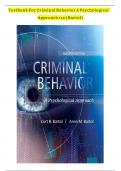
TEST BANK FOR CRIMINAL BEHAVIOR: Table of contents
A PSYCHOLOGICAL APPROACH 12TH EDITION (BARTOL) 1. Introduction to Criminal Behavior
CHAPTERS 1 - 16, COMPLETE 2. Origins of Criminal Behavior: Developmental Risk and Protective Factors
3. Origins of Criminal Behavior: Biological/Neurological Factors
4. Origins of Criminal Behavior: Learning and Situational Factors
5. Human Aggression and Violence
6. Juvenile Delinquency
7. Psychopathy
8. Crime and Mental Disorders
9. Homicide, Assault, and Intimate Partner and Family Violence
10. Multiple Murder, School, and Workplace Violence
11. Psychology of Modern Terrorism
12. Sexual Assault
13. Sexual Assault of Children and Youth
14. Burglary, Home Invasions, Thefts, and "White-Collar" Offenses
15. Violent Economic Crime, Cybercrime, and Crimes of Intimidation
16. Substance Abuse and Crime
110 111
, behaviorLevel: Difficult
Criminal Behavior: A Psychological Approach, 12e (Bartol) 4) All of the following are consistent with the developmental approach to the
study of crimeexcept
A) examining factors that place a child at risk of engaging in serious delinquency.
B) identifying the age of onset of antisocial behavior.
Chapter 1 Introduction to Criminal Behavior
C) searching for protective factors in a child's life.
1.1 Multiple-Choice Questions
1) Criminal behavior is best defined as
A) antisocial behavior.
B) deviant behavior.
C) an intentional act in violation of a criminal code.
D) a failure to impede the criminal
process.ANSWER: C
Page Ref: 2
Objective: Define criminal behavior and juvenile
delinquencyLevel: Basic
2) The end result of a theory that is not verified is
A) justification.
B) falsification.
C) clarification.
D) subjugatio
n.ANSWER: B
Page Ref: 6
Objective: Identify the different perspectives of human nature that underlie the
theoreticaldevelopment and research of criminal behavior
Level: Intermediate
3) Which piece of data would be included in the UCR?
A) A reported robbery with no arrest
B) A reported forgery with no arrest
C) A reported simple assault with no arrest
D) A reported statutory rape with no
arrestANSWER: A
Page Ref: 36
Objective: Introduce the reader to the various measurements of criminal and delinquent
112 113
,D) obtaining a child's IQ score as he or she enters Page Ref: 13
adolescence.ANSWER: D Objective: Point out that the study of criminal behavior and delinquency, from a
Page Ref: 13 psychologicalperspective, has shifted from a personality toward a more cognitive and
Objective: Point out that the study of criminal behavior and delinquency, from a developmental focus Level: Difficult
psychologicalperspective, has shifted from a personality toward a more cognitive and
developmental focus Level: Intermediate 8) Sara is a 23-year-old, single, college graduate who has just moved into her first
apartment.She is working as a barista at the local coffee house while she
5) According to the authors, our inability to prevent crime is largely due to the considers her career options. Which term best describes Sara's current life stage?
A) declining interest in the field of criminology.
B) lack of available research funding.
C) complexity of the issue.
D) difficulty in defining relevant
terms.ANSWER: C
Page Ref: 3
Objective: Define criminal behavior and juvenile
delinquencyLevel: Intermediate
6) After hearing that her neighbors' home was burglarized, Dee told her co-worker
that her neighbors were asking for the burglary because they never locked their
doors and didn't have asecurity system. Dee's statements reflect the
A) fairness doctrine.
B) self-fulfilling prophecy.
C) cognition distortion.
D) just-world
hypothesis. ANSWER:
D
Page Ref: 5
Objective: Identify the different perspectives of human nature that underlie the
theoreticaldevelopment and research of criminal behavior
Level: Difficult
7) Dr. Brown is a developmental criminologist. Dr. Brown's research most likely
examines
A) demographic features of offenders who participate in burglary.
B) how violent individuals learn their aggressive behavior.
C) the unequal power distribution among members of society.
D) when robberies most frequently
occur.ANSWER: B
114 115
, A) Adolescent-limited D) Crime occurs when one's level of stress outweighs one's coping
B) Emerging adulthood mechanisms.ANSWER: A
C) Life-course persistent Page Ref: 10
D) Social Objective: Introduce various theories that may help explain
control crimeLevel: Intermediate
ANSWER: B
Page Ref: 13
Objective: Point out that the study of criminal behavior and delinquency, from a
psychologicalperspective, has shifted from a personality toward a more cognitive and
developmental focus Level: Difficult
9) Positivist theory is to as classical theory is to .
A) determinism; free will
B) jurisprudence; behavior
C) cognitions; biology
D) predictability; social
normsANSWER: A
Page Ref: 8
Objective: Introduce various theories that may help explain
crimeLevel: Intermediate
10) Which perspective on crime is most closely linked with the humanistic perspective?
A) Conformity
B) Strain
C) Learning
D) Determinis
mANSWER:
A Page Ref: 9
Objective: Introduce various theories that may help explain
crimeLevel: Intermediate
11) Which statement reflects the basic premise of strain theory?
A) Crime occurs when there is a discrepancy between the materialistic values
and goals cherished in our society and the availability of legitimate means for
reaching these goals.
B) Crime occurs when a society's values are too materialistic.
C) Crime occurs when society places too much value and emphasis on doing the
right thing forthe highest number of individuals.
116 117
A PSYCHOLOGICAL APPROACH 12TH EDITION (BARTOL) 1. Introduction to Criminal Behavior
CHAPTERS 1 - 16, COMPLETE 2. Origins of Criminal Behavior: Developmental Risk and Protective Factors
3. Origins of Criminal Behavior: Biological/Neurological Factors
4. Origins of Criminal Behavior: Learning and Situational Factors
5. Human Aggression and Violence
6. Juvenile Delinquency
7. Psychopathy
8. Crime and Mental Disorders
9. Homicide, Assault, and Intimate Partner and Family Violence
10. Multiple Murder, School, and Workplace Violence
11. Psychology of Modern Terrorism
12. Sexual Assault
13. Sexual Assault of Children and Youth
14. Burglary, Home Invasions, Thefts, and "White-Collar" Offenses
15. Violent Economic Crime, Cybercrime, and Crimes of Intimidation
16. Substance Abuse and Crime
110 111
, behaviorLevel: Difficult
Criminal Behavior: A Psychological Approach, 12e (Bartol) 4) All of the following are consistent with the developmental approach to the
study of crimeexcept
A) examining factors that place a child at risk of engaging in serious delinquency.
B) identifying the age of onset of antisocial behavior.
Chapter 1 Introduction to Criminal Behavior
C) searching for protective factors in a child's life.
1.1 Multiple-Choice Questions
1) Criminal behavior is best defined as
A) antisocial behavior.
B) deviant behavior.
C) an intentional act in violation of a criminal code.
D) a failure to impede the criminal
process.ANSWER: C
Page Ref: 2
Objective: Define criminal behavior and juvenile
delinquencyLevel: Basic
2) The end result of a theory that is not verified is
A) justification.
B) falsification.
C) clarification.
D) subjugatio
n.ANSWER: B
Page Ref: 6
Objective: Identify the different perspectives of human nature that underlie the
theoreticaldevelopment and research of criminal behavior
Level: Intermediate
3) Which piece of data would be included in the UCR?
A) A reported robbery with no arrest
B) A reported forgery with no arrest
C) A reported simple assault with no arrest
D) A reported statutory rape with no
arrestANSWER: A
Page Ref: 36
Objective: Introduce the reader to the various measurements of criminal and delinquent
112 113
,D) obtaining a child's IQ score as he or she enters Page Ref: 13
adolescence.ANSWER: D Objective: Point out that the study of criminal behavior and delinquency, from a
Page Ref: 13 psychologicalperspective, has shifted from a personality toward a more cognitive and
Objective: Point out that the study of criminal behavior and delinquency, from a developmental focus Level: Difficult
psychologicalperspective, has shifted from a personality toward a more cognitive and
developmental focus Level: Intermediate 8) Sara is a 23-year-old, single, college graduate who has just moved into her first
apartment.She is working as a barista at the local coffee house while she
5) According to the authors, our inability to prevent crime is largely due to the considers her career options. Which term best describes Sara's current life stage?
A) declining interest in the field of criminology.
B) lack of available research funding.
C) complexity of the issue.
D) difficulty in defining relevant
terms.ANSWER: C
Page Ref: 3
Objective: Define criminal behavior and juvenile
delinquencyLevel: Intermediate
6) After hearing that her neighbors' home was burglarized, Dee told her co-worker
that her neighbors were asking for the burglary because they never locked their
doors and didn't have asecurity system. Dee's statements reflect the
A) fairness doctrine.
B) self-fulfilling prophecy.
C) cognition distortion.
D) just-world
hypothesis. ANSWER:
D
Page Ref: 5
Objective: Identify the different perspectives of human nature that underlie the
theoreticaldevelopment and research of criminal behavior
Level: Difficult
7) Dr. Brown is a developmental criminologist. Dr. Brown's research most likely
examines
A) demographic features of offenders who participate in burglary.
B) how violent individuals learn their aggressive behavior.
C) the unequal power distribution among members of society.
D) when robberies most frequently
occur.ANSWER: B
114 115
, A) Adolescent-limited D) Crime occurs when one's level of stress outweighs one's coping
B) Emerging adulthood mechanisms.ANSWER: A
C) Life-course persistent Page Ref: 10
D) Social Objective: Introduce various theories that may help explain
control crimeLevel: Intermediate
ANSWER: B
Page Ref: 13
Objective: Point out that the study of criminal behavior and delinquency, from a
psychologicalperspective, has shifted from a personality toward a more cognitive and
developmental focus Level: Difficult
9) Positivist theory is to as classical theory is to .
A) determinism; free will
B) jurisprudence; behavior
C) cognitions; biology
D) predictability; social
normsANSWER: A
Page Ref: 8
Objective: Introduce various theories that may help explain
crimeLevel: Intermediate
10) Which perspective on crime is most closely linked with the humanistic perspective?
A) Conformity
B) Strain
C) Learning
D) Determinis
mANSWER:
A Page Ref: 9
Objective: Introduce various theories that may help explain
crimeLevel: Intermediate
11) Which statement reflects the basic premise of strain theory?
A) Crime occurs when there is a discrepancy between the materialistic values
and goals cherished in our society and the availability of legitimate means for
reaching these goals.
B) Crime occurs when a society's values are too materialistic.
C) Crime occurs when society places too much value and emphasis on doing the
right thing forthe highest number of individuals.
116 117