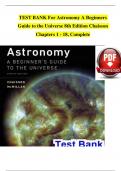
TEST BANK For Astronomy A Beginners
Guide to the Universe 8th Edition Chaisson
Chapters 1 - 18, Complete
,Table of Contents
0. Charting the Heavens: The Foundations of Astronomy
1. The Copernican Revolution: The Birth of Modern Science
2. Light and Matter: The Inner Workings of the Cosmos
3. Telescopes: The Tools of Astronomy
4. The Solar System: Interplanetary Matter and the Birth of the Planets
5. Earth and Its Moon: Our Cosmic Backyard
6. The Terrestrial Planets: A Study in Contrasts
7. The Jovian Planets: Giants of the Solar System
8. Moons, Rings, and Plutoids: Small Worlds Among Giants
9. The Sun: Our Parent Star
10. Measuring the Stars: Giants, Dwarfs, and the Main Sequence
11. The Interstellar Medium: Star Formation in the Milky Way
12. Stellar Evolution: The Lives and Deaths of Stars
13. Neutron Stars and Black Holes: Strange States of Matter
14. The Milky Way Galaxy: A Spiral in Space
15. Normal and Active Galaxies: Building Blocks of the Universe
16. Hubble’s Law and Dark Matter: The Large-Scale Structure of the Cosmos
17. Cosmology: The Big Bang and the Fate of the Universe
18. Life in the Universe: Are We Alone?
,Chapter 0 Charting the Heavens: The Foundations of Astronomy
1) Right ascension in the sky is very similar to latitude on the Earth.
ANSWER: FALSE
Diff: 1
Section Ref.: 0.1
2) Latitude and right ascension are coordinate systems used to find objects on the celestial
sphere.
ANSWER: FALSE
Diff: 1
Section Ref.: 0.1
3) The celestial sphere is divided into 88 modern constellations.
ANSWER: TRUE
Diff: 1
Section Ref.: 0.1
4) In the sky, declination is measured in degrees north or south of the celestial equator.
ANSWER: TRUE
Diff: 1
Section Ref.: 0.1
5) The south celestial pole is located at a declination of -90 degrees.
ANSWER: TRUE
Diff: 1
Section Ref.: 0.1
6) In general, the brightest star in a given constellation is designated as alpha.
ANSWER: TRUE
Diff: 1
Section Ref.: 0.1
7) Constellations are close clusters of stars, all at about the same distance from the Sun.
ANSWER: FALSE
Diff: 1
Section Ref.: 0.1
, 8) Over 20,000 stars are visible to the naked eye on the darkest, clearest nights.
ANSWER: FALSE
Diff: 2
Section Ref.: 0.1
9) A star with a right ascension of 2.6 hrs will rise 2.6 hours after the vernal equinox.
ANSWER: TRUE
Diff: 3
Section Ref.: More Prec. 0.1
10) A tropical year is the same as a sidereal year.
ANSWER: FALSE
Diff: 1
Section Ref.: 0.2
11) The sidereal day is determined by the Earth's rotation with respect to the stars.
ANSWER: TRUE
Diff: 1
Section Ref.: 0.2
12) The vernal equinox marks the beginning of spring in the northern hemisphere.
ANSWER: TRUE
Diff: 1
Section Ref.: 0.2
13) There are 3,600 arc seconds in a degree.
ANSWER: TRUE
Diff: 2
Section Ref.: More Prec. 0.1
14) An hour of right ascension corresponds to 60 degrees in the sky.
ANSWER: FALSE
Diff: 2
Section Ref.: 0.2
15) From Earth, the Sun and Moon have about the same angular diameter.
ANSWER: TRUE
Diff: 1
Section Ref.: 0.2
16) At the solstices, the Sun's declination will be 23.5 degrees from the equator.
ANSWER: TRUE
Diff: 2
Section Ref.: 0.2
Guide to the Universe 8th Edition Chaisson
Chapters 1 - 18, Complete
,Table of Contents
0. Charting the Heavens: The Foundations of Astronomy
1. The Copernican Revolution: The Birth of Modern Science
2. Light and Matter: The Inner Workings of the Cosmos
3. Telescopes: The Tools of Astronomy
4. The Solar System: Interplanetary Matter and the Birth of the Planets
5. Earth and Its Moon: Our Cosmic Backyard
6. The Terrestrial Planets: A Study in Contrasts
7. The Jovian Planets: Giants of the Solar System
8. Moons, Rings, and Plutoids: Small Worlds Among Giants
9. The Sun: Our Parent Star
10. Measuring the Stars: Giants, Dwarfs, and the Main Sequence
11. The Interstellar Medium: Star Formation in the Milky Way
12. Stellar Evolution: The Lives and Deaths of Stars
13. Neutron Stars and Black Holes: Strange States of Matter
14. The Milky Way Galaxy: A Spiral in Space
15. Normal and Active Galaxies: Building Blocks of the Universe
16. Hubble’s Law and Dark Matter: The Large-Scale Structure of the Cosmos
17. Cosmology: The Big Bang and the Fate of the Universe
18. Life in the Universe: Are We Alone?
,Chapter 0 Charting the Heavens: The Foundations of Astronomy
1) Right ascension in the sky is very similar to latitude on the Earth.
ANSWER: FALSE
Diff: 1
Section Ref.: 0.1
2) Latitude and right ascension are coordinate systems used to find objects on the celestial
sphere.
ANSWER: FALSE
Diff: 1
Section Ref.: 0.1
3) The celestial sphere is divided into 88 modern constellations.
ANSWER: TRUE
Diff: 1
Section Ref.: 0.1
4) In the sky, declination is measured in degrees north or south of the celestial equator.
ANSWER: TRUE
Diff: 1
Section Ref.: 0.1
5) The south celestial pole is located at a declination of -90 degrees.
ANSWER: TRUE
Diff: 1
Section Ref.: 0.1
6) In general, the brightest star in a given constellation is designated as alpha.
ANSWER: TRUE
Diff: 1
Section Ref.: 0.1
7) Constellations are close clusters of stars, all at about the same distance from the Sun.
ANSWER: FALSE
Diff: 1
Section Ref.: 0.1
, 8) Over 20,000 stars are visible to the naked eye on the darkest, clearest nights.
ANSWER: FALSE
Diff: 2
Section Ref.: 0.1
9) A star with a right ascension of 2.6 hrs will rise 2.6 hours after the vernal equinox.
ANSWER: TRUE
Diff: 3
Section Ref.: More Prec. 0.1
10) A tropical year is the same as a sidereal year.
ANSWER: FALSE
Diff: 1
Section Ref.: 0.2
11) The sidereal day is determined by the Earth's rotation with respect to the stars.
ANSWER: TRUE
Diff: 1
Section Ref.: 0.2
12) The vernal equinox marks the beginning of spring in the northern hemisphere.
ANSWER: TRUE
Diff: 1
Section Ref.: 0.2
13) There are 3,600 arc seconds in a degree.
ANSWER: TRUE
Diff: 2
Section Ref.: More Prec. 0.1
14) An hour of right ascension corresponds to 60 degrees in the sky.
ANSWER: FALSE
Diff: 2
Section Ref.: 0.2
15) From Earth, the Sun and Moon have about the same angular diameter.
ANSWER: TRUE
Diff: 1
Section Ref.: 0.2
16) At the solstices, the Sun's declination will be 23.5 degrees from the equator.
ANSWER: TRUE
Diff: 2
Section Ref.: 0.2