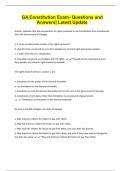
GA Constitution Exam- Questions and
Answers| Latest Update
Article I indicates that the enumeration of rights protected in the Constitution from interference
from the Government of Georgia
a. is to be considered the totality of the rights protected.
b. should not be construed so as to deny people any inherent right previously enjoyed..
c. is taken from the U.S. Constitution.
d. should be construed as privileges and not rights. *should not be construed so as to
deny people any inherent right previously enjoyed.
The rights listed in Article I, section 1, are
a. limitations on the power of the General Assembly
b. not limitations on the General Assembly
c. limitations on only the General Assembly, but not the rest of the government of Georgia
d. statements of principles rather than limitations on any branch of government.
*limitations on the power of the General Assembly
As seen in the Bill of Rights, the State of Georgia
a. May imprison citizens for failure to pay their debts.
b. May not imprison citizens for failure to pay their debts.
c. May imprison citizens for failure to pay their debts, but only after due process.
d. May imprison citizens for failure to pay their debts, but only if they have lived in Georgia for
less than ten years. *May not imprison citizens for failure to pay their debts.
,As seen in the Bill of Rights, the State of Georgia
a. May not directly or indirectly provide money in aid of religious institutions.
b. May provide money indirectly in aid of religion.
c. Is encouraged to provide money in aid of religious institutions..
d. May provide money for Christian institutions, but not for the institutions of other faiths.
*May not directly or indirectly provide money in aid of religious institutions.
According to the Bill of Rights, the judiciary of the State
a. may not declare legislative acts of the State to be violations of the Georgia Constitution.
b. may not declare legislative acts of the State to be violations of the U.S. Constitution.
c. must declare legislative acts of the State in violation of the Georgia Constitution or of the U.S.
Constitution to be
unconstitutional and therefore void.
d. may find a legislative act of the State to be unconstitutional and therefore void, but only if the
act violates both the Georgia and U.S. Constitutions. *must declare legislative acts of the
State in violation of the Georgia Constitution or of the U.S. Constitution to be
unconstitutional and therefore void.
According to Article III, Section VI what limits exists on the power of the General Assembly in
making laws?
a. Law may not be repugnant to the Georgia Constitution.
b. Laws may not violate either the Georgia Constitution or the U.S. Constitution.
c. The State may only exercise specifically enumerated powers.
d. The State may exercise only those powers specifically delegated by the U.S. Constitution to
the states. *Laws may not violate either the Georgia Constitution or the U.S.
Constitution.
,According to Article III, Section VI, which of the following is a specific limitation on the power of
the General Assembly?
a. It may not enact a special law relating to the rights or status of private persons.
b. It may not enact population bills (those that use classification by population to determine the
applicability of law) affecting local governments.
c. It may not grant gratuities, except as otherwise provided in the Constitution.
d. All of the above choices are correct.
e. None of the above choices is correct. *All of the above choices are correct.
The power to issue injunctions is
a. available to all courts in Georgia
b. limited to the Superior Courts
c. limited to the appellate courts
d. limited to the appellate courts and the Superior Courts *limited to the appellate courts
and the Superior Courts
Article VII, Section III, of the Constitution requires that, except as otherwise provided in the
Constitution
a. all revenue collected from taxes, fees, and assessments for state purposes be paid into the
general fund of the state treasury.
b. all revenue collected from taxes, fees and assessments for state purposes must be paid into
any funds chosen by the General Assembly.
c. all revenue collected from taxes, fees and assessments for state purposes must be paid into
funds designated by the state treasurer.
, d. all revenue collected from taxes, fees and assessments for state purposes must be paid into
funds designated by the governor. *all revenue collected from taxes, fees, and
assessments for state purposes be paid into the general fund of the state treasury.
According to Article V, Section II, the Constitution requires that, unless otherwise provided by
the Constitution or by law, a vacancy resulting from the death or resignation of the holder of a
public office
a. should be filled by appointment of the Governor until an election can be called to fill the
vacancy.
b. should be filled by election within a six month period.
c. should be filled by appointment of the governor to serve the balance of the unexpired term.
d. should be filled the Supreme Court to serve the balance of the unexpired term.
*should be filled by appointment of the governor to serve the balance of the unexpired
term
According to Article III, section VII, the General Assembly
a. may pass only one appropriations bill per session and that is called the general appropriation
bill.
b. may pass supplementary appropriations bills at any time without any restrictions.
c. may pass supplementary bills if revenue is available or has been provided for through a tax
d. may pass supplementary bills, but only after the passage of a general appropriations bill.
e. both c and d are correct choices *both c and d are correct choices
Which of the following is true about the veto powers of the governor?
a. The Governor lacks the power to veto legislation.
b. The veto of the Governor may be overridden by a majority vote of each house of the General
Assembly.
Answers| Latest Update
Article I indicates that the enumeration of rights protected in the Constitution from interference
from the Government of Georgia
a. is to be considered the totality of the rights protected.
b. should not be construed so as to deny people any inherent right previously enjoyed..
c. is taken from the U.S. Constitution.
d. should be construed as privileges and not rights. *should not be construed so as to
deny people any inherent right previously enjoyed.
The rights listed in Article I, section 1, are
a. limitations on the power of the General Assembly
b. not limitations on the General Assembly
c. limitations on only the General Assembly, but not the rest of the government of Georgia
d. statements of principles rather than limitations on any branch of government.
*limitations on the power of the General Assembly
As seen in the Bill of Rights, the State of Georgia
a. May imprison citizens for failure to pay their debts.
b. May not imprison citizens for failure to pay their debts.
c. May imprison citizens for failure to pay their debts, but only after due process.
d. May imprison citizens for failure to pay their debts, but only if they have lived in Georgia for
less than ten years. *May not imprison citizens for failure to pay their debts.
,As seen in the Bill of Rights, the State of Georgia
a. May not directly or indirectly provide money in aid of religious institutions.
b. May provide money indirectly in aid of religion.
c. Is encouraged to provide money in aid of religious institutions..
d. May provide money for Christian institutions, but not for the institutions of other faiths.
*May not directly or indirectly provide money in aid of religious institutions.
According to the Bill of Rights, the judiciary of the State
a. may not declare legislative acts of the State to be violations of the Georgia Constitution.
b. may not declare legislative acts of the State to be violations of the U.S. Constitution.
c. must declare legislative acts of the State in violation of the Georgia Constitution or of the U.S.
Constitution to be
unconstitutional and therefore void.
d. may find a legislative act of the State to be unconstitutional and therefore void, but only if the
act violates both the Georgia and U.S. Constitutions. *must declare legislative acts of the
State in violation of the Georgia Constitution or of the U.S. Constitution to be
unconstitutional and therefore void.
According to Article III, Section VI what limits exists on the power of the General Assembly in
making laws?
a. Law may not be repugnant to the Georgia Constitution.
b. Laws may not violate either the Georgia Constitution or the U.S. Constitution.
c. The State may only exercise specifically enumerated powers.
d. The State may exercise only those powers specifically delegated by the U.S. Constitution to
the states. *Laws may not violate either the Georgia Constitution or the U.S.
Constitution.
,According to Article III, Section VI, which of the following is a specific limitation on the power of
the General Assembly?
a. It may not enact a special law relating to the rights or status of private persons.
b. It may not enact population bills (those that use classification by population to determine the
applicability of law) affecting local governments.
c. It may not grant gratuities, except as otherwise provided in the Constitution.
d. All of the above choices are correct.
e. None of the above choices is correct. *All of the above choices are correct.
The power to issue injunctions is
a. available to all courts in Georgia
b. limited to the Superior Courts
c. limited to the appellate courts
d. limited to the appellate courts and the Superior Courts *limited to the appellate courts
and the Superior Courts
Article VII, Section III, of the Constitution requires that, except as otherwise provided in the
Constitution
a. all revenue collected from taxes, fees, and assessments for state purposes be paid into the
general fund of the state treasury.
b. all revenue collected from taxes, fees and assessments for state purposes must be paid into
any funds chosen by the General Assembly.
c. all revenue collected from taxes, fees and assessments for state purposes must be paid into
funds designated by the state treasurer.
, d. all revenue collected from taxes, fees and assessments for state purposes must be paid into
funds designated by the governor. *all revenue collected from taxes, fees, and
assessments for state purposes be paid into the general fund of the state treasury.
According to Article V, Section II, the Constitution requires that, unless otherwise provided by
the Constitution or by law, a vacancy resulting from the death or resignation of the holder of a
public office
a. should be filled by appointment of the Governor until an election can be called to fill the
vacancy.
b. should be filled by election within a six month period.
c. should be filled by appointment of the governor to serve the balance of the unexpired term.
d. should be filled the Supreme Court to serve the balance of the unexpired term.
*should be filled by appointment of the governor to serve the balance of the unexpired
term
According to Article III, section VII, the General Assembly
a. may pass only one appropriations bill per session and that is called the general appropriation
bill.
b. may pass supplementary appropriations bills at any time without any restrictions.
c. may pass supplementary bills if revenue is available or has been provided for through a tax
d. may pass supplementary bills, but only after the passage of a general appropriations bill.
e. both c and d are correct choices *both c and d are correct choices
Which of the following is true about the veto powers of the governor?
a. The Governor lacks the power to veto legislation.
b. The veto of the Governor may be overridden by a majority vote of each house of the General
Assembly.