UCE (Economic Finance) EXAM 5
PRACTICE QUESTIONS WITH VERIFIED
SOLUTIONS RATED A.
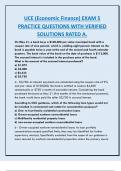
On May 31, a bank buys a $100,000 par value municipal bond with a
coupon rate of nine percent, which is yielding eight percent. Interest on the
bond is payable twice a year at the end of the second and fourth calendar
quarters. The book value of the bond on the date of purchase is $112,000.
The accrued interest is included in the purchase price of the bond.
What is the amount of the accrued interest purchased?
a) $1,875
b) $3,000
c) $3,333
d) $3,750
d - $3,750: As interest payments are calculated using the coupon rate of 9%
and par value of $100,000, the bank is entitled to receive $4,500
semiannually or $750 a month of accruable interest. Considering the bank
purchased the bond on May 31 (five months of the first semiannual payment),
the bank would have paid the seller $3,750 in accrued interest.
According to OCC guidance, which of the following loan types would not
be included in commercial real estate for concentration purposes?
a) One- to four-family residential construction loans
b) Owner-occupied nonfarm nonresidential loans
c) Multifamily residential property loans
d) non-owner-occupied nonfarm nonresidential loans
b - Owner-occupied nonfarm nonresidential loans: As loan portfolio
concentrations exceed specified limits, they may be identified for further
supervisory analysis. Specifically excluded from the scope of our guidance is
loans secured by nonfarm nonresidential properties where the primary source
,of repayment is cash flow from ongoing operations by the party who owns the
property. See OCC Bulletin 2006-46.
For the purpose of 12 USC 371c, an affiliate with which of the following
percentage ownership is deemed to have control?
a) 10%
b) 25%
c) 50%
d) 80%
b - 25%: Control is obtained at 25% ownership, while an affiliate would be
considered an operating subsidiary with over 50% ownership and a sister
bank with 80% or more ownership. See 12 USC 371c. 371c applies
specifically to legal restrictions as it relates to transactions with an affiliate.
During a recent asset quality review, an examiner downgraded a loan
from special mention to doubtful. What should have been done with the
accrued interest on the credit?
a) A reversal of accrued interest proportionate to the amount designated as
doubtful
b) Nothing; the loan should continue to accrue interest
c) A reduction to interest income only
d) A reversal of all previously accrued but uncollected interest
d - A reversal of all previously accrued but uncollected interest: A risk rating
of doubtful results in automatic nonaccrual status. In accordance with GAAP,
all previously accrued but uncollected interest should be reversed. The
appropriate journal entry for current-year interest reversal would include a
debit to interest income and a credit to accrued interest. See call report
instructions, pg. A-60
Use the following income statement information ($000's):
Interest on loans not held for sale: $2,785
Service charges on customer deposits: $500
Municipal bond interest: $1,275
Interest paid on time deposits: $1,835
Origination fees on loans held for sale: $325
,Interest paid on Fed Funds purchased: $200
What is the bank's net interest income?
a) $2,025
b) $2,225
c) $2,350
d) $2,850
Answer: a - $2,025: Service charges on customer deposits should be reported
as noninterest income. In general, origination fees on loans are includable in
interest income; however, when loans are held for sale, the origination fees
should be deferred until sold with the gain/loss recognized as noninterest
income. See Call Report Instructions, pg. RI-2
True/False:
Like national banks, federal savings associations must be a member of the
Federal Reserve System.
False: A national bank must be a member of the Federal Reserve System
under 12 USC 222. An FSA cannot be a member of the Federal Reserve
System under 12 USC 321. See Quick Reference Guide, pg. 24
http://occnet.occ/human-resources/training/training-guidance-by-
audience/examiners/commissioned/quick-reference-guide.pdf
First National Bank has a risk-based capital (RBC) ratio of 12 percent, a tier
1RBC ratio of 5 percent, and a tier 1 leverage ratio of 8 percent. The bank
is not under any form of enforcement action. Per Prompt Corrective Action,
the bank would be considered which of the following?
a) Well-capitalized
b) Adequately-capitalized
c) Undercapitalized
d) Significantly Undercapitalized
b - Currently, the bank would fall under the "adequately-capitalized"
definition. To be well-capitalized, a bank must have a RBC ratio of 10% or
greater, a tier 1 RBC ratio of 6% or greater, and a leverage ratio of 5% or
greater. It should be noted that as of January 1, 2015, tier 1 RBC minimums
would change. See 12 CFR 6, pg. 5
, Which of the following assets would not be considered an investment in
bank premises?
a) Parking facilities
b) Capital leases
c) Furniture and fixtures
d) Real estate acquired for future expansion
c - Bank premises are defined as 1)premises that are owned and occupied by
the bank, 2)capitalized leases and leasehold improvements, 3)remodeling
costs to existing premises, 4)real estate acquired and intended for future
expansion, and 5)parking facilities that are used by customers or employees.
See 12 CFR 5.37
Which of the following is the risk to earnings or capital arising from
violations of laws, rules, or regulations, or from nonconformance with
prescribed practices, internal polices, or ethical standards?
a) Strategic Risk
b) Compliance Risk
c) Operational Risk
d) Reputation Risk
b - Compliance Risk. Compliance risk is not limited to risk from failure to
comply with consumer protection laws, but also encompasses the risk of
noncompliance with all laws and regulations. See Bank Supervision Process
Handbook, pg. 98
Which of the following addresses loan portfolio stress testing?
a) 12 CFR 1
b) OCC Bulletin 2012-33
c) 12 CFR 215
d) OCC Bulletin 2010-12
b - OCC Bulletin 2012-33
True/False:
A bank may take shares of its holding company stock as collateral on a
loan.
PRACTICE QUESTIONS WITH VERIFIED
SOLUTIONS RATED A.
On May 31, a bank buys a $100,000 par value municipal bond with a
coupon rate of nine percent, which is yielding eight percent. Interest on the
bond is payable twice a year at the end of the second and fourth calendar
quarters. The book value of the bond on the date of purchase is $112,000.
The accrued interest is included in the purchase price of the bond.
What is the amount of the accrued interest purchased?
a) $1,875
b) $3,000
c) $3,333
d) $3,750
d - $3,750: As interest payments are calculated using the coupon rate of 9%
and par value of $100,000, the bank is entitled to receive $4,500
semiannually or $750 a month of accruable interest. Considering the bank
purchased the bond on May 31 (five months of the first semiannual payment),
the bank would have paid the seller $3,750 in accrued interest.
According to OCC guidance, which of the following loan types would not
be included in commercial real estate for concentration purposes?
a) One- to four-family residential construction loans
b) Owner-occupied nonfarm nonresidential loans
c) Multifamily residential property loans
d) non-owner-occupied nonfarm nonresidential loans
b - Owner-occupied nonfarm nonresidential loans: As loan portfolio
concentrations exceed specified limits, they may be identified for further
supervisory analysis. Specifically excluded from the scope of our guidance is
loans secured by nonfarm nonresidential properties where the primary source
,of repayment is cash flow from ongoing operations by the party who owns the
property. See OCC Bulletin 2006-46.
For the purpose of 12 USC 371c, an affiliate with which of the following
percentage ownership is deemed to have control?
a) 10%
b) 25%
c) 50%
d) 80%
b - 25%: Control is obtained at 25% ownership, while an affiliate would be
considered an operating subsidiary with over 50% ownership and a sister
bank with 80% or more ownership. See 12 USC 371c. 371c applies
specifically to legal restrictions as it relates to transactions with an affiliate.
During a recent asset quality review, an examiner downgraded a loan
from special mention to doubtful. What should have been done with the
accrued interest on the credit?
a) A reversal of accrued interest proportionate to the amount designated as
doubtful
b) Nothing; the loan should continue to accrue interest
c) A reduction to interest income only
d) A reversal of all previously accrued but uncollected interest
d - A reversal of all previously accrued but uncollected interest: A risk rating
of doubtful results in automatic nonaccrual status. In accordance with GAAP,
all previously accrued but uncollected interest should be reversed. The
appropriate journal entry for current-year interest reversal would include a
debit to interest income and a credit to accrued interest. See call report
instructions, pg. A-60
Use the following income statement information ($000's):
Interest on loans not held for sale: $2,785
Service charges on customer deposits: $500
Municipal bond interest: $1,275
Interest paid on time deposits: $1,835
Origination fees on loans held for sale: $325
,Interest paid on Fed Funds purchased: $200
What is the bank's net interest income?
a) $2,025
b) $2,225
c) $2,350
d) $2,850
Answer: a - $2,025: Service charges on customer deposits should be reported
as noninterest income. In general, origination fees on loans are includable in
interest income; however, when loans are held for sale, the origination fees
should be deferred until sold with the gain/loss recognized as noninterest
income. See Call Report Instructions, pg. RI-2
True/False:
Like national banks, federal savings associations must be a member of the
Federal Reserve System.
False: A national bank must be a member of the Federal Reserve System
under 12 USC 222. An FSA cannot be a member of the Federal Reserve
System under 12 USC 321. See Quick Reference Guide, pg. 24
http://occnet.occ/human-resources/training/training-guidance-by-
audience/examiners/commissioned/quick-reference-guide.pdf
First National Bank has a risk-based capital (RBC) ratio of 12 percent, a tier
1RBC ratio of 5 percent, and a tier 1 leverage ratio of 8 percent. The bank
is not under any form of enforcement action. Per Prompt Corrective Action,
the bank would be considered which of the following?
a) Well-capitalized
b) Adequately-capitalized
c) Undercapitalized
d) Significantly Undercapitalized
b - Currently, the bank would fall under the "adequately-capitalized"
definition. To be well-capitalized, a bank must have a RBC ratio of 10% or
greater, a tier 1 RBC ratio of 6% or greater, and a leverage ratio of 5% or
greater. It should be noted that as of January 1, 2015, tier 1 RBC minimums
would change. See 12 CFR 6, pg. 5
, Which of the following assets would not be considered an investment in
bank premises?
a) Parking facilities
b) Capital leases
c) Furniture and fixtures
d) Real estate acquired for future expansion
c - Bank premises are defined as 1)premises that are owned and occupied by
the bank, 2)capitalized leases and leasehold improvements, 3)remodeling
costs to existing premises, 4)real estate acquired and intended for future
expansion, and 5)parking facilities that are used by customers or employees.
See 12 CFR 5.37
Which of the following is the risk to earnings or capital arising from
violations of laws, rules, or regulations, or from nonconformance with
prescribed practices, internal polices, or ethical standards?
a) Strategic Risk
b) Compliance Risk
c) Operational Risk
d) Reputation Risk
b - Compliance Risk. Compliance risk is not limited to risk from failure to
comply with consumer protection laws, but also encompasses the risk of
noncompliance with all laws and regulations. See Bank Supervision Process
Handbook, pg. 98
Which of the following addresses loan portfolio stress testing?
a) 12 CFR 1
b) OCC Bulletin 2012-33
c) 12 CFR 215
d) OCC Bulletin 2010-12
b - OCC Bulletin 2012-33
True/False:
A bank may take shares of its holding company stock as collateral on a
loan.