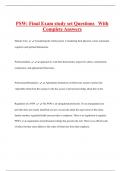
PSW: Final Exam study set Questions With
Complete Answers
Holistic Care Considering the whole person. Considering their physical, social, emotional,
cognitive and spiritual dimensions.
Professionalism an approach to work that demonstrates respect for others, commitment,
competence, and appropriate behaviours.
Professional Boundaries Appropriate limitations on behaviour, meant to protect the
vulnerable client from the caregiver who has access to private knowledge about him or her.
Regulation of a PSW The PSW is an unregulated profession. For an unregulated care
provider there are clearly identified services we provide under the supervision of the client,
family member, regulated health care provider or employer. There is no legislation to regulate
PSW's or an organization of professional college that governs the role. There is no official code
of ethics but they must adhere to the codes of behaviour from their employer.
, PSW: Final Exam study set Questions With
Complete Answers
Regulated Health Professions Act Regulated Health Professions. In Ontario, regulated
health professions are governed under the Regulated Health Professions Act, 1991 (RHPA) and
health profession Acts (i.e., Medicine Act, 1991). This legislative framework establishes health
regulatory colleges, which regulate the professions in the public interest. i.e. the college of
nurses.
Role of the occupational therapist Focuses on rehabilitation; teaches clients skills needed
to perform ADLs; designs adaptive equipment for ADLs
Role of the physical therapist Focuses on rehabilitation; assist clients with musculo-
skeletal impairments; focuses on restoring function and preventing disability from illness or
injury
Role of Registered Nurse (RN) assesses, makes nursing diagnoses, plans, implements, and
evaluates nursing care. Tends to clients with unstable health conditions; provides direct client
care, administers medications, supervises support workers
, PSW: Final Exam study set Questions With
Complete Answers
Role of RPN Licenced practical nurse (LPN) a health care provider licensed and regulated
by the province or territory to carry out nursing techniques and provide client care. Known as a
registered practical nurse (RPN) in Ontario.
ALL RULES REGARDING DELEGATION Only regulated health care providers like
nurses have the authority (legal right) to perform certain tasks because they have the knowledge,
skill and training to perform them. They are called controlled acts and are considered harmful if
they are performed by unqualified people. In some circumstances some acts will be delegated to
you. In order to do this, specific conditions called "exceptions" must be met for delegation to be
permitted. The nurse must feel confident the support worker understands what the
responsibilities are when performing the task, knowns when and who to ask for assistance, and
knowns when, how and whom to report the outcome of the task.
Tasks that may be delegated to support workers must be routine ones with predictable outcomes
that require little supervision and can only be delegated for stable clients.
Delegation tasks may include: suctioning a permanent tracheotomy in and out catherization;
administering glucometers, dressings, tube feedings and medication.
Only some nursing tasks can be delegated. Your employer's policies and guidelines, your job
description and provincial or territorial legislation determine what tasks can be delegated to you.
, PSW: Final Exam study set Questions With
Complete Answers
Sometimes these rules vary between community and LTC.
In Ontario an RN, RPN and LPN can delegate.
A delegated task is not transferrable to another client. Just because you did it for one person,
does not mean you are able to perform the SAME task on another client without training.
Before delegating tasks, the nurse must know the following: • What tasks your province or
territory allows support workers to perform.
• The tasks included in your job description.
• What you were taught in your training program.
• What skills you have learned and how they were evaluated.
• Your work experiences.
A nurse who delegates a task is required to: • Have the knowledge, skill, and judgement to
perform the task competently.
• Have the additional knowledge, skill and judgement to teach the task to others. The delegating
nurse is responsible for providing all necessary teaching, but not everyone is able to teach others
how to perform something. Good communication skills and patience required.
Complete Answers
Holistic Care Considering the whole person. Considering their physical, social, emotional,
cognitive and spiritual dimensions.
Professionalism an approach to work that demonstrates respect for others, commitment,
competence, and appropriate behaviours.
Professional Boundaries Appropriate limitations on behaviour, meant to protect the
vulnerable client from the caregiver who has access to private knowledge about him or her.
Regulation of a PSW The PSW is an unregulated profession. For an unregulated care
provider there are clearly identified services we provide under the supervision of the client,
family member, regulated health care provider or employer. There is no legislation to regulate
PSW's or an organization of professional college that governs the role. There is no official code
of ethics but they must adhere to the codes of behaviour from their employer.
, PSW: Final Exam study set Questions With
Complete Answers
Regulated Health Professions Act Regulated Health Professions. In Ontario, regulated
health professions are governed under the Regulated Health Professions Act, 1991 (RHPA) and
health profession Acts (i.e., Medicine Act, 1991). This legislative framework establishes health
regulatory colleges, which regulate the professions in the public interest. i.e. the college of
nurses.
Role of the occupational therapist Focuses on rehabilitation; teaches clients skills needed
to perform ADLs; designs adaptive equipment for ADLs
Role of the physical therapist Focuses on rehabilitation; assist clients with musculo-
skeletal impairments; focuses on restoring function and preventing disability from illness or
injury
Role of Registered Nurse (RN) assesses, makes nursing diagnoses, plans, implements, and
evaluates nursing care. Tends to clients with unstable health conditions; provides direct client
care, administers medications, supervises support workers
, PSW: Final Exam study set Questions With
Complete Answers
Role of RPN Licenced practical nurse (LPN) a health care provider licensed and regulated
by the province or territory to carry out nursing techniques and provide client care. Known as a
registered practical nurse (RPN) in Ontario.
ALL RULES REGARDING DELEGATION Only regulated health care providers like
nurses have the authority (legal right) to perform certain tasks because they have the knowledge,
skill and training to perform them. They are called controlled acts and are considered harmful if
they are performed by unqualified people. In some circumstances some acts will be delegated to
you. In order to do this, specific conditions called "exceptions" must be met for delegation to be
permitted. The nurse must feel confident the support worker understands what the
responsibilities are when performing the task, knowns when and who to ask for assistance, and
knowns when, how and whom to report the outcome of the task.
Tasks that may be delegated to support workers must be routine ones with predictable outcomes
that require little supervision and can only be delegated for stable clients.
Delegation tasks may include: suctioning a permanent tracheotomy in and out catherization;
administering glucometers, dressings, tube feedings and medication.
Only some nursing tasks can be delegated. Your employer's policies and guidelines, your job
description and provincial or territorial legislation determine what tasks can be delegated to you.
, PSW: Final Exam study set Questions With
Complete Answers
Sometimes these rules vary between community and LTC.
In Ontario an RN, RPN and LPN can delegate.
A delegated task is not transferrable to another client. Just because you did it for one person,
does not mean you are able to perform the SAME task on another client without training.
Before delegating tasks, the nurse must know the following: • What tasks your province or
territory allows support workers to perform.
• The tasks included in your job description.
• What you were taught in your training program.
• What skills you have learned and how they were evaluated.
• Your work experiences.
A nurse who delegates a task is required to: • Have the knowledge, skill, and judgement to
perform the task competently.
• Have the additional knowledge, skill and judgement to teach the task to others. The delegating
nurse is responsible for providing all necessary teaching, but not everyone is able to teach others
how to perform something. Good communication skills and patience required.