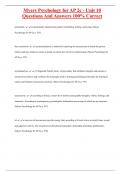
Myers Psychology for AP 2e - Unit 05
Questions And Answers 100% Correct
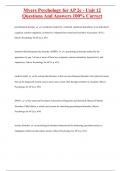
consciousness our awareness of ourselves and our environment. (Myers Psychology for AP 2e pp.
118, 219)
hypnosis a social interaction in which one person (the subject) responds to another person's (the
hypnotist's) suggestion that certain perceptions, feelings, thoughts, or behaviors will spontaneously occur.
(Myers Psychology for AP 2e p. 219)
posthypnotic suggestion a suggestion, made during a hypnosis session, to be carried out after the
subject is no longer hypnotized; used by some clinicians to help control undesired symptoms and
behaviors. (Myers Psychology for AP 2e p. 220)
dissociation a split in consciousness, which allows some thoughts and behaviors to occur
simultaneously with others. (Myers Psychology for AP 2e p. 222)
circadian rhythm the biological clock; regular bodily rhythms (for example, of temperature and
wakefulness) that occur on a 24-hour cycle. (Myers Psychology for AP 2e p. 226)
, Myers Psychology for AP 2e - Unit 05
Questions And Answers 100% Correct
REM sleep rapid eye movement sleep; a recurring sleep stage during which vivid dreams
commonly occur. Also known as paradoxical sleep, because the muscles are relaxed (except for minor
twitches) but other body systems are active. (Myers Psychology for AP 2e p. 226)
alpha waves the relatively slow brain waves of a relaxed, awake state. (Myers Psychology for AP
2e p. 227)
sleep periodic, natural loss of consciousness—as distinct from unconsciousness resulting from a
coma, general anesthesia, or hibernation. (Adapted from Dement, 1999.) (Myers Psychology for AP 2e p.
227)
hallucinations false sensory experiences, such as seeing something in the absence of an external
visual stimulus. (Myers Psychology for AP 2e pp. 228, 685)
delta waves the large, slow brain waves associated with deep sleep. (Myers Psychology for AP 2e
p. 228)
NREM sleep nonrapid eye movement sleep; encompasses all sleep stages except for REM sleep.
(Myers Psychology for AP 2e p. 228)
Questions And Answers 100% Correct
consciousness our awareness of ourselves and our environment. (Myers Psychology for AP 2e pp.
118, 219)
hypnosis a social interaction in which one person (the subject) responds to another person's (the
hypnotist's) suggestion that certain perceptions, feelings, thoughts, or behaviors will spontaneously occur.
(Myers Psychology for AP 2e p. 219)
posthypnotic suggestion a suggestion, made during a hypnosis session, to be carried out after the
subject is no longer hypnotized; used by some clinicians to help control undesired symptoms and
behaviors. (Myers Psychology for AP 2e p. 220)
dissociation a split in consciousness, which allows some thoughts and behaviors to occur
simultaneously with others. (Myers Psychology for AP 2e p. 222)
circadian rhythm the biological clock; regular bodily rhythms (for example, of temperature and
wakefulness) that occur on a 24-hour cycle. (Myers Psychology for AP 2e p. 226)
, Myers Psychology for AP 2e - Unit 05
Questions And Answers 100% Correct
REM sleep rapid eye movement sleep; a recurring sleep stage during which vivid dreams
commonly occur. Also known as paradoxical sleep, because the muscles are relaxed (except for minor
twitches) but other body systems are active. (Myers Psychology for AP 2e p. 226)
alpha waves the relatively slow brain waves of a relaxed, awake state. (Myers Psychology for AP
2e p. 227)
sleep periodic, natural loss of consciousness—as distinct from unconsciousness resulting from a
coma, general anesthesia, or hibernation. (Adapted from Dement, 1999.) (Myers Psychology for AP 2e p.
227)
hallucinations false sensory experiences, such as seeing something in the absence of an external
visual stimulus. (Myers Psychology for AP 2e pp. 228, 685)
delta waves the large, slow brain waves associated with deep sleep. (Myers Psychology for AP 2e
p. 228)
NREM sleep nonrapid eye movement sleep; encompasses all sleep stages except for REM sleep.
(Myers Psychology for AP 2e p. 228)