Myers Psychology for AP 2e - Unit 09
Questions And Answers 100% Correct
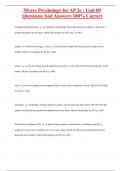
developmental psychology a branch of psychology that studies physical, cognitive, and social
change throughout the life span. (Myers Psychology for AP 2e pp. 14, 462)
zygote the fertilized egg; it enters a 2-week period of rapid cell division and develops into an
embryo. (Myers Psychology for AP 2e p. 466)
embryo the developing human organism from about 2 weeks after fertilization through the second
month. (Myers Psychology for AP 2e p. 466)
fetus the developing human organism from 9 weeks after conception to birth. (Myers Psychology
for AP 2e p. 466)
teratogens (literally, "monster makers") agents, such as chemicals and viruses, that can reach the
embryo or fetus during prenatal development and cause harm. (Myers Psychology for AP 2e p. 467)
fetal alcohol syndrome (FAS) physical and cognitive abnormalities in children caused by a
pregnant woman's heavy drinking. In severe cases, signs include a small, out-of-proportion head and
abnormal facial features. (Myers Psychology for AP 2e p. 467)
, Myers Psychology for AP 2e - Unit 09
Questions And Answers 100% Correct
habituation decreasing responsiveness with repeated stimulation. As infants gain familiarity with
repeated exposure to a visual stimulus, their interest wanes and they look away sooner. (Myers
Psychology for AP 2e pp. 264, 468)
maturation biological growth processes that enable orderly changes in behavior, relatively
uninfluenced by experience. (Myers Psychology for AP 2e p. 471)
cognition all the mental activities associated with thinking, knowing, remembering, and
communicating. (Myers Psychology for AP 2e pp. 356, 476)
schema a concept or framework that organizes and interprets information. (Myers Psychology for
AP 2e p. 477)
assimilation interpreting our new experiences in terms of our existing schemas. (Myers Psychology
for AP 2e p. 477)
accommodation (2) in developmental psychology, adapting our current understandings (schemas)
to incorporate new information. (Myers Psychology for AP 2e p. 477)
Questions And Answers 100% Correct
developmental psychology a branch of psychology that studies physical, cognitive, and social
change throughout the life span. (Myers Psychology for AP 2e pp. 14, 462)
zygote the fertilized egg; it enters a 2-week period of rapid cell division and develops into an
embryo. (Myers Psychology for AP 2e p. 466)
embryo the developing human organism from about 2 weeks after fertilization through the second
month. (Myers Psychology for AP 2e p. 466)
fetus the developing human organism from 9 weeks after conception to birth. (Myers Psychology
for AP 2e p. 466)
teratogens (literally, "monster makers") agents, such as chemicals and viruses, that can reach the
embryo or fetus during prenatal development and cause harm. (Myers Psychology for AP 2e p. 467)
fetal alcohol syndrome (FAS) physical and cognitive abnormalities in children caused by a
pregnant woman's heavy drinking. In severe cases, signs include a small, out-of-proportion head and
abnormal facial features. (Myers Psychology for AP 2e p. 467)
, Myers Psychology for AP 2e - Unit 09
Questions And Answers 100% Correct
habituation decreasing responsiveness with repeated stimulation. As infants gain familiarity with
repeated exposure to a visual stimulus, their interest wanes and they look away sooner. (Myers
Psychology for AP 2e pp. 264, 468)
maturation biological growth processes that enable orderly changes in behavior, relatively
uninfluenced by experience. (Myers Psychology for AP 2e p. 471)
cognition all the mental activities associated with thinking, knowing, remembering, and
communicating. (Myers Psychology for AP 2e pp. 356, 476)
schema a concept or framework that organizes and interprets information. (Myers Psychology for
AP 2e p. 477)
assimilation interpreting our new experiences in terms of our existing schemas. (Myers Psychology
for AP 2e p. 477)
accommodation (2) in developmental psychology, adapting our current understandings (schemas)
to incorporate new information. (Myers Psychology for AP 2e p. 477)