ALL H7 ESSAY PLANS
QUESTIONS AND COMPLETE
SOLUTIONS GRADED A+
Your Exam Plug
,'REBELLIONS IN THE YEARS 1489 AND 1497 STEMMED FROM THE WEAKNESS OF CENTRAL
GOVERNMENT.'
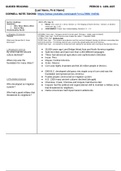
Essay Overview - Answer: INTRODUCTION
- Two main rebellions during this time period: Cornish and Yorkshire
- Both fundamentally caused by weaknesses from central government
- Both had economics BUT H7 excessive use heavy taxation = caused rebellion - passed thru. parliament
- Already crippled under high taxes and ways of extracting money from the crown e.g. feudal dues
- Was caused by weakness in gov due to sometimes being too centred around external dynastic threats
DID STEM
- 1489 Yorkshire Rebellion
- 1497 Cornish Rebellion
- External social conditions were not poor = cause for rebellion questionable
DID NOT STEM
- 1489 Yorkshire Rebellion - to do more so with foreign policy however this was a gov. initiative
- 1497 Cornish Rebellion - crippled more so due to financial situation thus stemmed from this
CONCLUSION
- Overall still was caused by weaknesses in central government
- Not weaknesses in the fundamentals of gov. e.g. structure but the ability to recognise issues
- E.R. passed through parliament + weaknesses of gov. aims = rebellions would emerge
- Not that bad as advice given by gov -purpose - was to secure dynastic security: money and f.p
'REBELLIONS IN THE YEARS 1489 AND 1497 STEMMED FROM THE WEAKNESS OF CENTRAL
GOVERNMENT.'
Did stem: 1489 Yorkshire Rebellion - Answer: - Resentment of 1489 taxation granted in parliament of
£100,000
- Finance the involvement of English forced in the campaign in Brittany
- Appointed Surrey as lieutenant - had no vested interest in North
,- Loyalty guaranteed as the restoration of his own states rested on his success here
- Less people were involved but geographically further away + North = not Henry's stronghold
- Emphasised how he lacked power in North = weak central gov could not do other functions?
'REBELLIONS IN THE YEARS 1489 AND 1497 STEMMED FROM THE WEAKNESS OF CENTRAL
GOVERNMENT.'
Did stem: 1497 Cornish Rebellion - Answer: - January 1497: heavy taxation = finance expedition North -
resist invasion of James IV + Warbeck
- Cornish: claimed loudly they could not bear weight of taxation
- Accused king: cruelty + malice counsellors / out of hand - threat. death authors of great oppression
- Posed greater threat than Yorkshire: up to 15,000 involved
- Attempt to exploit the rebellion made by Perkin Warbeck
- Rebels marched on London = capital = key! Only halted at Blackheath
- Punished only the leaders - executed = strong message / treated bulk rebels w conspicuous leniency
'REBELLIONS IN THE YEARS 1489 AND 1497 STEMMED FROM THE WEAKNESS OF CENTRAL
GOVERNMENT.'
Did stem: External social conditions were not poor = cause for rebellion questionable - Answer: - Did not
suffer from a subsistence crisis
- John Guy: 'Tudor England's greatest success was its ability to feed itself'
- 1490s: real wages appear to have increased / inflation more evident by turn of the century
- 90% of the value of English exports flourished in the last ¼ of C15th
- Jack Landers: 'an increase in over 60% in the volume of cloth exports during Henry VII's reign'
'REBELLIONS IN THE YEARS 1489 AND 1497 STEMMED FROM THE WEAKNESS OF CENTRAL
GOVERNMENT.'
Did not stem: 1489 Yorkshire Rebellion - Answer: - to do more so with foreign policy however this was a
gov. initiative
- 1489: Henry had summoned parliament to grant him e.r. - £100,000
- Raised an army against the French // Yorkshire rebellion
- Did this due to: sense of obligations to Britons / feared that F. could be threat to England
, - Showed country was not prepared financially for a major war BUT still e.r. in Cornish due to Scot
'REBELLIONS IN THE YEARS 1489 AND 1497 STEMMED FROM THE WEAKNESS OF CENTRAL
GOVERNMENT.'
Did not stem: 1497 Cornish Rebellion - Answer: - crippled more so due to financial situation thus
stemmed from this o - 'Normal decade' = 1/4 of all harvests in some degree deficient + 1/6 were very
bad
Caused violent price fluctuation
- Henry interested in building personal wealth but had no specific economic policy
- 1490s: decline in the export prices of wool / grain / animal products
- 1496: Intercursus malus - after Warbeck left in 1495 and brought trade embargo to an end
- Second half C15th: living conditions for the poor seemed to be worsening
'THE RISE IN PRETENDERS IN HENRY VII REIGN STEMMED FROM THE WEAKNESS OF CENTRAL
GOVERNMENT.'
Essay Overview - Answer: INTRODUCTION
- Weaknesses not so much to do with central gov. but with exploiting H7 lack of dynastic security
- Weak claim: claims through mothers' line + 1485 seizure of the crown was another source of instability
- Pretenders all threatened his dynastic security but due to good central gov. enacted by H7 he had
control of classes within England e.g. nobility who also helped to suppress rebellions
- Some places where it can be questioned but this was inevitable for a monarch trying to set up a
dynasty
- No severe systemic problems and especially not as seen in later terms with religious / taxation
rebellions
WEAKNESSES IN CENTRAL GOVERNMENT
- 1486: Viscount Lovell and the Stafford's
- Lambert Simnel - some weaknesses in gov. here = couldn't response as effectively to the threat
- The White Rose
WERE NOT WEAKNESSES IN CENTRAL GOVERNMENT
QUESTIONS AND COMPLETE
SOLUTIONS GRADED A+
Your Exam Plug
,'REBELLIONS IN THE YEARS 1489 AND 1497 STEMMED FROM THE WEAKNESS OF CENTRAL
GOVERNMENT.'
Essay Overview - Answer: INTRODUCTION
- Two main rebellions during this time period: Cornish and Yorkshire
- Both fundamentally caused by weaknesses from central government
- Both had economics BUT H7 excessive use heavy taxation = caused rebellion - passed thru. parliament
- Already crippled under high taxes and ways of extracting money from the crown e.g. feudal dues
- Was caused by weakness in gov due to sometimes being too centred around external dynastic threats
DID STEM
- 1489 Yorkshire Rebellion
- 1497 Cornish Rebellion
- External social conditions were not poor = cause for rebellion questionable
DID NOT STEM
- 1489 Yorkshire Rebellion - to do more so with foreign policy however this was a gov. initiative
- 1497 Cornish Rebellion - crippled more so due to financial situation thus stemmed from this
CONCLUSION
- Overall still was caused by weaknesses in central government
- Not weaknesses in the fundamentals of gov. e.g. structure but the ability to recognise issues
- E.R. passed through parliament + weaknesses of gov. aims = rebellions would emerge
- Not that bad as advice given by gov -purpose - was to secure dynastic security: money and f.p
'REBELLIONS IN THE YEARS 1489 AND 1497 STEMMED FROM THE WEAKNESS OF CENTRAL
GOVERNMENT.'
Did stem: 1489 Yorkshire Rebellion - Answer: - Resentment of 1489 taxation granted in parliament of
£100,000
- Finance the involvement of English forced in the campaign in Brittany
- Appointed Surrey as lieutenant - had no vested interest in North
,- Loyalty guaranteed as the restoration of his own states rested on his success here
- Less people were involved but geographically further away + North = not Henry's stronghold
- Emphasised how he lacked power in North = weak central gov could not do other functions?
'REBELLIONS IN THE YEARS 1489 AND 1497 STEMMED FROM THE WEAKNESS OF CENTRAL
GOVERNMENT.'
Did stem: 1497 Cornish Rebellion - Answer: - January 1497: heavy taxation = finance expedition North -
resist invasion of James IV + Warbeck
- Cornish: claimed loudly they could not bear weight of taxation
- Accused king: cruelty + malice counsellors / out of hand - threat. death authors of great oppression
- Posed greater threat than Yorkshire: up to 15,000 involved
- Attempt to exploit the rebellion made by Perkin Warbeck
- Rebels marched on London = capital = key! Only halted at Blackheath
- Punished only the leaders - executed = strong message / treated bulk rebels w conspicuous leniency
'REBELLIONS IN THE YEARS 1489 AND 1497 STEMMED FROM THE WEAKNESS OF CENTRAL
GOVERNMENT.'
Did stem: External social conditions were not poor = cause for rebellion questionable - Answer: - Did not
suffer from a subsistence crisis
- John Guy: 'Tudor England's greatest success was its ability to feed itself'
- 1490s: real wages appear to have increased / inflation more evident by turn of the century
- 90% of the value of English exports flourished in the last ¼ of C15th
- Jack Landers: 'an increase in over 60% in the volume of cloth exports during Henry VII's reign'
'REBELLIONS IN THE YEARS 1489 AND 1497 STEMMED FROM THE WEAKNESS OF CENTRAL
GOVERNMENT.'
Did not stem: 1489 Yorkshire Rebellion - Answer: - to do more so with foreign policy however this was a
gov. initiative
- 1489: Henry had summoned parliament to grant him e.r. - £100,000
- Raised an army against the French // Yorkshire rebellion
- Did this due to: sense of obligations to Britons / feared that F. could be threat to England
, - Showed country was not prepared financially for a major war BUT still e.r. in Cornish due to Scot
'REBELLIONS IN THE YEARS 1489 AND 1497 STEMMED FROM THE WEAKNESS OF CENTRAL
GOVERNMENT.'
Did not stem: 1497 Cornish Rebellion - Answer: - crippled more so due to financial situation thus
stemmed from this o - 'Normal decade' = 1/4 of all harvests in some degree deficient + 1/6 were very
bad
Caused violent price fluctuation
- Henry interested in building personal wealth but had no specific economic policy
- 1490s: decline in the export prices of wool / grain / animal products
- 1496: Intercursus malus - after Warbeck left in 1495 and brought trade embargo to an end
- Second half C15th: living conditions for the poor seemed to be worsening
'THE RISE IN PRETENDERS IN HENRY VII REIGN STEMMED FROM THE WEAKNESS OF CENTRAL
GOVERNMENT.'
Essay Overview - Answer: INTRODUCTION
- Weaknesses not so much to do with central gov. but with exploiting H7 lack of dynastic security
- Weak claim: claims through mothers' line + 1485 seizure of the crown was another source of instability
- Pretenders all threatened his dynastic security but due to good central gov. enacted by H7 he had
control of classes within England e.g. nobility who also helped to suppress rebellions
- Some places where it can be questioned but this was inevitable for a monarch trying to set up a
dynasty
- No severe systemic problems and especially not as seen in later terms with religious / taxation
rebellions
WEAKNESSES IN CENTRAL GOVERNMENT
- 1486: Viscount Lovell and the Stafford's
- Lambert Simnel - some weaknesses in gov. here = couldn't response as effectively to the threat
- The White Rose
WERE NOT WEAKNESSES IN CENTRAL GOVERNMENT