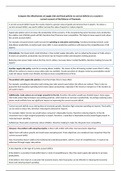
Compare the effectiveness of supply side and fiscal policies to correct deficits on a country’s
current account of the Balance of Payments
A current account deficit means the country imports a greater value of goods and services than it exports. To reduce a
current account deficit, we need to either increase the value of exports or reduce imports.
Supply side policies aim to increase the productivity of the economy. If the manufacturing sector becomes more productive,
the relative cost of British goods will fall, therefore they’ll become more competitive. This helps increase exports and reduce
the current account deficit.
For example, the government could increase the spending on education and training. Vocational training schemes could
help labour productivity as workers gain more skills. A more productive workforce will improve the competitiveness of UK
exports.
Alternatively, the Government could introduce a free market supply side policy such as reducing the power of trade unions.
If unions are powerful, productivity may be lower due to frequent strikes and disruptive working practices.
Reducing union power helps reduce the time lost to strikes, increases labour market flexibility, therefore helping increase UK
exports
Another supply side policy could be increasing labour mobility. The nature of the UK housing market means that it’s often
difficult for workers to move to areas where jobs are available. Greater provision of cheaper rented accommodation would
make the labour market more flexible and help increase competitiveness of firms.
The problem with supply side policies is that they’ll take time to have effect.
For example, spending on education and training may take several years before the effects are noticed. There is also no
guarantee that education spending will increase labour productivity, especially if the money is misspent or if the workers do
not want to learn.
Additionally, trade unions are no longer powerful in the UK, therefore this policy would have limited impact. Some argue
that trade unions help introduce new working practices, which lead to an increase in productivity. So perhaps reducing union
power would unlikely have any significant impact on improving the current account deficit.
Current account deficits occur during times of economic growth, therefore high consumer spending on imports. Fiscal policy
can be used to reduce this, therefore reducing the demand for imports.
For example, higher income tax would reduce consumer’s disposable income, therefore reducing imports. In the UK,
consumers have a high marginal propensity to import, therefore, a reduction in disposable income would hugely impact in
reducing import spending.
Deflationary fiscal policy would also reduce inflation, therefore helping to make the UK goods more competitive.
However, the problem with using fiscal policy is that it will conflict with other macroeconomic objectives.
Higher taxes will reduce growth and could cause unemployment. These objectives are considered more important than the
current account deficit.
Also, fiscal policy doesn’t address the fundamental underlying problem, which is a lack of competitiveness. It needs to be
addressed through supply side policies.
It also depends on the type of current account deficit.
If the deficit is a persistent trade deficit due to a lack of competitiveness, then this needs supply side policies to increase
productivity.
If the deficit is the result of a consumer led economic boom, then fiscal policy can be effective in reducing the economic
boom and reducing import spending.
current account of the Balance of Payments
A current account deficit means the country imports a greater value of goods and services than it exports. To reduce a
current account deficit, we need to either increase the value of exports or reduce imports.
Supply side policies aim to increase the productivity of the economy. If the manufacturing sector becomes more productive,
the relative cost of British goods will fall, therefore they’ll become more competitive. This helps increase exports and reduce
the current account deficit.
For example, the government could increase the spending on education and training. Vocational training schemes could
help labour productivity as workers gain more skills. A more productive workforce will improve the competitiveness of UK
exports.
Alternatively, the Government could introduce a free market supply side policy such as reducing the power of trade unions.
If unions are powerful, productivity may be lower due to frequent strikes and disruptive working practices.
Reducing union power helps reduce the time lost to strikes, increases labour market flexibility, therefore helping increase UK
exports
Another supply side policy could be increasing labour mobility. The nature of the UK housing market means that it’s often
difficult for workers to move to areas where jobs are available. Greater provision of cheaper rented accommodation would
make the labour market more flexible and help increase competitiveness of firms.
The problem with supply side policies is that they’ll take time to have effect.
For example, spending on education and training may take several years before the effects are noticed. There is also no
guarantee that education spending will increase labour productivity, especially if the money is misspent or if the workers do
not want to learn.
Additionally, trade unions are no longer powerful in the UK, therefore this policy would have limited impact. Some argue
that trade unions help introduce new working practices, which lead to an increase in productivity. So perhaps reducing union
power would unlikely have any significant impact on improving the current account deficit.
Current account deficits occur during times of economic growth, therefore high consumer spending on imports. Fiscal policy
can be used to reduce this, therefore reducing the demand for imports.
For example, higher income tax would reduce consumer’s disposable income, therefore reducing imports. In the UK,
consumers have a high marginal propensity to import, therefore, a reduction in disposable income would hugely impact in
reducing import spending.
Deflationary fiscal policy would also reduce inflation, therefore helping to make the UK goods more competitive.
However, the problem with using fiscal policy is that it will conflict with other macroeconomic objectives.
Higher taxes will reduce growth and could cause unemployment. These objectives are considered more important than the
current account deficit.
Also, fiscal policy doesn’t address the fundamental underlying problem, which is a lack of competitiveness. It needs to be
addressed through supply side policies.
It also depends on the type of current account deficit.
If the deficit is a persistent trade deficit due to a lack of competitiveness, then this needs supply side policies to increase
productivity.
If the deficit is the result of a consumer led economic boom, then fiscal policy can be effective in reducing the economic
boom and reducing import spending.