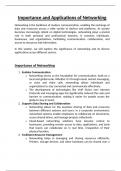
Importance and Applications of Networking
Networking is the backbone of modern communication, enabling the exchange of
data and resources across a wide variety of devices and platforms. As society
becomes increasingly reliant on digital technologies, networking plays a pivotal
role in both personal and professional domains. It connects individuals,
businesses, and organizations, facilitating communication, collaboration, and
access to resources and information.
In this section, we will explore the significance of networking and its diverse
applications across different sectors.
Importance of Networking
1. Enables Communication:
o Networking serves as the foundation for communication, both on a
local and global scale. Whether it’s through email, instant messaging,
or voice and video calls, networking allows individuals and
organizations to stay connected and communicate effectively.
o The development of technologies like VoIP (Voice over Internet
Protocol) and messaging apps has significantly reduced the costs and
barriers to communication, making it easier for people across the
globe to stay in touch.
2. Supports Data Sharing and Collaboration:
o Networking allows for the seamless sharing of data and resources
between different systems and users. In a corporate environment,
networked systems enable employees to collaborate on documents,
access shared drives, and manage projects collectively.
o Cloud-based networking solutions have become central to
businesses, providing remote access to data, applications, and tools
that teams can collaborate on in real time, irrespective of their
physical location.
3. Facilitates Resource Management:
o Networking helps in managing and sharing resources efficiently.
Printers, storage devices, and other hardware can be shared over a
, network, reducing the need for duplicating resources and increasing
cost-effectiveness.
o It also enables network administrators to manage systems and
devices remotely, reducing the need for on-site intervention and
making maintenance and troubleshooting more efficient.
4. Enhances Scalability and Flexibility:
o Networks enable organizations to scale their operations quickly and
efficiently. Adding new devices, expanding internet bandwidth, or
integrating new applications can be easily accomplished within a
networked environment.
o Virtualization technologies and cloud computing further enhance
scalability, allowing businesses to expand their infrastructure without
the need for significant physical resources.
5. Security and Data Protection:
o Networking enables the implementation of centralized security
measures, including firewalls, encryption, and access control, to
protect data from unauthorized access and potential cyberattacks.
o Advanced network security protocols, such as VPNs and intrusion
detection systems, safeguard sensitive data, and secure
communication channels in both personal and business contexts.
6. Global Connectivity and Remote Access:
o Networking connects people and organizations across geographical
boundaries, enabling access to global information and services. With
high-speed internet and robust networking technologies, users can
access a wide range of services, including e-commerce, social media,
entertainment, and financial services.
o Remote work has become increasingly popular, and networking
technologies allow employees to securely access company resources,
participate in virtual meetings, and collaborate remotely, providing
flexibility and increased productivity.
Applications of Networking
1. Business and Enterprise Applications:
o Enterprise Resource Planning (ERP): Networking enables the
integration of various business functions, such as finance, HR, and
Networking is the backbone of modern communication, enabling the exchange of
data and resources across a wide variety of devices and platforms. As society
becomes increasingly reliant on digital technologies, networking plays a pivotal
role in both personal and professional domains. It connects individuals,
businesses, and organizations, facilitating communication, collaboration, and
access to resources and information.
In this section, we will explore the significance of networking and its diverse
applications across different sectors.
Importance of Networking
1. Enables Communication:
o Networking serves as the foundation for communication, both on a
local and global scale. Whether it’s through email, instant messaging,
or voice and video calls, networking allows individuals and
organizations to stay connected and communicate effectively.
o The development of technologies like VoIP (Voice over Internet
Protocol) and messaging apps has significantly reduced the costs and
barriers to communication, making it easier for people across the
globe to stay in touch.
2. Supports Data Sharing and Collaboration:
o Networking allows for the seamless sharing of data and resources
between different systems and users. In a corporate environment,
networked systems enable employees to collaborate on documents,
access shared drives, and manage projects collectively.
o Cloud-based networking solutions have become central to
businesses, providing remote access to data, applications, and tools
that teams can collaborate on in real time, irrespective of their
physical location.
3. Facilitates Resource Management:
o Networking helps in managing and sharing resources efficiently.
Printers, storage devices, and other hardware can be shared over a
, network, reducing the need for duplicating resources and increasing
cost-effectiveness.
o It also enables network administrators to manage systems and
devices remotely, reducing the need for on-site intervention and
making maintenance and troubleshooting more efficient.
4. Enhances Scalability and Flexibility:
o Networks enable organizations to scale their operations quickly and
efficiently. Adding new devices, expanding internet bandwidth, or
integrating new applications can be easily accomplished within a
networked environment.
o Virtualization technologies and cloud computing further enhance
scalability, allowing businesses to expand their infrastructure without
the need for significant physical resources.
5. Security and Data Protection:
o Networking enables the implementation of centralized security
measures, including firewalls, encryption, and access control, to
protect data from unauthorized access and potential cyberattacks.
o Advanced network security protocols, such as VPNs and intrusion
detection systems, safeguard sensitive data, and secure
communication channels in both personal and business contexts.
6. Global Connectivity and Remote Access:
o Networking connects people and organizations across geographical
boundaries, enabling access to global information and services. With
high-speed internet and robust networking technologies, users can
access a wide range of services, including e-commerce, social media,
entertainment, and financial services.
o Remote work has become increasingly popular, and networking
technologies allow employees to securely access company resources,
participate in virtual meetings, and collaborate remotely, providing
flexibility and increased productivity.
Applications of Networking
1. Business and Enterprise Applications:
o Enterprise Resource Planning (ERP): Networking enables the
integration of various business functions, such as finance, HR, and