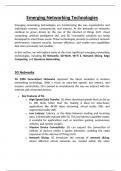
Emerging Networking Technologies
Emerging networking technologies are transforming the way organizations and
individuals connect, communicate, and interact. As the demands on networks
continue to grow—driven by the rise of the internet of things (IoT), cloud
computing, artificial intelligence (AI), and 5G—innovative solutions are being
developed to meet these needs. These technologies promise to enhance network
performance, improve security, increase efficiency, and enable new capabilities
that were previously not possible.
In this section, we will explore some of the most significant emerging networking
technologies, including 5G Networks, SD-WAN, Wi-Fi 6, Network Slicing, Edge
Computing, and Quantum Networking.
5G Networks
5G (Fifth Generation) Networks represent the latest evolution in wireless
networking technology. With a focus on ultra-fast speeds, low latency, and
massive connectivity, 5G is poised to revolutionize the way we interact with the
internet and connected devices.
Key Features of 5G:
o High-Speed Data Transfer: 5G offers download speeds that can be up
to 100 times faster than 4G, making it ideal for data-heavy
applications like 4K/8K video streaming, virtual reality (VR), and
augmented reality (AR).
o Low Latency: Latency, or the delay between sending and receiving
data, is drastically reduced with 5G. This low-latency capability makes
it essential for applications such as real-time gaming, autonomous
vehicles, and remote surgery.
o Massive Device Connectivity: 5G can support the connection of
millions of devices within a square kilometer, enabling the rapid
expansion of the Internet of Things (IoT).
o Network Slicing: 5G introduces the concept of network slicing,
where different virtual networks are created within the same
, physical infrastructure to cater to different use cases, such as ultra-
reliable low-latency communications (URLLC) and enhanced mobile
broadband (eMBB).
Impact of 5G:
o Smart Cities: 5G enables faster and more reliable communication for
smart city infrastructure, such as traffic management systems, IoT
devices, and emergency response systems.
o Industrial IoT (IIoT): With its ability to support a high number of
devices, 5G will power the next generation of connected factories,
providing real-time data monitoring, automation, and predictive
maintenance capabilities.
o Healthcare: 5G's low latency and high bandwidth will enable
advancements in telemedicine, including remote surgery, patient
monitoring, and diagnostic tools.
Software-Defined Wide Area Network (SD-WAN)
SD-WAN (Software-Defined Wide Area Network) is a transformative technology
that simplifies the management and operation of a wide area network (WAN) by
decoupling the network control plane from the underlying hardware. SD-WAN
offers a more flexible, efficient, and cost-effective way to manage WANs,
especially for organizations with multiple branch offices or remote locations.
Key Features of SD-WAN:
o Centralized Control: SD-WAN provides a centralized management
dashboard that allows administrators to configure, monitor, and
optimize the network from a single location.
o Dynamic Path Selection: SD-WAN can automatically select the best
path for network traffic based on factors such as application type,
network conditions, and performance requirements.
o Improved Performance: By intelligently routing traffic over multiple
connections (e.g., MPLS, broadband, LTE), SD-WAN ensures optimal
performance and low latency for critical applications.
o Security: SD-WAN integrates built-in security features, such as
encryption, firewalling, and secure tunneling, to protect data as it
travels across the network.
Emerging networking technologies are transforming the way organizations and
individuals connect, communicate, and interact. As the demands on networks
continue to grow—driven by the rise of the internet of things (IoT), cloud
computing, artificial intelligence (AI), and 5G—innovative solutions are being
developed to meet these needs. These technologies promise to enhance network
performance, improve security, increase efficiency, and enable new capabilities
that were previously not possible.
In this section, we will explore some of the most significant emerging networking
technologies, including 5G Networks, SD-WAN, Wi-Fi 6, Network Slicing, Edge
Computing, and Quantum Networking.
5G Networks
5G (Fifth Generation) Networks represent the latest evolution in wireless
networking technology. With a focus on ultra-fast speeds, low latency, and
massive connectivity, 5G is poised to revolutionize the way we interact with the
internet and connected devices.
Key Features of 5G:
o High-Speed Data Transfer: 5G offers download speeds that can be up
to 100 times faster than 4G, making it ideal for data-heavy
applications like 4K/8K video streaming, virtual reality (VR), and
augmented reality (AR).
o Low Latency: Latency, or the delay between sending and receiving
data, is drastically reduced with 5G. This low-latency capability makes
it essential for applications such as real-time gaming, autonomous
vehicles, and remote surgery.
o Massive Device Connectivity: 5G can support the connection of
millions of devices within a square kilometer, enabling the rapid
expansion of the Internet of Things (IoT).
o Network Slicing: 5G introduces the concept of network slicing,
where different virtual networks are created within the same
, physical infrastructure to cater to different use cases, such as ultra-
reliable low-latency communications (URLLC) and enhanced mobile
broadband (eMBB).
Impact of 5G:
o Smart Cities: 5G enables faster and more reliable communication for
smart city infrastructure, such as traffic management systems, IoT
devices, and emergency response systems.
o Industrial IoT (IIoT): With its ability to support a high number of
devices, 5G will power the next generation of connected factories,
providing real-time data monitoring, automation, and predictive
maintenance capabilities.
o Healthcare: 5G's low latency and high bandwidth will enable
advancements in telemedicine, including remote surgery, patient
monitoring, and diagnostic tools.
Software-Defined Wide Area Network (SD-WAN)
SD-WAN (Software-Defined Wide Area Network) is a transformative technology
that simplifies the management and operation of a wide area network (WAN) by
decoupling the network control plane from the underlying hardware. SD-WAN
offers a more flexible, efficient, and cost-effective way to manage WANs,
especially for organizations with multiple branch offices or remote locations.
Key Features of SD-WAN:
o Centralized Control: SD-WAN provides a centralized management
dashboard that allows administrators to configure, monitor, and
optimize the network from a single location.
o Dynamic Path Selection: SD-WAN can automatically select the best
path for network traffic based on factors such as application type,
network conditions, and performance requirements.
o Improved Performance: By intelligently routing traffic over multiple
connections (e.g., MPLS, broadband, LTE), SD-WAN ensures optimal
performance and low latency for critical applications.
o Security: SD-WAN integrates built-in security features, such as
encryption, firewalling, and secure tunneling, to protect data as it
travels across the network.