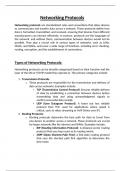
Networking Protocols
Networking protocols are standardized rules and conventions that allow devices
to communicate and transfer data across a network. These protocols define how
data is formatted, transmitted, and received, ensuring that devices from different
manufacturers can interact efficiently. In essence, protocols are the languages of
the network, and without them, communication between devices would not be
possible. They play a crucial role in various types of networks, such as LANs,
MANs, and WANs, and cover a wide range of functions, including error checking,
routing, encryption, and the establishment of connections.
Types of Networking Protocols:
Networking protocols can be broadly categorized based on their function and the
layer of the OSI or TCP/IP model they operate in. The primary categories include:
1. Transmission Protocols:
o These protocols are responsible for the transmission and delivery of
data across networks. Examples include:
TCP (Transmission Control Protocol): Ensures reliable delivery
of data by establishing a connection between devices before
transmitting data and using acknowledgment signals to
confirm successful data receipt.
UDP (User Datagram Protocol): A faster but less reliable
protocol than TCP, used for applications where speed is
critical, such as video streaming or VoIP (Voice over IP).
2. Routing Protocols:
o Routing protocols determine the best path for data to travel from
one device to another across a network. These protocols are crucial
for larger networks like the internet and WANs. Examples include:
RIP (Routing Information Protocol): A distance-vector routing
protocol that uses hop count as its routing metric.
OSPF (Open Shortest Path First): A link-state routing protocol
that uses the shortest path first algorithm to determine the
best route.
, BGP (Border Gateway Protocol): A path vector protocol used
to exchange routing information between different networks
(autonomous systems) on the internet.
3. Application Protocols:
o These protocols define the rules for specific applications to
communicate over a network. They handle tasks such as email, web
browsing, file transfer, and more. Examples include:
HTTP (HyperText Transfer Protocol): Used for transferring web
pages and resources over the World Wide Web.
FTP (File Transfer Protocol): Used for transferring files
between devices on a network.
SMTP (Simple Mail Transfer Protocol): Used for sending and
receiving email.
4. Security Protocols:
o These protocols provide security measures for ensuring the privacy,
integrity, and authenticity of data transmitted over the network.
Examples include:
SSL/TLS (Secure Sockets Layer / Transport Layer Security):
Protocols used to encrypt data transmitted over the internet,
ensuring secure communication between web browsers and
servers.
IPsec (Internet Protocol Security): A protocol suite used to
secure IP communications by authenticating and encrypting
each IP packet in a communication session.
5. Data Link Protocols:
o These protocols operate at the Data Link Layer (Layer 2) of the OSI
model and are responsible for the reliable transmission of data over
the physical network. Examples include:
Ethernet: The most common protocol used in LANs, defining
the rules for data transmission over wired networks.
PPP (Point-to-Point Protocol): Used to establish direct
connections between two devices over a serial link.
6. Network Layer Protocols:
o These protocols operate at the Network Layer (Layer 3) and are
responsible for routing data between devices across networks.
Examples include:
Networking protocols are standardized rules and conventions that allow devices
to communicate and transfer data across a network. These protocols define how
data is formatted, transmitted, and received, ensuring that devices from different
manufacturers can interact efficiently. In essence, protocols are the languages of
the network, and without them, communication between devices would not be
possible. They play a crucial role in various types of networks, such as LANs,
MANs, and WANs, and cover a wide range of functions, including error checking,
routing, encryption, and the establishment of connections.
Types of Networking Protocols:
Networking protocols can be broadly categorized based on their function and the
layer of the OSI or TCP/IP model they operate in. The primary categories include:
1. Transmission Protocols:
o These protocols are responsible for the transmission and delivery of
data across networks. Examples include:
TCP (Transmission Control Protocol): Ensures reliable delivery
of data by establishing a connection between devices before
transmitting data and using acknowledgment signals to
confirm successful data receipt.
UDP (User Datagram Protocol): A faster but less reliable
protocol than TCP, used for applications where speed is
critical, such as video streaming or VoIP (Voice over IP).
2. Routing Protocols:
o Routing protocols determine the best path for data to travel from
one device to another across a network. These protocols are crucial
for larger networks like the internet and WANs. Examples include:
RIP (Routing Information Protocol): A distance-vector routing
protocol that uses hop count as its routing metric.
OSPF (Open Shortest Path First): A link-state routing protocol
that uses the shortest path first algorithm to determine the
best route.
, BGP (Border Gateway Protocol): A path vector protocol used
to exchange routing information between different networks
(autonomous systems) on the internet.
3. Application Protocols:
o These protocols define the rules for specific applications to
communicate over a network. They handle tasks such as email, web
browsing, file transfer, and more. Examples include:
HTTP (HyperText Transfer Protocol): Used for transferring web
pages and resources over the World Wide Web.
FTP (File Transfer Protocol): Used for transferring files
between devices on a network.
SMTP (Simple Mail Transfer Protocol): Used for sending and
receiving email.
4. Security Protocols:
o These protocols provide security measures for ensuring the privacy,
integrity, and authenticity of data transmitted over the network.
Examples include:
SSL/TLS (Secure Sockets Layer / Transport Layer Security):
Protocols used to encrypt data transmitted over the internet,
ensuring secure communication between web browsers and
servers.
IPsec (Internet Protocol Security): A protocol suite used to
secure IP communications by authenticating and encrypting
each IP packet in a communication session.
5. Data Link Protocols:
o These protocols operate at the Data Link Layer (Layer 2) of the OSI
model and are responsible for the reliable transmission of data over
the physical network. Examples include:
Ethernet: The most common protocol used in LANs, defining
the rules for data transmission over wired networks.
PPP (Point-to-Point Protocol): Used to establish direct
connections between two devices over a serial link.
6. Network Layer Protocols:
o These protocols operate at the Network Layer (Layer 3) and are
responsible for routing data between devices across networks.
Examples include: