OSI Model
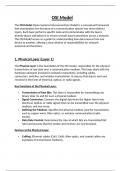
The OSI Model (Open Systems Interconnection Model) is a conceptual framework
that standardizes the functions of a communication system into seven distinct
layers. Each layer performs specific tasks and communicates with the layers
directly above and below it to ensure smooth data transmission across a network.
The OSI Model serves as a guide for understanding how data moves from one
device to another, offering a clear division of responsibilities for network
protocols and functions.
1. Physical Layer (Layer 1)
The Physical Layer is the foundation of the OSI model, responsible for the physical
transmission of raw data over a communication medium. This layer deals with the
hardware elements involved in network connectivity, including cables,
connectors, switches, and wireless transmission. It ensures that data is sent and
received in the form of electrical, optical, or radio signals.
Key Functions of the Physical Layer:
Transmission of Raw Bits: This layer is responsible for transmitting raw
binary data (1s and 0s) over a physical medium.
Signal Conversion: Converts the digital data from the higher layers into
electrical, optical, or radio signals that can be transmitted over the physical
medium, and vice versa.
Defining the Medium: Specifies the physical medium used for transmission,
such as copper wires, fiber optics, or wireless communication (radio
waves).
Data Rate Control: Determines the rate at which bits are transmitted (bit
rate) and ensures that the sender and receiver are synchronized.
Devices at the Physical Layer:
Cabling: Ethernet cables (Cat5, Cat6), fiber optics, and coaxial cables are
examples of transmission mediums.
, Hubs and Repeaters: Hubs are used to broadcast data to all devices
connected to a network. Repeaters extend the range of signals by
amplifying weak signals.
Network Interface Cards (NICs): Hardware that allows devices to connect
to the network and transmits signals through the physical medium.
2. Data Link Layer (Layer 2)
The Data Link Layer is responsible for ensuring reliable data transfer over the
physical medium. It packages raw bits from the physical layer into frames and
adds necessary headers and trailers to control the flow of data and ensure error-
free transmission. This layer provides reliable point-to-point communication
between devices on the same network.
Key Functions of the Data Link Layer:
Framing: Data is encapsulated into frames to ensure that the data can be
sent over the physical layer in manageable chunks.
Error Detection and Correction: The Data Link Layer adds error-checking
mechanisms (e.g., cyclic redundancy checks, or CRC) to frames to detect
and correct errors in data transmission.
Flow Control: Manages the flow of data to ensure that the receiving device
is not overwhelmed with too much data at once.
MAC Addressing: The Data Link Layer uses Media Access Control (MAC)
addresses to uniquely identify devices on a local network. MAC addresses
are used for communication within a LAN (Local Area Network).
Devices at the Data Link Layer:
Switches: Operate at this layer to forward frames based on MAC addresses,
directing traffic within a LAN.
Network Interface Cards (NICs): Responsible for creating frames and
appending MAC addresses for communication.
Bridges: Used to divide large networks into segments and filter traffic based
on MAC addresses.
The OSI Model (Open Systems Interconnection Model) is a conceptual framework
that standardizes the functions of a communication system into seven distinct
layers. Each layer performs specific tasks and communicates with the layers
directly above and below it to ensure smooth data transmission across a network.
The OSI Model serves as a guide for understanding how data moves from one
device to another, offering a clear division of responsibilities for network
protocols and functions.
1. Physical Layer (Layer 1)
The Physical Layer is the foundation of the OSI model, responsible for the physical
transmission of raw data over a communication medium. This layer deals with the
hardware elements involved in network connectivity, including cables,
connectors, switches, and wireless transmission. It ensures that data is sent and
received in the form of electrical, optical, or radio signals.
Key Functions of the Physical Layer:
Transmission of Raw Bits: This layer is responsible for transmitting raw
binary data (1s and 0s) over a physical medium.
Signal Conversion: Converts the digital data from the higher layers into
electrical, optical, or radio signals that can be transmitted over the physical
medium, and vice versa.
Defining the Medium: Specifies the physical medium used for transmission,
such as copper wires, fiber optics, or wireless communication (radio
waves).
Data Rate Control: Determines the rate at which bits are transmitted (bit
rate) and ensures that the sender and receiver are synchronized.
Devices at the Physical Layer:
Cabling: Ethernet cables (Cat5, Cat6), fiber optics, and coaxial cables are
examples of transmission mediums.
, Hubs and Repeaters: Hubs are used to broadcast data to all devices
connected to a network. Repeaters extend the range of signals by
amplifying weak signals.
Network Interface Cards (NICs): Hardware that allows devices to connect
to the network and transmits signals through the physical medium.
2. Data Link Layer (Layer 2)
The Data Link Layer is responsible for ensuring reliable data transfer over the
physical medium. It packages raw bits from the physical layer into frames and
adds necessary headers and trailers to control the flow of data and ensure error-
free transmission. This layer provides reliable point-to-point communication
between devices on the same network.
Key Functions of the Data Link Layer:
Framing: Data is encapsulated into frames to ensure that the data can be
sent over the physical layer in manageable chunks.
Error Detection and Correction: The Data Link Layer adds error-checking
mechanisms (e.g., cyclic redundancy checks, or CRC) to frames to detect
and correct errors in data transmission.
Flow Control: Manages the flow of data to ensure that the receiving device
is not overwhelmed with too much data at once.
MAC Addressing: The Data Link Layer uses Media Access Control (MAC)
addresses to uniquely identify devices on a local network. MAC addresses
are used for communication within a LAN (Local Area Network).
Devices at the Data Link Layer:
Switches: Operate at this layer to forward frames based on MAC addresses,
directing traffic within a LAN.
Network Interface Cards (NICs): Responsible for creating frames and
appending MAC addresses for communication.
Bridges: Used to divide large networks into segments and filter traffic based
on MAC addresses.