AI and Big Data
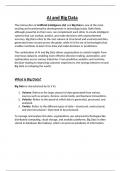
The intersection of Artificial Intelligence (AI) and Big Data is one of the most
exciting and transformative developments in technology today. Both fields,
although powerful on their own, can complement each other to create intelligent
systems that can analyze, predict, and make decisions with unprecedented
accuracy. Big Data refers to the vast volume of structured and unstructured data
generated every second across the globe, while AI is the set of technologies that
enables machines to learn from data and make decisions or predictions.
The combination of AI and Big Data allows organizations to unlock insights from
enormous datasets, enabling more effective decision-making, automation, and
optimization across various industries. From predictive analytics and real-time
decision-making to improving customer experiences, the synergy between AI and
Big Data is reshaping the world.
What is Big Data?
Big Data is characterized by its 3 Vs:
1. Volume: Refers to the large amount of data generated from various
sources such as sensors, devices, social media, and business transactions.
2. Velocity: Refers to the speed at which data is generated, processed, and
analyzed.
3. Variety: Refers to the different types of data—structured, unstructured,
and semi-structured—that need to be processed.
To manage and analyze this data, organizations use advanced technologies like
distributed computing, cloud storage, and analytics platforms. Big Data is often
stored in databases like Hadoop, which can process petabytes of information.
, How AI Enhances Big Data
AI plays a pivotal role in analyzing Big Data, turning raw data into actionable
insights, and improving decision-making. Here's how AI enhances Big Data:
1. Automated Data Processing
o AI systems can process large datasets automatically, eliminating the
need for manual intervention. This allows organizations to work with
data in real-time, rather than relying on traditional methods that
take longer.
o Example: AI-powered chatbots can handle thousands of customer
service queries simultaneously, processing data from each
interaction and learning from it to improve responses.
2. Pattern Recognition and Predictive Analytics
o AI algorithms, particularly machine learning models, can identify
patterns and trends in massive datasets that would be impossible for
humans to detect. This can lead to more accurate predictions.
o Example: In finance, AI can analyze Big Data to predict stock market
trends, while in healthcare, it can predict disease outbreaks or
patient conditions based on medical records.
3. Real-time Decision-Making
o The combination of Big Data and AI enables systems to make
decisions in real-time, based on the continuous flow of incoming
data.
o Example: Autonomous vehicles rely on AI and Big Data to process
environmental data in real-time, making driving decisions instantly to
ensure safety.
4. Natural Language Processing (NLP)
o AI technologies like NLP allow systems to analyze and extract
meaning from unstructured data, such as text, audio, and video,
found in Big Data sources like social media or customer feedback.
o Example: Sentiment analysis of customer reviews and social media
posts can provide businesses with valuable insights into consumer
preferences and emotions.
The intersection of Artificial Intelligence (AI) and Big Data is one of the most
exciting and transformative developments in technology today. Both fields,
although powerful on their own, can complement each other to create intelligent
systems that can analyze, predict, and make decisions with unprecedented
accuracy. Big Data refers to the vast volume of structured and unstructured data
generated every second across the globe, while AI is the set of technologies that
enables machines to learn from data and make decisions or predictions.
The combination of AI and Big Data allows organizations to unlock insights from
enormous datasets, enabling more effective decision-making, automation, and
optimization across various industries. From predictive analytics and real-time
decision-making to improving customer experiences, the synergy between AI and
Big Data is reshaping the world.
What is Big Data?
Big Data is characterized by its 3 Vs:
1. Volume: Refers to the large amount of data generated from various
sources such as sensors, devices, social media, and business transactions.
2. Velocity: Refers to the speed at which data is generated, processed, and
analyzed.
3. Variety: Refers to the different types of data—structured, unstructured,
and semi-structured—that need to be processed.
To manage and analyze this data, organizations use advanced technologies like
distributed computing, cloud storage, and analytics platforms. Big Data is often
stored in databases like Hadoop, which can process petabytes of information.
, How AI Enhances Big Data
AI plays a pivotal role in analyzing Big Data, turning raw data into actionable
insights, and improving decision-making. Here's how AI enhances Big Data:
1. Automated Data Processing
o AI systems can process large datasets automatically, eliminating the
need for manual intervention. This allows organizations to work with
data in real-time, rather than relying on traditional methods that
take longer.
o Example: AI-powered chatbots can handle thousands of customer
service queries simultaneously, processing data from each
interaction and learning from it to improve responses.
2. Pattern Recognition and Predictive Analytics
o AI algorithms, particularly machine learning models, can identify
patterns and trends in massive datasets that would be impossible for
humans to detect. This can lead to more accurate predictions.
o Example: In finance, AI can analyze Big Data to predict stock market
trends, while in healthcare, it can predict disease outbreaks or
patient conditions based on medical records.
3. Real-time Decision-Making
o The combination of Big Data and AI enables systems to make
decisions in real-time, based on the continuous flow of incoming
data.
o Example: Autonomous vehicles rely on AI and Big Data to process
environmental data in real-time, making driving decisions instantly to
ensure safety.
4. Natural Language Processing (NLP)
o AI technologies like NLP allow systems to analyze and extract
meaning from unstructured data, such as text, audio, and video,
found in Big Data sources like social media or customer feedback.
o Example: Sentiment analysis of customer reviews and social media
posts can provide businesses with valuable insights into consumer
preferences and emotions.