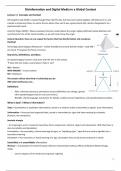
Disinformation and Digital Media in a Global Context
Lecture 1 | Concepts and Context
HIV-negative aids (2010) = people thought they had HIV aids, but they were tested negative, still believed in it, and
created a conspiracy theory on online forums where they said it was a government plot, doctors designated it as a
psychosomatic event.
Covid-19 Origin (2020) = Many conspiracy theories created about the origin, highly politicised media attention and
uncertainty for the entire Covid situation, so we will never know the origin.
General Question: How can we unpack the factors that fuel disinformation and conspiracy
thinking?
Technology (technological affordance) + market (neoliberal economy behind media) + state (IR) =
structural → however the focus is humans
Key terms, Definitions, and Ideas
An epistemological concern: that story with the tree in the woods…
→ Does the tree make a sound when it falls or not?
YES = Realism
WHO KNOWS? = Critical realism
NO = Relativism
The answer reflects what kind of scholarship you do
AND what method you use…
Definitions
- Risks: enforced consensus, premature closure (definitions can change, ignores
other epistemologies that are not Euro-centric)
- Benefits: shared language, touchstone for debate, enables precise hypotheses and operationalised variables.
What is data? / What is information?
!Data = Quantitative or qualitative observations, stored in a medium and/or transmitted as signals. (raw information)
!Information = Processed and organised data, stored or transmitted as signs that have meaning to recipients
(humans, not computers)
Semiotic triangle
– for meaning to occur it needs to have these three components: referent, object and interpretant. With that there is
also connotation and denotation.
Connotation = the secondary, cultural meanings of signs; or "signifying signs," signs that are used as signifiers for a
secondary meaning
Denotation = the most basic or literal meaning of a sign, denotation may not be present anymore in media
Unverified and unverifiable information
!Rumour = A proposition for belief of topical reference disseminated without official verification (Robert Knapp,
1944).
- Can be weapons of the weak (to bring down regimes)
1
, - Rumours lay in a grey space because it can be good but also bad
What is communication?
Producer → message → recipient (addressee) = simplified version, more actors involved
!Communication = shall refer to the practice of coding a message and transmitting it from a source to a destination,
where it is decoded and interpreted.
(giving signs) Encoding → code decoding (interpreting
!Code = in communication science, refers to system of correlational rules
linking signs to content, based on social and cultural conventions .e.g.
dictionary
!Framing = means using a set of signs to guide the perception, code of communication
understanding, or interpretation of a piece of information. In other words: framing
forces a specific code onto the communication process. → has a lot to do with power
Communication & Power = power relies on the control of communication, as counterpower depends on breaking
through such controls… communication power is at the heart of the structure and dynamics of society (Manuel
Castells).
Rumouring …from above or …from below.
!Strategic communication = any kind of planned and intentional communicative activity that is meant to further the
goal of a person or organisation.
China is a good example Internal External
Overt (visible) Newsletters, (public) Advertising, public diplomacy,
committee meetings public relations, propaganda
Covert (not visible) Closed-door meetings, internal Whistleblowing, guerrilla
memos, encrypted orders advertising, disinformation
Misinformation vs disinformation
- !Misinformation = Information that may seem plausible but that is factually incorrect.
- !Disinformation = Misinformation that authoritative actors deploying strategically to achieve certain political
ends.→ Weaponised Falsehood
Anatomy of Disinformation
- Lies vs Bullshit: not wanting to get caught vs does not care if caught
- Half-Truths (they are important in disinformation): not revealing all information so it gets spread
- Reframed facts: putting facts into a situation where it fits but, in another context, it does not fit and is wrong.
- Questions & Doubts
Rumour leads to extended narratives = urban legends + conspiracy theories
What is a conspiracy theory?
An unwarranted, implausible, or even dangerous explanation for a situation characterised by uncertainty, usually
invoking spiralling narratives about the sinister machinations of powerful elites, imagined or real.
!New definition →An often-convoluted explanation for a situation characterized by uncertainty, usually invoking
spiralling narratives about the (sinister) secret machinations of powerful elites, imagined or real.
2
,Conspiracies
Benign Malicious
True Santa Claus The Watergate Scandal
False Horoscopes Qanon
Why do people share misinformation? / Why do they buy into conspiracy theories?
- Pleasure/entertainment
- Information overload (we need structures)
- Reassurance in beliefs
- Reduce uncertainty and complexity
- (re)assert agency
- Social benefits
o Belonging and social identity
Stupid?
Stupidity is not a cognitive defect…it is a social phenomenon.
- Social benefits: belonging and social identity
!Social identity = those aspect of an individual’s self-image that derive from the social categories to which they
perceive themselves as belonging.
Communication is deeply connected to our social identities…as our
relationship with information, knowledge, and power.
What happens when our social groups are large and
impersonal for instance in digital networks?
- Imagined communities → symbols & rituals
- (amplified) para-social relations
- No mere ‘aggregates’ (other people define themselves as and are defined by others as members of a group)
From traditional rumours to digital rumours
!Digital rumour = Any unverified topical statement that ICT users creatively assemble and circulate through digital
technology as they discursively and socially construct meaning in the face of information ambiguities.
Weekly assignment question: describe a conspiracy theory that is immoral and one that is not. Explain and justify
your response.
3
, Lecture 2 | Narrating Truth and Fiction
‘Reading’ ‘texts’
- Text is not limited to the written word. Think of:
o Artworks (e.g. paintings, sculptures, photographs, experimental arts)
o Media (films/series, documentaries, interviews, radio programmes)
o New media (podcasts, blogs, social media, websites)
- The same ‘text’ can change in different incarnations:
o E.g. book > film/tv adaption: manga > anime > Hollywood film; written text > audiobook: etc.
But what about the role of readers? Does everyone ‘read’ the same ‘text?
o The reader might read the same next but will interpret it differently due to background context:
experiences, ideology, religion etc. (positionality= what colour glasses you are wearing)
H. Porter Abbott on narrative
- Narrative “as the distinctive human trait”? (Abbott 1)
- “what does narrative do for us? … narrative is the principal way in which our species organizes its
understanding of time” (Abbott 3)
o “What makes narrative unique among text-types is its ‘chrono-logic,’ it is doubly temporal logic.
Narrative entails movement through time not only ‘externally’ (the duration of the presentation of
the novel, film, play) but also ‘internally’ (the duration of the sequence of events that constitute the
plot) … Non-narrative text-types do not have an internal time sequence, even though, obviously, they
take time to read, view, or hear. Their underlying structures are static or atemporal.” (Seymour
Chatman, qtd. in Abbott 16)
Is storytelling what makes us human?
o Not about things that are true of false, but it is about the way that things are ordered/structured.
Storytelling makes it easier for us to bridge memories.
How do we experience (or ‘read’) a story?
- “story is always mediated (constructed) by narrative discourse. We are always called upon to be active
participants in narrative, because receiving the story depends on how we in turn construct it from the
discourse … Where differences between readings become fraught with significance is in interpretation.”
(Abbott 21-22)
- “Story … is something that is delivered by narrative but seems (important word) to pre-exist it. Narrative,
by the same token, is something that always seems (again, an important word) to come after, to be a re-
presentation. Narrative, in other words, conveys story … If we hold this useful distinction between story
and narrative, then neither life nor role-playing games qualify as narrative, since there is no pre-existing
story.” (Abbott 36)
o Main point: Story pre-exists narrative, and narrative conveys the story through representation
The danger of a single story (2009) → Chimamanda Ngozi Adichie (*1977), Nigerian author
- Link between storytelling and power
(un)read books
- Umberto Eco: “the world is full of books that we haven’t read, but that we know pretty well” (The
Guardian online, 22 May 2011)
4
Lecture 1 | Concepts and Context
HIV-negative aids (2010) = people thought they had HIV aids, but they were tested negative, still believed in it, and
created a conspiracy theory on online forums where they said it was a government plot, doctors designated it as a
psychosomatic event.
Covid-19 Origin (2020) = Many conspiracy theories created about the origin, highly politicised media attention and
uncertainty for the entire Covid situation, so we will never know the origin.
General Question: How can we unpack the factors that fuel disinformation and conspiracy
thinking?
Technology (technological affordance) + market (neoliberal economy behind media) + state (IR) =
structural → however the focus is humans
Key terms, Definitions, and Ideas
An epistemological concern: that story with the tree in the woods…
→ Does the tree make a sound when it falls or not?
YES = Realism
WHO KNOWS? = Critical realism
NO = Relativism
The answer reflects what kind of scholarship you do
AND what method you use…
Definitions
- Risks: enforced consensus, premature closure (definitions can change, ignores
other epistemologies that are not Euro-centric)
- Benefits: shared language, touchstone for debate, enables precise hypotheses and operationalised variables.
What is data? / What is information?
!Data = Quantitative or qualitative observations, stored in a medium and/or transmitted as signals. (raw information)
!Information = Processed and organised data, stored or transmitted as signs that have meaning to recipients
(humans, not computers)
Semiotic triangle
– for meaning to occur it needs to have these three components: referent, object and interpretant. With that there is
also connotation and denotation.
Connotation = the secondary, cultural meanings of signs; or "signifying signs," signs that are used as signifiers for a
secondary meaning
Denotation = the most basic or literal meaning of a sign, denotation may not be present anymore in media
Unverified and unverifiable information
!Rumour = A proposition for belief of topical reference disseminated without official verification (Robert Knapp,
1944).
- Can be weapons of the weak (to bring down regimes)
1
, - Rumours lay in a grey space because it can be good but also bad
What is communication?
Producer → message → recipient (addressee) = simplified version, more actors involved
!Communication = shall refer to the practice of coding a message and transmitting it from a source to a destination,
where it is decoded and interpreted.
(giving signs) Encoding → code decoding (interpreting
!Code = in communication science, refers to system of correlational rules
linking signs to content, based on social and cultural conventions .e.g.
dictionary
!Framing = means using a set of signs to guide the perception, code of communication
understanding, or interpretation of a piece of information. In other words: framing
forces a specific code onto the communication process. → has a lot to do with power
Communication & Power = power relies on the control of communication, as counterpower depends on breaking
through such controls… communication power is at the heart of the structure and dynamics of society (Manuel
Castells).
Rumouring …from above or …from below.
!Strategic communication = any kind of planned and intentional communicative activity that is meant to further the
goal of a person or organisation.
China is a good example Internal External
Overt (visible) Newsletters, (public) Advertising, public diplomacy,
committee meetings public relations, propaganda
Covert (not visible) Closed-door meetings, internal Whistleblowing, guerrilla
memos, encrypted orders advertising, disinformation
Misinformation vs disinformation
- !Misinformation = Information that may seem plausible but that is factually incorrect.
- !Disinformation = Misinformation that authoritative actors deploying strategically to achieve certain political
ends.→ Weaponised Falsehood
Anatomy of Disinformation
- Lies vs Bullshit: not wanting to get caught vs does not care if caught
- Half-Truths (they are important in disinformation): not revealing all information so it gets spread
- Reframed facts: putting facts into a situation where it fits but, in another context, it does not fit and is wrong.
- Questions & Doubts
Rumour leads to extended narratives = urban legends + conspiracy theories
What is a conspiracy theory?
An unwarranted, implausible, or even dangerous explanation for a situation characterised by uncertainty, usually
invoking spiralling narratives about the sinister machinations of powerful elites, imagined or real.
!New definition →An often-convoluted explanation for a situation characterized by uncertainty, usually invoking
spiralling narratives about the (sinister) secret machinations of powerful elites, imagined or real.
2
,Conspiracies
Benign Malicious
True Santa Claus The Watergate Scandal
False Horoscopes Qanon
Why do people share misinformation? / Why do they buy into conspiracy theories?
- Pleasure/entertainment
- Information overload (we need structures)
- Reassurance in beliefs
- Reduce uncertainty and complexity
- (re)assert agency
- Social benefits
o Belonging and social identity
Stupid?
Stupidity is not a cognitive defect…it is a social phenomenon.
- Social benefits: belonging and social identity
!Social identity = those aspect of an individual’s self-image that derive from the social categories to which they
perceive themselves as belonging.
Communication is deeply connected to our social identities…as our
relationship with information, knowledge, and power.
What happens when our social groups are large and
impersonal for instance in digital networks?
- Imagined communities → symbols & rituals
- (amplified) para-social relations
- No mere ‘aggregates’ (other people define themselves as and are defined by others as members of a group)
From traditional rumours to digital rumours
!Digital rumour = Any unverified topical statement that ICT users creatively assemble and circulate through digital
technology as they discursively and socially construct meaning in the face of information ambiguities.
Weekly assignment question: describe a conspiracy theory that is immoral and one that is not. Explain and justify
your response.
3
, Lecture 2 | Narrating Truth and Fiction
‘Reading’ ‘texts’
- Text is not limited to the written word. Think of:
o Artworks (e.g. paintings, sculptures, photographs, experimental arts)
o Media (films/series, documentaries, interviews, radio programmes)
o New media (podcasts, blogs, social media, websites)
- The same ‘text’ can change in different incarnations:
o E.g. book > film/tv adaption: manga > anime > Hollywood film; written text > audiobook: etc.
But what about the role of readers? Does everyone ‘read’ the same ‘text?
o The reader might read the same next but will interpret it differently due to background context:
experiences, ideology, religion etc. (positionality= what colour glasses you are wearing)
H. Porter Abbott on narrative
- Narrative “as the distinctive human trait”? (Abbott 1)
- “what does narrative do for us? … narrative is the principal way in which our species organizes its
understanding of time” (Abbott 3)
o “What makes narrative unique among text-types is its ‘chrono-logic,’ it is doubly temporal logic.
Narrative entails movement through time not only ‘externally’ (the duration of the presentation of
the novel, film, play) but also ‘internally’ (the duration of the sequence of events that constitute the
plot) … Non-narrative text-types do not have an internal time sequence, even though, obviously, they
take time to read, view, or hear. Their underlying structures are static or atemporal.” (Seymour
Chatman, qtd. in Abbott 16)
Is storytelling what makes us human?
o Not about things that are true of false, but it is about the way that things are ordered/structured.
Storytelling makes it easier for us to bridge memories.
How do we experience (or ‘read’) a story?
- “story is always mediated (constructed) by narrative discourse. We are always called upon to be active
participants in narrative, because receiving the story depends on how we in turn construct it from the
discourse … Where differences between readings become fraught with significance is in interpretation.”
(Abbott 21-22)
- “Story … is something that is delivered by narrative but seems (important word) to pre-exist it. Narrative,
by the same token, is something that always seems (again, an important word) to come after, to be a re-
presentation. Narrative, in other words, conveys story … If we hold this useful distinction between story
and narrative, then neither life nor role-playing games qualify as narrative, since there is no pre-existing
story.” (Abbott 36)
o Main point: Story pre-exists narrative, and narrative conveys the story through representation
The danger of a single story (2009) → Chimamanda Ngozi Adichie (*1977), Nigerian author
- Link between storytelling and power
(un)read books
- Umberto Eco: “the world is full of books that we haven’t read, but that we know pretty well” (The
Guardian online, 22 May 2011)
4