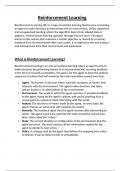
Reinforcement Learning
Reinforcement Learning (RL) is a type of machine learning that focuses on training
an agent to make decisions by interacting with an environment. Unlike supervised
and unsupervised learning, where the algorithm learns from labeled data or
patterns, reinforcement learning operates through trial and error. The agent
learns to take actions that maximize a certain objective or reward by receiving
feedback from its environment after each action. It is inspired by the way humans
and animals learn from their environment and experience.
What is Reinforcement Learning?
Reinforcement learning is an area of machine learning where an agent learns to
make decisions by performing actions in an environment and receiving feedback
in the form of rewards or penalties. The goal is for the agent to learn the optimal
sequence of actions that will maximize the total cumulative reward over time.
Agent: The learner or decision maker, typically a program or model, that
interacts with the environment. The agent makes decisions and takes
actions based on its observations of the environment.
Environment: The world in which the agent operates. It provides feedback
to the agent, based on the agent’s actions, and can be anything from a
virtual game to a physical robot interacting with the world.
Actions: The decisions or moves made by the agent. In every state, the
agent chooses an action that will maximize its reward.
Rewards: The feedback signal that the agent receives after performing an
action. The agent’s goal is to maximize the total cumulative reward over
time, often called the "return."
State: The current situation or configuration of the environment that the
agent perceives. The state contains all the information needed for the
agent to decide its next action.
Policy: A strategy used by the agent that defines the mapping from states
to actions. It can be deterministic or probabilistic.
, Value Function: A function that estimates the expected cumulative reward
that can be achieved from any given state, helping the agent decide which
actions to take.
Key Concepts in Reinforcement Learning
1. Exploration vs. Exploitation One of the central challenges in reinforcement
learning is balancing exploration and exploitation. Exploration involves
trying new actions to discover potentially better strategies, while
exploitation focuses on using the known actions that yield the highest
rewards.
o Exploration: The agent tries different actions to gather more
information and explore the environment. It may not always lead to
immediate rewards but can uncover new, better strategies.
o Exploitation: The agent chooses actions that have already yielded
high rewards in the past, aiming to maximize short-term gain.
o Fun Fact: The exploration-exploitation dilemma is often compared to
a scenario where you can choose between exploring new restaurants
in your city or going back to your favorite one. Both strategies have
their merits!
2. Markov Decision Process (MDP) A key framework for reinforcement
learning is the Markov Decision Process (MDP), which provides a formal
description of an RL problem. MDP consists of the following components:
o States: The possible situations or configurations of the environment.
o Actions: The actions that the agent can take.
o Transition Model: Describes the probability of transitioning from one
state to another after taking a certain action.
o Reward Function: Assigns a reward value to each state-action pair.
o Policy: The strategy used by the agent to choose actions.
3. Return and Discount Factor In reinforcement learning, the objective is to
maximize the total cumulative reward. However, rewards received in the
future are often considered less valuable than immediate rewards, which is
why the discount factor (denoted as γ) is used. The discount factor
determines the importance of future rewards.
o Return: The total accumulated reward an agent receives, often
discounted over time.
Reinforcement Learning (RL) is a type of machine learning that focuses on training
an agent to make decisions by interacting with an environment. Unlike supervised
and unsupervised learning, where the algorithm learns from labeled data or
patterns, reinforcement learning operates through trial and error. The agent
learns to take actions that maximize a certain objective or reward by receiving
feedback from its environment after each action. It is inspired by the way humans
and animals learn from their environment and experience.
What is Reinforcement Learning?
Reinforcement learning is an area of machine learning where an agent learns to
make decisions by performing actions in an environment and receiving feedback
in the form of rewards or penalties. The goal is for the agent to learn the optimal
sequence of actions that will maximize the total cumulative reward over time.
Agent: The learner or decision maker, typically a program or model, that
interacts with the environment. The agent makes decisions and takes
actions based on its observations of the environment.
Environment: The world in which the agent operates. It provides feedback
to the agent, based on the agent’s actions, and can be anything from a
virtual game to a physical robot interacting with the world.
Actions: The decisions or moves made by the agent. In every state, the
agent chooses an action that will maximize its reward.
Rewards: The feedback signal that the agent receives after performing an
action. The agent’s goal is to maximize the total cumulative reward over
time, often called the "return."
State: The current situation or configuration of the environment that the
agent perceives. The state contains all the information needed for the
agent to decide its next action.
Policy: A strategy used by the agent that defines the mapping from states
to actions. It can be deterministic or probabilistic.
, Value Function: A function that estimates the expected cumulative reward
that can be achieved from any given state, helping the agent decide which
actions to take.
Key Concepts in Reinforcement Learning
1. Exploration vs. Exploitation One of the central challenges in reinforcement
learning is balancing exploration and exploitation. Exploration involves
trying new actions to discover potentially better strategies, while
exploitation focuses on using the known actions that yield the highest
rewards.
o Exploration: The agent tries different actions to gather more
information and explore the environment. It may not always lead to
immediate rewards but can uncover new, better strategies.
o Exploitation: The agent chooses actions that have already yielded
high rewards in the past, aiming to maximize short-term gain.
o Fun Fact: The exploration-exploitation dilemma is often compared to
a scenario where you can choose between exploring new restaurants
in your city or going back to your favorite one. Both strategies have
their merits!
2. Markov Decision Process (MDP) A key framework for reinforcement
learning is the Markov Decision Process (MDP), which provides a formal
description of an RL problem. MDP consists of the following components:
o States: The possible situations or configurations of the environment.
o Actions: The actions that the agent can take.
o Transition Model: Describes the probability of transitioning from one
state to another after taking a certain action.
o Reward Function: Assigns a reward value to each state-action pair.
o Policy: The strategy used by the agent to choose actions.
3. Return and Discount Factor In reinforcement learning, the objective is to
maximize the total cumulative reward. However, rewards received in the
future are often considered less valuable than immediate rewards, which is
why the discount factor (denoted as γ) is used. The discount factor
determines the importance of future rewards.
o Return: The total accumulated reward an agent receives, often
discounted over time.