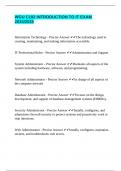
WGU C182 INTRODUCTION TO IT UPDATED EXAM WITH
100% VERIFIED SOLUTIONS!!
WGU C182 Introduction to IT
IT Professional Roles - ANSWER>>Administration and Support
Information Technology - ANSWER>>The technology used in creating, maintaining,
and making information accessible.
System Administrator - ANSWER>>Maintains all aspects of the system including
hardware, software, and programming.
Database Administrator - ANSWER>>Focuses on the design, development, and
support of database management systems (DBMSs).
Security Administrator - ANSWER>>Installs, configures, and administers firewall
security to protect systems and proactively work to stop intrusions.
Network Administrator - ANSWER>>In charge of all aspects of the computer network
Web Administrator - ANSWER>>Installs, configures, maintains, secures, and
troubleshoots web severs.
Support IT Professionals - ANSWER>>Help desk and training.
Information - ANSWER>>Processed data.
DIKW Hierarchy - ANSWER>>Defines the transition of data to information from
knowledge to wisdom. (Data Information Knowledge Wisdom)
,ETL - ANSWER>> Extract Transform, Load; process of extracting data, transforming it
for purposes of analysis, and loading it into the final target database.
Variance Report - ANSWER>>Used to determine the variance between what was
expected and what actually occurred.
Waterfall Model - ANSWER>>Used during the system development life cycle, SDLC, to
indicate that each of the steps are completed one at a time.
HIPAA - ANSWER>>The protection of medical information.
FERPA - ANSWER>>Protects student education records.
SEAL - ANSWER>>The Digital Signature and Electronic Authentication Law, SEAL, of
1998.
Data in DIKW - ANSWER>>The input directly received by the user (or computer). It is
generally not usable until it has been converted into a relevant form.
Information in DIKW - ANSWER>>Having been inferred from data; one or more
processes have been applied to the data to transform it into a more useful form.
Knowledge in DIKW - ANSWER>>Information that has been put to use; information
placed into a context. Refined information such that the user of the knowledge is able to
call forth only relevant portions of information when needed.
Wisdom in DIKW - ANSWER>>Provides a social setting to knowledge; an
understanding of the "why". Can only come by having both knowledge and experience.
Information Systems - ANSWER>>A collection of data and information used to support
the management of an organization. Also refers to the technical components and human
,resources that enable the assembly, storage, and processing of data and the delivery of
information. This has existed for a lot longer than computers.
Characteristics of Quality Data - ANSWER>>Relevance - the data being used must
apply directly to the decision being made
Timely - data should be efficient and must be provided at the right time
Thorough - the data should be comprehensive
Accurate - data should be captured once, where possible and should be captured as
near to the point of activity as possible.
Reliable - data should reflect stable and consistent data collection processes across
collections points and over time
IPOS - ANSWER>>The Input-Procession-Output-Storage Cycle
Input - ANSWER>>Raw data is entered by the user.
Processing - ANSWER>>Raw data is organized or structured for usefulness.
Output - ANSWER>>Information is output so user can see results.
Storage - ANSWER>>Processed information is stored for permanent record.
Computer System - ANSWER>>A collection of components that work together to meet
the needs of the user; typically categorized as either hardware, software, networks, or
users.
, Hardware - ANSWER>>Tangible parts of the computer system that include the system
unit and all its components as well as all peripheral devices such as keyboard and
mouse; everything that can be touched.
Software - ANSWER>>Programs that instruct the computer about what to do, that is, the
commands to carry out to process information
Network - ANSWER>>Several computers and resources interconnected through some
media such that they communicate with one another.
User - ANSWER>>Persons who use the computer.
Software Categories - ANSWER>>Systems Software and Applications Software
Evolution of Users - ANSWER>>First users were the engineers who built and
programmed computers, then employees who had received specialized training were
users, and now today, anyone and everybody can be a user.
Protocol - ANSWER>>Rules provided by which networks communicate with each
other.
Shell - ANSWER>>An interface for the user, often customized for that given user, that
provides access to the kernel.
Services - ANSWER>>OS programs that are usually started when the OS is loaded and
initialized, but they run in the background. Also called daemons.
Utility Programs - ANSWER>>Programs that allow the user to maintain and improve
system performance.
Proxy Server - ANSWER>>A server that acts like a giant cache of web pages for
anyone within the organization who has recently retrieved it; can also block access to
certain web pages
100% VERIFIED SOLUTIONS!!
WGU C182 Introduction to IT
IT Professional Roles - ANSWER>>Administration and Support
Information Technology - ANSWER>>The technology used in creating, maintaining,
and making information accessible.
System Administrator - ANSWER>>Maintains all aspects of the system including
hardware, software, and programming.
Database Administrator - ANSWER>>Focuses on the design, development, and
support of database management systems (DBMSs).
Security Administrator - ANSWER>>Installs, configures, and administers firewall
security to protect systems and proactively work to stop intrusions.
Network Administrator - ANSWER>>In charge of all aspects of the computer network
Web Administrator - ANSWER>>Installs, configures, maintains, secures, and
troubleshoots web severs.
Support IT Professionals - ANSWER>>Help desk and training.
Information - ANSWER>>Processed data.
DIKW Hierarchy - ANSWER>>Defines the transition of data to information from
knowledge to wisdom. (Data Information Knowledge Wisdom)
,ETL - ANSWER>> Extract Transform, Load; process of extracting data, transforming it
for purposes of analysis, and loading it into the final target database.
Variance Report - ANSWER>>Used to determine the variance between what was
expected and what actually occurred.
Waterfall Model - ANSWER>>Used during the system development life cycle, SDLC, to
indicate that each of the steps are completed one at a time.
HIPAA - ANSWER>>The protection of medical information.
FERPA - ANSWER>>Protects student education records.
SEAL - ANSWER>>The Digital Signature and Electronic Authentication Law, SEAL, of
1998.
Data in DIKW - ANSWER>>The input directly received by the user (or computer). It is
generally not usable until it has been converted into a relevant form.
Information in DIKW - ANSWER>>Having been inferred from data; one or more
processes have been applied to the data to transform it into a more useful form.
Knowledge in DIKW - ANSWER>>Information that has been put to use; information
placed into a context. Refined information such that the user of the knowledge is able to
call forth only relevant portions of information when needed.
Wisdom in DIKW - ANSWER>>Provides a social setting to knowledge; an
understanding of the "why". Can only come by having both knowledge and experience.
Information Systems - ANSWER>>A collection of data and information used to support
the management of an organization. Also refers to the technical components and human
,resources that enable the assembly, storage, and processing of data and the delivery of
information. This has existed for a lot longer than computers.
Characteristics of Quality Data - ANSWER>>Relevance - the data being used must
apply directly to the decision being made
Timely - data should be efficient and must be provided at the right time
Thorough - the data should be comprehensive
Accurate - data should be captured once, where possible and should be captured as
near to the point of activity as possible.
Reliable - data should reflect stable and consistent data collection processes across
collections points and over time
IPOS - ANSWER>>The Input-Procession-Output-Storage Cycle
Input - ANSWER>>Raw data is entered by the user.
Processing - ANSWER>>Raw data is organized or structured for usefulness.
Output - ANSWER>>Information is output so user can see results.
Storage - ANSWER>>Processed information is stored for permanent record.
Computer System - ANSWER>>A collection of components that work together to meet
the needs of the user; typically categorized as either hardware, software, networks, or
users.
, Hardware - ANSWER>>Tangible parts of the computer system that include the system
unit and all its components as well as all peripheral devices such as keyboard and
mouse; everything that can be touched.
Software - ANSWER>>Programs that instruct the computer about what to do, that is, the
commands to carry out to process information
Network - ANSWER>>Several computers and resources interconnected through some
media such that they communicate with one another.
User - ANSWER>>Persons who use the computer.
Software Categories - ANSWER>>Systems Software and Applications Software
Evolution of Users - ANSWER>>First users were the engineers who built and
programmed computers, then employees who had received specialized training were
users, and now today, anyone and everybody can be a user.
Protocol - ANSWER>>Rules provided by which networks communicate with each
other.
Shell - ANSWER>>An interface for the user, often customized for that given user, that
provides access to the kernel.
Services - ANSWER>>OS programs that are usually started when the OS is loaded and
initialized, but they run in the background. Also called daemons.
Utility Programs - ANSWER>>Programs that allow the user to maintain and improve
system performance.
Proxy Server - ANSWER>>A server that acts like a giant cache of web pages for
anyone within the organization who has recently retrieved it; can also block access to
certain web pages