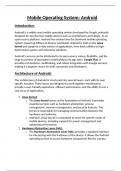
Mobile Operating System: Android
Introduction:
Android is a widely used mobile operating system developed by Google, primarily
designed for touchscreen mobile devices such as smartphones and tablets. As an
open-source platform, Android has evolved into the dominant mobile operating
system, powering billions of devices worldwide. Android is built on the Linux
kernel and supports a wide variety of applications, from basic utilities to high-
performance games and enterprise solutions.
Android’s success can be attributed to its open-source nature, flexibility, and the
large ecosystem of developers contributing to its app store, Google Play. It
provides rich features, multitasking, and robust integration with Google services,
making it a popular choice for both consumers and developers.
Architecture of Android:
The architecture of Android is structured into several layers, each with its own
specific function. These layers are designed to work together seamlessly to
provide a user-friendly experience, efficient performance, and the ability to run a
vast array of applications.
1. Linux Kernel:
o The Linux kernel serves as the foundation of Android. It provides
essential services such as hardware abstraction, process
management, memory management, and security features. The
kernel is responsible for managing communication between the
hardware and software.
o Android’s Linux kernel is customized to meet the specific needs of
mobile devices, including support for power management and
optimized performance.
2. Hardware Abstraction Layer (HAL):
o The Hardware Abstraction Layer (HAL) provides a standard interface
for interacting with the hardware of the device. It allows the Android
operating system to access hardware components like the camera,
, sensors, display, and Wi-Fi without needing to be aware of the
underlying hardware specifics.
o HAL ensures that Android applications can run on different hardware
platforms by providing a consistent interface to hardware services.
3. Android Runtime (ART):
o The Android Runtime (ART) is responsible for running Android
applications. It uses a Just-In-Time (JIT) compiler to convert Android
applications (in APK format) into machine code that the device’s CPU
can execute.
o ART also incorporates Ahead-Of-Time (AOT) compilation, where
parts of an application’s code are compiled before they run, which
helps in improving the overall performance and responsiveness of
apps.
o ART replaced the older Dalvik Virtual Machine in Android 5.0
(Lollipop), offering better performance and memory management.
4. Libraries:
o Android includes a variety of native libraries and services that
provide common functionality needed by apps. These libraries are
built in C and C++ and are used by Android’s runtime and system
services. Some notable libraries include:
WebKit: A web rendering engine used by the WebView
component to display web content.
OpenGL ES: A graphics library for rendering 2D and 3D
graphics, commonly used for gaming and graphical
applications.
SQLite: A lightweight database engine used by Android apps to
store local data.
Media Framework: Provides support for multimedia content,
such as audio, video, and images.
5. Application Framework:
o The Application Framework provides a higher-level set of services
and APIs that developers use to create Android applications. It
includes services for managing user interface (UI), content providers,
and resources.
o Key components of the application framework include:
Activity Manager: Manages the lifecycle of apps and activities,
such as starting, pausing, and stopping activities.
Introduction:
Android is a widely used mobile operating system developed by Google, primarily
designed for touchscreen mobile devices such as smartphones and tablets. As an
open-source platform, Android has evolved into the dominant mobile operating
system, powering billions of devices worldwide. Android is built on the Linux
kernel and supports a wide variety of applications, from basic utilities to high-
performance games and enterprise solutions.
Android’s success can be attributed to its open-source nature, flexibility, and the
large ecosystem of developers contributing to its app store, Google Play. It
provides rich features, multitasking, and robust integration with Google services,
making it a popular choice for both consumers and developers.
Architecture of Android:
The architecture of Android is structured into several layers, each with its own
specific function. These layers are designed to work together seamlessly to
provide a user-friendly experience, efficient performance, and the ability to run a
vast array of applications.
1. Linux Kernel:
o The Linux kernel serves as the foundation of Android. It provides
essential services such as hardware abstraction, process
management, memory management, and security features. The
kernel is responsible for managing communication between the
hardware and software.
o Android’s Linux kernel is customized to meet the specific needs of
mobile devices, including support for power management and
optimized performance.
2. Hardware Abstraction Layer (HAL):
o The Hardware Abstraction Layer (HAL) provides a standard interface
for interacting with the hardware of the device. It allows the Android
operating system to access hardware components like the camera,
, sensors, display, and Wi-Fi without needing to be aware of the
underlying hardware specifics.
o HAL ensures that Android applications can run on different hardware
platforms by providing a consistent interface to hardware services.
3. Android Runtime (ART):
o The Android Runtime (ART) is responsible for running Android
applications. It uses a Just-In-Time (JIT) compiler to convert Android
applications (in APK format) into machine code that the device’s CPU
can execute.
o ART also incorporates Ahead-Of-Time (AOT) compilation, where
parts of an application’s code are compiled before they run, which
helps in improving the overall performance and responsiveness of
apps.
o ART replaced the older Dalvik Virtual Machine in Android 5.0
(Lollipop), offering better performance and memory management.
4. Libraries:
o Android includes a variety of native libraries and services that
provide common functionality needed by apps. These libraries are
built in C and C++ and are used by Android’s runtime and system
services. Some notable libraries include:
WebKit: A web rendering engine used by the WebView
component to display web content.
OpenGL ES: A graphics library for rendering 2D and 3D
graphics, commonly used for gaming and graphical
applications.
SQLite: A lightweight database engine used by Android apps to
store local data.
Media Framework: Provides support for multimedia content,
such as audio, video, and images.
5. Application Framework:
o The Application Framework provides a higher-level set of services
and APIs that developers use to create Android applications. It
includes services for managing user interface (UI), content providers,
and resources.
o Key components of the application framework include:
Activity Manager: Manages the lifecycle of apps and activities,
such as starting, pausing, and stopping activities.